"Prairie Empire" not only records the magnificent history of the Xiongnu, Turks, Mongols and other steppe peoples, but also describes the bravery and talents of Attila, Genghis Khan, Timur and other steppe people. They broke into developed historical and civilized areas, clashed with farming peoples and destroyed farming civilization, and gradually formed their own rich and diverse culture.
Of course, there is also their impact on the entire world civilization, pattern, order and historical process.
Reader comments
As a leading figure in French Asian history research, René Grusset conducted academic research on the Huns, Xianbei, Turks, Mongols and other ethnic groups in this general history of Central Asia. It tells the story of tribes or regime changes that took place on the Eurasian steppes in a narrative style. Attila, Genghis Khan and Timur are the historical figures that the author focuses on in detail, and the author regards them as great heroes and outstanding representatives of the establishment of empires on the steppe. The book is not obscure to read, and the language is fluent. Readers can easily follow the author's writing and sink into the history of the vast grassland thousands of years ago, which is full of pleasure.
The evolutionary history of human civilization often unfolds from the standpoint of advanced civilization centrism, such as Western centrism and Oriental centrism. Since Greece and Rome, there have always been military or religious confrontations between Mediterranean and Atlantic civilizations and barbarian groups in North Africa, West Asia, Eastern Europe and other places in the West. This is especially true in China. The relationship between the Central Plains region and other civilizations has constituted the Hua-Yi debate very early on, and this has helped to complete the construction of the identity of the Chinese nation's subjective consciousness. In this regard, this book changes the perspective and focuses on the latter to think about the relationship between civilizations.
The large span is the biggest highlight of this book. This book starts from the Neolithic Age, the dawn of steppe culture, and ends with the Mongolian Khanate in the late 18th century AD. The time span is very large. This is the biggest difference between this book and other popular historical science books. At the same time, the logical clues of this book are very clear. Starting from the political, economic, social, cultural and other aspects of various countries in the steppe, the book draws out a clue and context of Central Asian history, achieving both historical and artistic qualities. It allows readers to maintain their interest in reading and keep reading on the premise of learning historical knowledge.
Starting from this, the author starts from the Neolithic Age, the dawn of steppe culture, and ends with the Mongolian Khanate in the late 18th century AD. He processes and studies the history of politics, economy, society, culture, ethnic complexity, political chaos, dynasty changes and intricate relationships in various parts of the steppe. What is even more gratifying is the content described in this book. In addition to Greater Central Asia, it also includes the Eastern European countries east of Poland, namely the Eastern European steppe, the Russian steppe, the West Asian steppe, the Central Asian steppe and the North Asian steppe. It completely tells this steppe civilization that is different from ours.
Recommended, worth reading! The large span is the biggest highlight of this book. This book starts from the Neolithic Age, the dawn of steppe culture, and ends with the Mongolian Khanate in the late 18th century AD. The time span is very large. This is the biggest difference between this book and other popular historical science books. At the same time, the logical clues of this book are very clear. Starting from the political, economic, social, cultural and other aspects of various countries in the steppe, the book draws out a clue and context of Central Asian history, achieving both historical and artistic qualities. It allows readers to maintain their interest in reading and keep reading on the premise of learning historical knowledge.
This is a kind of history book that looks at the world. It has strict textual research and objective narrative. It uses time and region as clues to show the rise and fall of the steppe empires of Eurasia in a panoramic view. Worth reading!
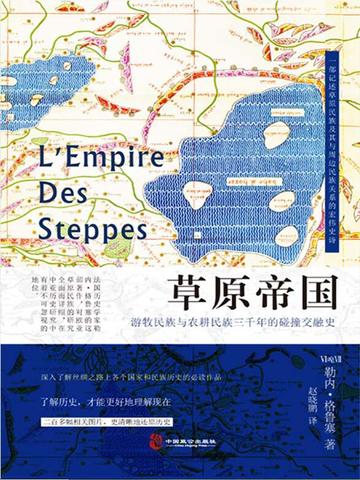
As a leading figure in French Asian history research, René Grusset conducted academic research on the Huns, Xianbei, Turks, Mongols and other ethnic groups in this general history of Central Asia. It tells the story of tribes or regime changes that took place on the Eurasian steppes in a narrative style. Attila, Genghis Khan and Timur are the historical figures that the author focuses on in detail, and the author regards them as great heroes and outstanding representatives of the establishment of empires on the steppe. The book is not obscure to read, and the language is fluent. Readers can easily follow the author's writing and sink into the history of the vast grassland thousands of years ago, which is full of pleasure.
The evolutionary history of human civilization often unfolds from the standpoint of advanced civilization centrism, such as Western centrism and Oriental centrism. Since Greece and Rome, there have always been military or religious confrontations between Mediterranean and Atlantic civilizations and barbarian groups in North Africa, West Asia, Eastern Europe and other places in the West. This is especially true in China. The relationship between the Central Plains region and other civilizations has constituted the Hua-Yi debate very early on, and this has helped to complete the construction of the identity of the Chinese nation's subjective consciousness. In this regard, this book changes the perspective and focuses on the latter to think about the relationship between civilizations.
The large span is the biggest highlight of this book. This book starts from the Neolithic Age, the dawn of steppe culture, and ends with the Mongolian Khanate in the late 18th century AD. The time span is very large. This is the biggest difference between this book and other popular historical science books. At the same time, the logical clues of this book are very clear. Starting from the political, economic, social, cultural and other aspects of various countries in the steppe, the book draws out a clue and context of Central Asian history, achieving both historical and artistic qualities. It allows readers to maintain their interest in reading and keep reading on the premise of learning historical knowledge.
Starting from this, the author starts from the Neolithic Age, the dawn of steppe culture, and ends with the Mongolian Khanate in the late 18th century AD. He processes and studies the history of politics, economy, society, culture, ethnic complexity, political chaos, dynasty changes and intricate relationships in various parts of the steppe. What is even more gratifying is the content described in this book. In addition to Greater Central Asia, it also includes the Eastern European countries east of Poland, namely the Eastern European steppe, the Russian steppe, the West Asian steppe, the Central Asian steppe and the North Asian steppe. It completely tells this steppe civilization that is different from ours.
Recommended, worth reading! The large span is the biggest highlight of this book. This book starts from the Neolithic Age, the dawn of steppe culture, and ends with the Mongolian Khanate in the late 18th century AD. The time span is very large. This is the biggest difference between this book and other popular historical science books. At the same time, the logical clues of this book are very clear. Starting from the political, economic, social, cultural and other aspects of various countries in the steppe, the book draws out a clue and context of Central Asian history, achieving both historical and artistic qualities. It allows readers to maintain their interest in reading and keep reading on the premise of learning historical knowledge.
This is a kind of history book that looks at the world. It has strict textual research and objective narrative. It uses time and region as clues to show the rise and fall of the steppe empires of Eurasia in a panoramic view. Worth reading!