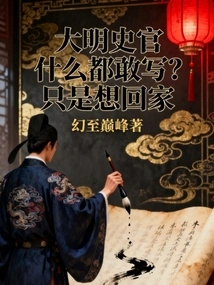
Ming Historians Dared to Write Anything? Just Want to Go Home
About This Novel
Su Chengze, the second generation of rich people, accidentally traveled through time and became a candidate for the imperial examination during the Hongwu period. He knew how difficult it was to make a living during the Hongwu period, and he wanted to return to Earth. And he learned that he could only return to modern times if he was executed by Zhu Yuanzhang's order. So, Su Chengze wrote on the test paper with a big stroke of his pen, "Acquisition of officials through the imperial examination will harm the country and the people", and he wanted to die. But contrary to expectations, he did not die... Seeing that Su Chengze was so brave and unafraid of death, Zhu Yuanzhang said: "If you are so unafraid of death, you should become an upright historian." Unexpectedly, since he became a historian, Su Chengze began to hold on to Zhu Yuanzhang's "little pigtail" every day. Zhu Yuanzhang felt tired and asked the beautiful maid next to him to squeeze his shoulders. Su Chengze held a small notebook and muttered while writing: "The emperor ignores government affairs and is obsessed with women..." Zhu Yuanzhang ignored the advice of his ministers and insisted on enfeoffing the princes to various parts of the country. Su Chengze took the small notebook again and read while writing: "The emperor is ignorant and stubborn, ignoring the lessons of history, laying hidden dangers for the future..." Zhu Yuanzhang's eyes twitched as he gritted his teeth secretly: "This historian is really not afraid of death!"
Official Sources
What Readers Think
Rating
Community(0)
Official(8)Scraped 1mo ago
Average, a bit too deliberate
After reading a few chapters, I was a little bit annoyed by the identity of the male protagonist at the beginning. He is a rich second generation who hangs out in nightclubs and likes to drive cars and party. He is also a special forces instructor. It is too outrageous. But it was just one sentence that made it clear that it didn't matter to me, an old poisoner. The following plot begins with the male protagonist criticizing the imperial examination. This starting point is very problematic. The Ming Dynasty's stereotyped selection of scholars did have drawbacks and stifled ideas. It was believed that those who came out of the imperial examination were all nerds. It's a bit too general. It's definitely reasonable for the imperial examination system to survive as an examination system that has been used until now. As the only easiest way for ordinary people from poor families to rise, it is much better than the previous imperial examination system. Secondly, people like Fang Xuanling, Bao Zheng, and Liu Zongyuan feel like the left brain is attacking the right brain. On the one hand, they say that they are famous for their country and the people, and on the other hand, it makes no sense to say that they stood out from the imperial examination. I can only say that for talents, everyone knows everything. Which civil servants who have been famous for generations are poor in the imperial examination? The imperial examination is just a way to select talents. Without the imperial examination, would you bring illiterate soldiers to the cabinet to handle government affairs? The top group of students entered the cabinet and began to slowly learn how to govern the country, such as the price of rice. To put it bluntly, who do what, let the prime minister worry every day about how much money a farmer can save in a year? Those with great talents occupy high positions, those with medium talents occupy middle positions, and those with small talents occupy low positions. This is the meaning of the imperial examination. All in all, I can understand that the male protagonist wants to die, but if you just shut up and don't talk about the Yi tribe, that's the end of it? Are you arguing with those students about the price of rice, farmers, and taxes, you idiot?
According to your ideas, the first chapter travels to the past, the second chapter scolds Zhu Yuanzhang's eighteenth generation of ancestors, scolds Ma Dajiao, the third chapter is execution, and the book is over. What's the point of this? Do you like to watch the unfinished eunuch?
Hasn't it been updated for so long?_(:З∠)_. . . . . Tsk tsk tsk tsk tsk tsk tsk tsk tsk tsk tsk tsk tsk tsk tsk
This book is testing the waters for promotion. Is there any book recommendation expert who can help promote the book?
New books are meant to be read and tested. The number of people who read them to the last chapter will determine the life or death of the book.
Nothing, just mark it so you don't open it again!
So fake
The writing is too fake. The character of Zhu Yuanzhang, a historical figure, is entirely based on obscenity. Anyone with some historical knowledge knows that if Zhu Yuanzhang wants to kill you, he will never care whether you are an upright official or an upright person. If you kill him, thousands of people will be implicated. If the protagonist is lucky, he can survive for 3 chapters. If he is unlucky, he will receive a lunch box in one chapter.
Lao Zhu was the only emperor in history who killed all the founding heroes, and he was famous for his love of involvement. He killed for a long time, killing in years, or even more than ten years, and in a wide range. The Longxi Group killed one area, Jiangnan area, and one state capital after another. The killing is very innovative, with many tricks, fast pace, and no matter how painful it is. To be honest, most time-travelers would rather face the lunatic Duke Wu of Han Dynasty in his later years, or the mentally ill emperors of the Five Dynasties and Ten Kingdoms than face Lao Zhu. The most ideal one was the Song Dynasty, which seemed weak and cowardly and had many corrupt officials. It couldn't stand that the living conditions were good, the officials had status, and the emperor didn't look for trouble.
Rating
Community(0)
Official(8)Scraped 1mo ago
Average, a bit too deliberate
After reading a few chapters, I was a little bit annoyed by the identity of the male protagonist at the beginning. He is a rich second generation who hangs out in nightclubs and likes to drive cars and party. He is also a special forces instructor. It is too outrageous. But it was just one sentence that made it clear that it didn't matter to me, an old poisoner. The following plot begins with the male protagonist criticizing the imperial examination. This starting point is very problematic. The Ming Dynasty's stereotyped selection of scholars did have drawbacks and stifled ideas. It was believed that those who came out of the imperial examination were all nerds. It's a bit too general. It's definitely reasonable for the imperial examination system to survive as an examination system that has been used until now. As the only easiest way for ordinary people from poor families to rise, it is much better than the previous imperial examination system. Secondly, people like Fang Xuanling, Bao Zheng, and Liu Zongyuan feel like the left brain is attacking the right brain. On the one hand, they say that they are famous for their country and the people, and on the other hand, it makes no sense to say that they stood out from the imperial examination. I can only say that for talents, everyone knows everything. Which civil servants who have been famous for generations are poor in the imperial examination? The imperial examination is just a way to select talents. Without the imperial examination, would you bring illiterate soldiers to the cabinet to handle government affairs? The top group of students entered the cabinet and began to slowly learn how to govern the country, such as the price of rice. To put it bluntly, who do what, let the prime minister worry every day about how much money a farmer can save in a year? Those with great talents occupy high positions, those with medium talents occupy middle positions, and those with small talents occupy low positions. This is the meaning of the imperial examination. All in all, I can understand that the male protagonist wants to die, but if you just shut up and don't talk about the Yi tribe, that's the end of it? Are you arguing with those students about the price of rice, farmers, and taxes, you idiot?
According to your ideas, the first chapter travels to the past, the second chapter scolds Zhu Yuanzhang's eighteenth generation of ancestors, scolds Ma Dajiao, the third chapter is execution, and the book is over. What's the point of this? Do you like to watch the unfinished eunuch?
Hasn't it been updated for so long?_(:З∠)_. . . . . Tsk tsk tsk tsk tsk tsk tsk tsk tsk tsk tsk tsk tsk tsk tsk
This book is testing the waters for promotion. Is there any book recommendation expert who can help promote the book?
New books are meant to be read and tested. The number of people who read them to the last chapter will determine the life or death of the book.
Nothing, just mark it so you don't open it again!
So fake
The writing is too fake. The character of Zhu Yuanzhang, a historical figure, is entirely based on obscenity. Anyone with some historical knowledge knows that if Zhu Yuanzhang wants to kill you, he will never care whether you are an upright official or an upright person. If you kill him, thousands of people will be implicated. If the protagonist is lucky, he can survive for 3 chapters. If he is unlucky, he will receive a lunch box in one chapter.
Lao Zhu was the only emperor in history who killed all the founding heroes, and he was famous for his love of involvement. He killed for a long time, killing in years, or even more than ten years, and in a wide range. The Longxi Group killed one area, Jiangnan area, and one state capital after another. The killing is very innovative, with many tricks, fast pace, and no matter how painful it is. To be honest, most time-travelers would rather face the lunatic Duke Wu of Han Dynasty in his later years, or the mentally ill emperors of the Five Dynasties and Ten Kingdoms than face Lao Zhu. The most ideal one was the Song Dynasty, which seemed weak and cowardly and had many corrupt officials. It couldn't stand that the living conditions were good, the officials had status, and the emperor didn't look for trouble.
You Might Also Like
Reborn Female General
Qianshan Tea Guest
Daming: I Can't Kill Such a Greedy Prince-in-law?
Present Or Ancient
Daming: My Boss Zhu Yuanzhang
That Li Wei
Datang: Please Quickly Invite the Prince to Supervise the Country
Unknown College Students
Daming: I'm Lying Down, You Guys Can Do Whatever You Want
This Ganges Beaver
The Crown Prince of the Ming Dynasty, I, Zhu Yunxi, Am Trying to Force the Palace with Blood
Lanma Tundra
Daming: I Asked You to Die to Remonstrate, Why Are You Really Dead?
Shou Wood Stove
Control Wei Zhongxian at the Beginning and Copy Him for 100 Million First!
That's My Money
Three Kingdoms: from Woodcutter to General Ji Han
Thousands Of Gold Gone Will Never Come Back
Zhenguan Warrior: Starting from Teaching the Prince to Counterattack
Writer Wolf Prince