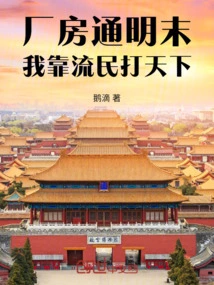
At the End of the Factory's Reign, I Relied on Refugees to Conquer the World
by Goose Drop
About This Novel
In the fifteenth year of Chongzhen, the entire Ming army was defeated in the Songjin War. The cavalry outside the Pass were watching with eager eyes. The Central Plains had been drought-stricken for ten years, and the land was bare for thousands of miles. They changed their sons and ate them. The Ming Dynasty had reached its final moment of turmoil. In modern times hundreds of years later, Lin Chen, the owner of Jiangnan Weaving Factory, is at the lowest point in his life: the factory is on the verge of bankruptcy, with only 2,000 yuan in cash in his pocket, and a bank loan of 100,000 yuan still owed. There is a large backlog of bamboo and rattan raw materials in the warehouse, and even no processing workers can be found. In an accident, the aging high-voltage wires short-circuited and exploded, and a fixed crossing door was opened on the cement wall in the deepest part of the warehouse to the end of the Ming Dynasty. On one side are raw materials that cannot be sold in modern times and e-commerce channels that cannot be used. On the other side are the desperate refugees who are everywhere in the late Ming Dynasty and just want a good meal. Lin Chen set the simplest rules: two meals of white rice a day and one day of weaving bamboo baskets. In this troubled world where human life is worth as little as trivial matter, in his eyes, rice costing a few cents is the only life-saving driftwood that refugees can grab; he considers employment to be "extremely exploitative" and a way of survival that no one else can ask for. He considers himself a profit-seeking black-hearted capitalist, and has never been a good person. He just wants to make enough pension money while the time-travel portal is still there, and return to modern times to live a peaceful life. But he didn't expect that the full meal he gave would allow the desperate old, weak, women and children to have a home; the workshops he built in the deserted villages gave the people in troubled times a stable life; the guards he trained blocked the marauding bandits and the Qing troops who massacred the villages, and protected the common people.
Official Sources
What Readers Think
Rating
Community(0)
Rating
Community(0)
You Might Also Like
Driving the Rv Back to Datang
Drunk In The Flower Room. Cs
Overthrow the Han Dynasty
Grenades Are Afraid Of Water
Reborn Female General
Qianshan Tea Guest

I'm Not a Savage
Jie And 2
The Emperor of the Tang Dynasty Will Never Show Off His Cards
Anti-travel Cat
Da Qin, Rebelled and Had His Heart Eavesdropped by Zulong
Just Forget It
Daming: Recognize Zhu Yuanzhang as His Grandfather at the Beginning!
Anti-travel Cat
Qin Gong
When It Rains, I Bring A Knife

Being a Salted Fish in Hongwu
Fiery Red Chicken Fir
My Father-in-law is Li Shimin
Zhangwei