


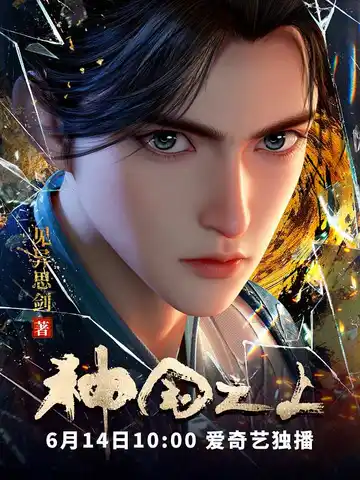
Above the Kingdom of God
神国之上
- Status
- Completed
- Length
- 2.8M Words
- Subgenre
- Classical Xianxia
- Updated
- 5y ago
- Source
- Qimao
Stats
All-time: Popularity, Must-read votes.
489Chapters
1.4MPopularity
11kReaders
22kMust-read votes
9.3Score
9.2kRatings
Tags
Honours
Synopsis
Readers also read
 Start Cultivating Immortality from Prison
 The World of Vicious Dogs
 The Ordinary Road of the Xiuzhen Family
 Honghuang: What Is the Use of This Sect? Disband!
 The Beginning of Journey to the West Refuses to Cause Havoc in Heaven
 Zongwu: People Are in a Restaurant, Picking up Corpses Wang Yuyan
 I Have a Martial Arts Panel
 Journey to the West: the Great Entertainer
 Supreme Sword Prison
 Journey to the West: Sign in with the Four Monkeys at the Beginning!
 The Practice of Immortality Begins with the Martial Arts Examination.
 Fengshen: I Can Inherit the Inheritance of My Subordinates
 Unique in the World
 Start into the Abyss
 Taoist Priest, Times Have Changed.
 Three-Inch Human Room
 Gou Zai's Family Farmed and Became an Immortal
 The Sword Comes Out of Beiming
 Immortal Journey
 This Swordsman Is Too Strong
Reader comments 50
Google Translate
The following is copied: A brief review of the aesthetic core of "Beyond the Kingdom of God" ——The combination of literary youth paradigm, emotional narrative and punk-like aesthetics Above the Kingdom of God has been updated to Chapter 231 (September 8, 2020). The entire narrative strategy largely follows the "upgrade and fight monsters" strategy of online novels. That is, the novel uses the protagonist's journey along the way as the main line of advancement, and establishes a series of hierarchical orders to regulate the level of strength. However, the difference is that "Beyond the Kingdom of God" has its own original artistic features, which makes its reading experience very different from most online novels. The effect of defamiliarization has led to polarized readers' evaluations of it. In view of this, this article attempts to explore its aesthetic core, analyze its endogenous mechanism, and summarize three core points to elaborate on it for the benefit of readers. 1. Li Mi's literary style and the "literary youth" paradigm The word "Li Mi" can be the same as "Mi Li", which originally meant beauty and tranquility. It was also used by word commentators to guide the generalization of Song Dynasty poet Wu Wenying's style of writing, describing its gorgeous imagery and profound meaning. However, sometimes the words and sentences are often too elaborate and have a sense of obscurity, which has been criticized by later generations and makes it difficult to understand the meaning. Praisers especially like the sense of infinite meaning in his words, calling Wu Wenying "Li Shangyin in Ci". The meaning of the text has multiple interpretations, forming an ethereal and ambiguous artistic style. The author's writings on Jian Yisi Sword are similar to this. Critics accuse it of excessive rhetoric and carelessness, making it difficult to feel comfortable in the reading process. Like the famous writers Mao Ni and Feng Huo, it suffers from the "literary youth" disease, and many obstacles are added to the understanding of the entire text. Fans believe that the author's text should not be read quickly. For example, when drinking strong tea, you should not pour it in one bowl. You must sip it in small sips and savor it slowly to experience the taste of the tea. Starting from the readers' habits, because of their different reading habits and previous understandings, their attitudes towards this book are very different, and the two often argue about this. The author's independent existence inevitably makes his literary style different from that of any other author, but the difference is huge. If a large number of identical literary styles exist, it will inevitably obliterate the author's subjective status in the entire literary creation. The behavior of online articles will tend to be the same. The entire online article industry will be like a ditch of stagnant water, and the breeze will not be able to blow any polyester. Each author will be different from other authors because of his or her own experience, reading literacy, and even his or her mentality when creating. The more significant this difference is and the author can continue to be created, and if the author continues to be appreciated by the same group, he will be able to find a place in the world of online literature. Even if there are more critics, it will be enough for some people to support the author. Readers do not need to criticize dissidents because of different attitudes, and authors should not hesitate to move forward and stop writing because of too many controversies. "The beauty of harmony lies in the unity of differences." The difference between the author's creativity and the reader's individual acceptance makes each work have a different impact on different readers. There are a lot of situations where "the other is the fairy and the other is the poison". Generally speaking, the author's literary style of Seeing Strange Swords has formed its own characteristics. The use of the word "Limi" is a high-level summary of his literary style. In the current chapter, the writing style is more gorgeous, less fond of using plain narratives, and the words are more decorative, from which we can get a glimpse of the author's writing skills. The author changed the beginning countless times, and finally settled on a short sentence to start with, confirming the time and place of the story. It was short and powerful. He did not choose to use a straightforward narrative and use physical stimulation (in ordinary online articles, the appearance of a peerless beauty is often used as a way to enjoy reading) to attract readers to join the reading activity. This is a novelty. The entire narrative process is full of pictures, drawing on similar film creation techniques. It starts with a distant view, from far to near, from high to low, from top to bottom. The curtain slowly opens, and the final mystery is gradually revealed. However, the expressive power of words is not as good as the lens language and action language of movies. Readers need to construct a picture in their minds. This is actually not in line with the fast reading and non-retrospective reading method in online articles. But if you calm down and read it, you will feel that it has a novel artistic effect and is full of pictures. As the story progresses, this literary style becomes more and more prominent. During several fights, camera language was used. Since words are beyond the power of words and the sense of expression is not as good as that of movies, metaphors, symbols, and similes are used many times in the fight scenes to allow readers to immerse themselves in the sounds of sword strikes. From the first scene where the imperial city undergoes a sudden change and the protagonist begins to be reborn, to the latest chapter where the story returns to the starting point, the entire fighting scene is colorful and diversifies the world conceived by the author. Readers glance at ten lines and quickly skim over the text, which makes it difficult to process the huge amount of information. Therefore, some information is not clear, and it feels like seeing flowers in the fog. The scene suddenly switches from one place to the second. Coincidentally, Wu Wenying's words also have similarities. His poem "Three thousand years of things have happened except for the ruined crows, and I am silent and tired of relying on the autumn trees." The poet leans on the railing to remember the past, and thinks of the past from the scene of the day. The image of the setting sun corresponding to the ruined crows is usually omitted, and the next sentence jumps from the past to the autumn trees of today. Time and space change freely with the poet's thoughts, and it is the first of the stream of consciousness. In this book, the speed and sequence of narrative time and space also change freely. In the imperial city in the first volume, scenes of inner demon tribulations appear many times, changing from real to imaginary, while the real scenes continue to unfold. In the third volume, the battle between the protagonist and the guilty king took only one night but half a year had passed, and the speed of time and space suddenly accelerated. The first volume only covers seven days of scenes, while the second volume captures several typical clips over a period of several months, leaving the rest of the time in one go. The third volume narrates the story of nearly two years, interspersed with character activities in another scene, blurring the continuous changes in time and space. The virtual and real scenes constantly change freely, and foreshadowing narratives and flashbacks often appear. First reading requires calmness and appreciation. This is often understood as one of the manifestations of "literary youth". In terms of narrative structure, it breaks through the shackles of continuous narrative in traditional online novels. In many chapters, the narrative development is artificially hindered. The development of one event is suddenly split into two parts by another event. Events can be arbitrarily sequenced and combined, breaking the linear development of time and space. The end of Chapter 112 describes the meeting between Madam Bai and Zhao Xiang'er, but the beginning of the next chapter begins with another narrative. The scene of their meeting is arranged after the events that happened later, with only a few strokes describing it.
Lightning protection guide: male protagonist x two female protagonists (Marry and Zhao Xiang) Thoughts after viewing: The whole text is really good, and it doesn't have the messy feeling of Shuangwen at all. It seems to be very reasonable and well-founded. What I like most is the interaction between the male protagonist and Zhao Xiang. How can I put it, it is a perfect match. It's very strange why the author arranged for the previous male protagonist to marry her. Since she truly loves each other, you can help others with a wave of your hand. It's very contradictory. You have to say it's reasonable or not. For a proud woman like Zhao Xiang, I would rather she not fall in love with Ning Jiujiu and leave the male protagonist to be in love with another female protagonist. Wouldn't it be nice for her to concentrate on her career?
It's really good-looking. It's a rare online novel that combines real-life mythology and astronomical knowledge with wonderful writing, ups and downs in the plot, a lot of foreshadowing, and fills in all the pitfalls. High praise!
After reading Chapter 289, I really can't stand it anymore. The framework of the description is very grand, but the Ancient God and the Six Gods of Taichu thought it was very awesome. Unexpectedly, it was only in the Five Realms, but a priest or divine envoy was in the Three Realms of Legend. As a result, the realm of the twelve most powerful gods mentioned so far is blurred. In addition, if you want to ascend, the realm you need to reach is also very confusing. One is the peak of the Five Paths (stepping into the legendary Three Mirrors), and the other is the peak of Ziting (stepping into the Five Paths). After reading it for so long, I feel like there is some writing, but not much! Because it gives people the feeling of being forced to "bite words".
I don't know what to say about this book. I said this book is well written, but it is too convoluted. I can write something clearly in just a few sentences. I insist on writing twenty or thirty sentences each time, and it is a lot of convoluted and convoluted. It is boring to read. I used to think that the sword in the snow is convoluted, but this time I was completely convinced when I saw this book. It is more convoluted than in the snow. It just doesn't explain it clearly to you and lets you guess by yourself. It's a lot of nonsense. It's okay to say it's not well written, but the plot is okay, and it's a harem story that I like. Generally speaking, I personally feel that the author's writing style and ideas of this book are not interesting, and there is nothing else to say.
The novel constructs a grand setting of the game between the twelve divine kingdoms and the six gods of Taichu. Through the rebirth journey of the protagonist Ning Jiujiu, it connects multiple narrative lines such as the mystery in the imperial city, the cultivation of the Yujian Tianzong, and the revelation of the truth about the divine kingdom. The plot combines elements of suspense reasoning and fantasy combat, and the settings such as "Dark Sun Destroys the World" and "Cage God's Kingdom" are quite original. The images of the cold sword fairy Lu Jianjian and the arrogant empress Zhao Xianger are vivid, and the emotional interaction has elements of light lily and training. Regarding the Shura field in the harem, from my perspective, the male protagonist has always been in a weak state. With Lu Yaoyuan, one moment he pretends to be a master, and the other moment he is a disciple who is submissive and gets slapped in the palm of his hand without paying attention; with Zhao Xianger, they are constantly arguing, either fighting or betting on the game from the beginning to the end. The male protagonist always wants to "reinforce his husband", but he fails several times from beginning to end; with Ye Changong, let alone this; with Ning Xiaoling, Shao Xiaoli is relatively in a strong position. The heroines are all well portrayed. In the first two hundred chapters, when the world view has not been revealed much, there is an elusive feeling about looking at flowers in the fog. There is an air of elegant youth, which makes me think that the male protagonist also has an air of air. He is dressed in white, has a fairy spirit, smiles faintly, and then waves, and everyone falls down easily. Next comes the plot. I think people mainly want to see harem stories, followed by battles and the like. One of the things I like about this book is that it is not like many popular harem novels on the Internet, where the battles are brushed off, or there is no depth, it is just a pure Shura field, with weird things to do every day, and some forced settings. This book starts with the fight against the old fox and the white-bone demon, and later includes the fight against the king of crime in Duansui City. It is not cliché, and there are plots of a battle of wits.
I hate this male protagonist extremely. He is a person with a split personality. One moment he looks like a genius, calm and conceited, and the other moment he looks like a fool. The reader can think of all the things he can't think of. One moment he is affectionate, and the next moment he looks like a pervert with low IQ. It's disgusting. He constantly puts on pretense in order to create conflicts and incidents, leaving viewers speechless with embarrassment. From this alone, we can understand that the author, like his writing style, is an exaggerated person without any real substance. His brain hurts after reading it, and he decisively abandons the article.
Very good, not the same one that wrote about Qiong Ming before.
The writing is awesome, but it's a pity that I can't understand it
I discovered a novel by chance. It looked a bit like Qiong Ming at first, but later I found out that both novels were written by the same author. Overall, it was pretty good.