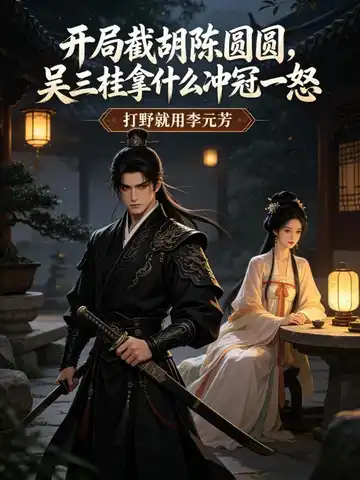
From the Start, I Snatched Chen Yuanyuan. What Could Wu Sangui Possibly Rage Against?
开局截胡陈圆圆,吴三桂拿什么冲冠一怒
- Status
- Ongoing
- Length
- 380k Words
- Genre
- Historical
- Subgenre
- Historical Transmigration
- Updated
- 1d ago
- Source
- Qimao
Also on Fanqie
Synopsis
All-time: Popularity, Must-read votes.
143Chapters
30kPopularity
1.3kReaders
244Must-read votes
8.4Score
42Ratings
Honours
Readers also read
 The Three Kingdoms: The Grand Eunuch
 Great Ming: I, the Emperor’s Craftsman, Set Him Straight
 The Fierce General
 The Ultimate Scoundrel
 The Imperial Ming Crown Prince's Heir
 The Water Margin: Ambitions Above the Clouds
 I Found the First Emperor
 Great Tang: The Carefree Prince Consort
 I'm a Censor, and I Rebuke the Empress from the Start
 The First Prince of Great Xia
 A Dynasty Born of Humble Beginnings
 My Ministers Are All Too Insane!
 Great Tang: I Tear Down Emperor Taizong from the Start
 Great Tang: I Transmigrated as Li Chengqian, So Your Majesty Should Call Me Crown Prince
 The Most Savage Soldier in History
 The All-Rounder of the Tang Dynasty
 The Greatest Official in Water Margin
 A Ming Dynasty Warrior
 My Wife Is Mi Furen
 The Jingnan Campaign: My Younger Brother Shall Be a Yao or Shun
Reader comments 4
Translated by Google Translate
I have read more than 30 chapters so far, which is very good, but I don't know what will happen next. The author needs to add more! Give a good review and encourage me
As a historical time travel novel with the background of the Jiashen Incident in the late Ming Dynasty, many settings in this book seriously violate the logic of historical development, making it very confusing to read. The core plot of this book is based on a historical misunderstanding: in history, Wu Sangui introduced Qing troops into the Pass, and his fundamental starting point was the survival interests of the Guan Ning Group and fear of the Dashun regime's policy of pursuing stolen goods and plundering. Chen Yuanyuan was only a symbolic excuse deduced by later literature, and was not the root of his decision-making. The novel imagines that as long as Hu and Chen Yuanyuan are intercepted, Wu Sangui can directly prevent Wu Sangui from introducing Qing troops into the pass. It seriously underestimates the complexity of the game between warlords, the Qing court, and Dashun in the late Ming Dynasty. To take a step back, even if the protagonist changed Wu Sangui's personal choice, after the Qing court entered the customs, they went south to conquer Jiangnan and implemented the order to shave their hair, which triggered fierce resistance, and then there were tragedies such as the Yangzhou Tenth Day and the Jiading Three Massacres. The root cause was the Qing Dynasty's high-pressure strategy of unified conquest, which was not something Wu Sangui could decide alone. However, the whole book completely ignores this background of the era and simply binds the trend of the Ming and Qing dynasties to Chen Yuanyuan. The historical logic is completely untenable. In addition to the flaw in the general framework, the actual plot in the middle and later stages is even more divorced from reality: the protagonist is just a low-level Jin Yiwei. In the chaos when the Dashun Army breaks through Beijing and the whole city is on guard, he can easily break into the Wu Mansion and take away Chen Yuanyuan; the follow-up recruitment of soldiers, collection of intelligence, raising money and food, and arranging garrison all progress very quickly, and even the minting of coins is completed in just three days. Ancient coinage required mineral materials, molds, craftsmen, equipment, and complex technological processes. In troubled times, it was impossible to make coins in just three days. This plot was very inconsistent. The responses of the characters on all sides are also very complex, and the advancement of the plot is highly dependent on the halo of the protagonist. Historical time-travel novels can be adapted with reasonable imagination, but they cannot completely abandon the underlying contradictions of the era and the objective technical conditions of ancient society. I hope that the author can study more relevant historical materials of the late Ming and early Qing dynasties in the future to optimize the overall plot logic.
The plot is compact and the story is fascinating
Pretty good