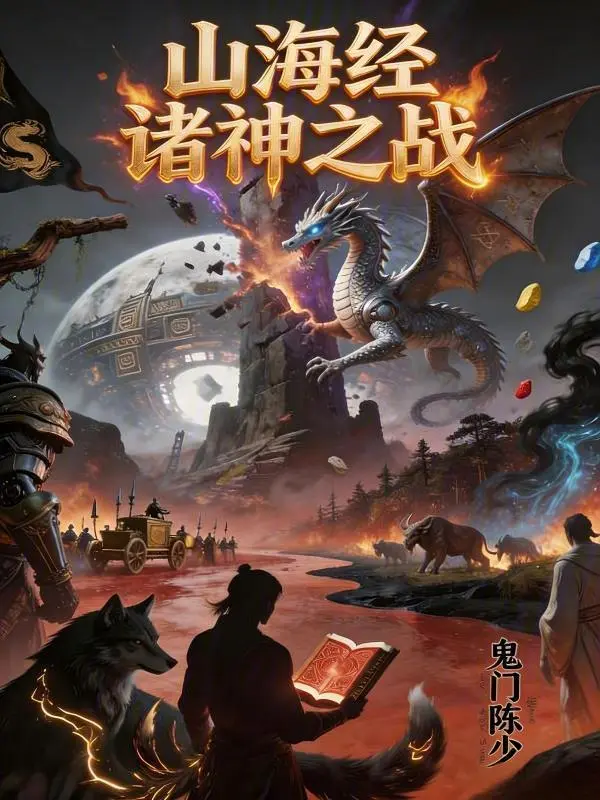
The Battle of the Gods in the Classic of Mountains and Seas: a Great Conjecture of Ancient Science Fiction
山海经诸神之战:远古科幻大猜想
- Status
- Completed
- Length
- 1.4M Words
- Genre
- Western Fantasy
- Audience
- Male
- Subgenre
- Historical Myth
- Updated
- 1mo ago
- Source
- Qidian
Stats
0Monthly votes
65Recommends
0Fans
500Chapters
Synopsis
Reader comments
Readers also read
 The Devil's Illustrated Collector of the Steam Age
 Great Voyage: My Summons Can Be Upgraded While Idle
 Reincarnated Heavy Knight, I Can Simplify My Skills
 I Unlocked the Extraordinary Craftsman Panel
 Lao Ji, Help Me Become an Immortal
 Gao Wu, My Love Strategist Is Actually the School Beauty Herself
 I Really Want to Be the President of the Universe
 Traveling Through Time at the Same Time, How Come No One Is Human?
 Master Tao, I Became an Immortal, Only Then Did I Realize It Was the Red Mansion
 My Progress Bar Can Reach the Sky!
 Mr. Diga, You Have Another Private Visit in the Incognito Server Today.
 Cultivation, I Have a Book of Eternity
 Fortune Teller at Sea: the Mysteries of Zheng He's Treasure Ship in the West
 The Soul Refining Notes of All Heavens
 The Nine Heavens of Bianjing: a Record of Hanging Records in Kyoto During the Song Dynasty
The "Yuetian Heritage City" hovering near the earth - the most stunning setting in the book
"Heaven" is not a concept of nothingness, but an ancient celestial body hovering near the earth - "Yuetian Heritage City". As soon as this setting came out, the entire book's layout instantly rose from the ground to space. Because of the instability of the "Moon and Sky" caused by several generations of imperial wars, the disaster of rewriting the tides, destroying the world by floods, and the collapse of the earth dimension is approaching step by step. Nuwa's patching up of the sky is no longer a myth, but has become an urgent track repair project. When "Destiny" is redefined as "the monopoly on ancient technological heritage," the science fiction undertone of the entire novel comes to light. This is the real "hardcore myth".
When myths are re-decoded
This is not your impression of ancient mythology. Pangu's creation of the sky is a project to restart civilization, Nuwa's patching of the sky is the orbital crisis of repairing the "Yuetian Heritage City", Yinglong is a prehistoric war platform, Buzhou Mountain is the celestial anchor point - the author uses the knife of science fiction to cut open the skin of myth. The most fascinating thing about the book is that it is not "making up" stories, but "explaining" them. The legends we have read since childhood have been stripped of their divine cloak one by one, revealing the cold technological bones underneath. This kind of deconstruction is not sensationalism, but based on strict logic: If the myth is true, what is its most reasonable explanation? The answer is spine-chilling.
The gods are not fighting for the throne, but for the right to interpret.
"The battle between Yanhuang and Banquan was never a competition for the throne, but a civilized and deadly battle between the 'kingship of vitality' and the 'kingdom of order'." This sentence penetrates the core of the whole book. The author redefines the ancient war as the ultimate game between two civilization paths - Emperor Yan represents the possibility of vitality and symbiosis of all things, and Emperor Huang represents the necessity of order and institutionalization. And Jiang Shou was caught in a dilemma between Yan Emperor's vitality, Huang Emperor's order, Chi You's revenge, and Gonggong's destruction. This setting allows "War of the Gods" to escape from the simple confrontation between good and evil and become a confrontation of ideas about "where human beings should go."
Buzhou Mountain is not a pillar of heaven, but an anchor point
"Buzhou Mountain has never been just a mountain that will be cracked later. It is the main anchor, the main bone that can barely maintain balance between the heights and the ground after Pangu." This setting gives a new weight to the allusion of Gonggong's anger at Buzhou Mountain - it is not an angry destruction, but the ultimate gamble to prevent history from being buried. Whoever fails to touch it first will determine how future generations will understand "what should be kept, what should be destroyed, what is the truth, and what is just a price." The throne became lighter, and the anchor became heavier. The most shocking thing in the book is this change of perspective that redefines mythical events as a "competition for the right to interpret history." {"TopicId":"1287128456471969792","TopicName":"The Battle of the Gods in Shanhaijing"}
Jiang Shou - a mortal trapped between the gods
Jiang Shou is the most heart-wrenching character in the book. He holds the bronze book of mountains and seas handed down by Emperor Yan, and can control all kinds of beasts, connect blood vessels, and glimpse ancient secrets. He sounds like the protagonist with a golden finger. But if you actually read it, you will find that the more he has, the fewer choices he has. He was involved in a civilization-level game that far exceeded his personal abilities - Emperor Yan wanted him to inherit vitality, Huang Emperor wanted him to obey order, Gonggong wanted him to be destroyed together, and Chi You wanted him to take revenge. Every choice means betraying someone else. He is not "saving the world", but is torn apart by forces from all sides at the crossroads of "deciding what the world should look like".
The cruel collision between the system and people's hearts
It can be seen from Chapter 59 "Gaoyang Trial Ban" that the real thickness of this book is not in the fighting scenes, but in the collision between the system and people's hearts. Gao Yang implemented a trial ban plan - sealing sick wells, offering sacrifices at night, and relocating "those with observable old blood" - which looked perfect from the drawings and could cut off three disaster chains. But when the ban falls on specific people, everything changes: the car owners who rely on salt roads to eat at night, the old women who rely on well mud to treat illnesses, and the boys and girls who are entered into the book. They become the price of the "overall situation." A child was suffering from fever and convulsions, and the grandmother was kneeling by the well, crying and cursing, "Can you see my grandson's tone in the picture?" This scene exposed the warmth of people's hearts and the coldness of the system.
I'm curious, how do you manage to write more than ten or twenty chapters a day?