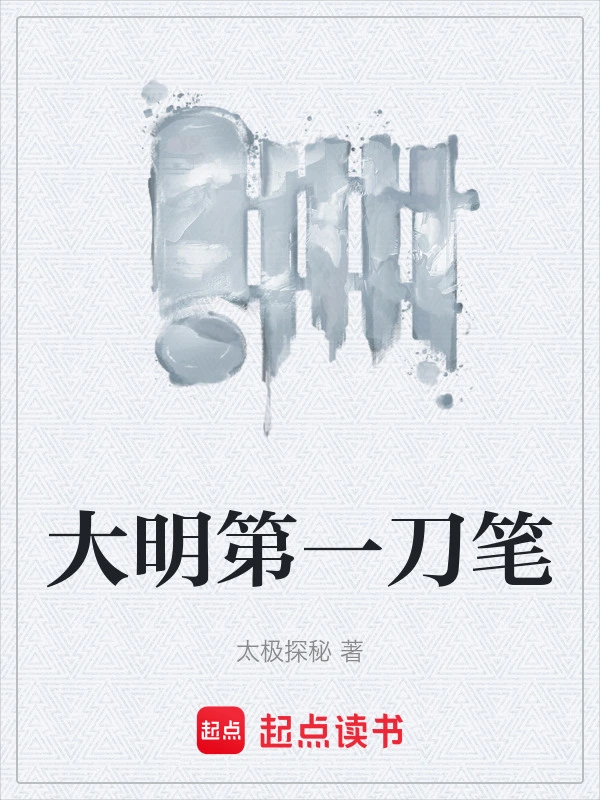
The First Sword and Pen of Ming Dynasty
大明第一刀笔
- Status
- Ongoing
- Length
- 192k Words
- Genre
- Historical
- Audience
- Male
- Subgenre
- Alternate History
- Updated
- 2mo ago
- Source
- Qidian
Stats
0Monthly votes
222Recommends
0Fans
51Chapters
Synopsis
Reader comments
Readers also read
 Red Mansion: Start Escaping and Farming from the Equipment Bar
 Northern Qi, Sage Khan
 After Lying in Bed for Three Years, He Was Forced to Help the Han Dynasty
 Fu Ming 1627
 Criminal Investigation Notes 2: Buried Corpse in Songhu
 Five Dynasties and Ten Kingdoms: Starting from Saving the Refugees
 The Ministers of the Great Zhou Dynasty
 The Black Witch's Journey to Another World
 Martial Arts!
 Ming Dynasty: the First Assistant of a Poor Family
 Time Travel Li Zicheng: Chongzhen, You Can Rest in Peace
 The Case Has Been Solved, Zhu Di Is Also a Remnant of Jianwen
 I Was a Tai Chi Ancestor in the Yuan Dynasty
Homecoming! Wonderful!
The essence of Tai Chi is to stay calm, follow the trend, and not fight. Movement and stillness are the same, body and use are from the same source, knowledge and action go hand in hand, and finally come to a harmonious place. The core of the whole article is the word "Shou Zhuo". The sword and pen are the way for literati to establish themselves, just like Tai Chi to soften the strength. It should hide the sharp edge in the heart, rather than deliberately showing the sharp edge. When the mind is at peace, the writing is correct, and blindly striving for advancement and striving for victory is exactly deviating from the origins of Tai Chi and Literary Dao. The artistic conception expressed in this chapter is profound and impressive.
Fascinating, relaxed and antique, it is an elegant work on officialdom and a top-quality work in popular literature. It's been many years since I've seen such elegant and powerful writing, and I've fallen into the trap, so I'll catch up! Follow up!
😁😁😁😁😁😁😁😁😂😂😂😁😂😂😂😁😁😁😁😁😁😁😁😁😁😁
The writing is really good. I look forward to the author's updates. The plot is very exciting!
Catch up to Chapter 46 With some emotion, throughout the entire book "The First Sword of the Ming Dynasty", there are countless chapters filled with the intrigues of the officialdom and the confrontation of lawsuits. Only this chapter truly explains the weight of the book's title: The so-called "The No. 1 Sword of the Ming Dynasty" does not mean that the writing is sharp and can win all the lawsuits, but that it dares to write for the centuries-old nameless souls, and dares to split the dark clouds covering the sky with a piece of paper, allowing justice to see the sky again. This chapter is not only the conclusion of the old case, but also the concentrated sublimation of the spirit of "keeping the law with pen" in the whole book, which is worth reading again and again. The author's writing style is excellent, I like it!
Suggestion, you can ignore it: the appearance of a higher-level power gangster will give readers a lot of motivation to follow up. - There is no situation where "solving the case depends entirely on the protagonist's golden finger". The clues and reasoning process are logically closed, in line with the laws and social background of the Ming Dynasty. The protagonist's character is further established - The protagonist's "sword and pen" ability is the national sentiment, which transcends ordinary swords and pens. It has concrete manifestations and is very refreshing. - The protagonist's "Tao" and "Skills" are reflected: he not only uses the law to make decisions for the people, but also knows how to survive in the cracks of officialdom, not the Virgin. The tension of Machiavellian plots begins to emerge - The old cases of Qingping are not just local tycoons committing evil, but also involve deeper conflicts such as officialdom factions, imperial examination fraud, clan interests, etc., Which upgrade the story pattern from a "small case" to a "Ming Dynasty plot", paving the way for the subsequent court line. - The supporting characters have vivid images: such as corrupt officials, masters, powerful people, and ordinary people at the bottom. - Disadvantages: The pace is too slow: the entire chapter is laying out clues, without any conflict breaking out, and the reader cannot see the progress; or the pace is too fast: the clues are seen through by the protagonist in one second
Not bad, very well written 👍👍👍👍
The sword and pen of the feelings of family and country are flesh and blood, which is beyond the ordinary swordsman and lawyer.
Please write faster, sister? Big Brother? Come on👏
It's been a long time since I've seen a book like this, it's fascinating
Wang Zhuo's character is very stable, low-key and reserved on the surface, but he has a good sense of officialdom. He doesn't take the lead or take sides, and he works step by step. He is a typical "big wise but foolish" type, much more real than those blustering characters. It is very realistic, the protagonist has a delicate mind, the writing is thick, and the cultural significance is strong. You can read it a second or third time. Each time you read it, you will have a different experience.
Chapter twenty-two in one go! Miao Miao Miao! It's been a long time since I've had such a fascinating feeling!
If the heart is harmonious, all things will be harmonious, and the pen will follow the heart and go anywhere.
I have finished following the latest chapter, and I hope the author will speed up the update. The chapter "Returning to the Nest" can be regarded as the masterpiece of the whole book. It breaks away from the clichés of common historical novels about fighting, killing, and scheming. It perfectly integrates the judge's "knife and pen" with Tai Chi psychology, and the artistic conception and pattern are directly completed. Mr. Zhan passed down to Wang Zhuo the three strokes and one general formula of "Shou Zhuo Pen", which is not only the teaching of peerless skills, but also the passing down of the way of being an official, a person, solving cases, and establishing oneself. It inherits Wang Zhuo's character of forbearance and dormancy and keeping his original intention, and also lays the core spiritual foundation for his subsequent writing to determine the world, bring down the powerful traitors, and redress the unjust cases in the world. In addition, what is really admirable is that the entire chapter runs through the Eastern core of Tai Chi's yin and yang and the heart as the foundation: The first move is the unity of movement and stillness, which is the essence of Tai Chi's "quietness is the essence, movement is the magical function". If he does not move, he will not move, and he will move first, and pay attention to using stillness to stop and follow the trend; 1. The profound meaning of "the unity of spirit, mind and energy" is exactly the same; The third step of knowing and doing goes hand in hand, which implements the core of Tai Chi's practical practice of "unifying knowledge and action, and studying things to achieve knowledge". It refuses empty talk. Only by practicing on the matter and grinding in the case can we truly see the true heart; The concepts in the article, "A righteous mind leads to righteous things, a confused mind leads to chaos", "Foolish people do things to the end" and "Soldiers use weapons to stop fighting", which breaks away from the simple narrative of strong men and conveys the true character and benevolence of Confucianism: swords and pens are never meant to kill. The purpose of fighting for victory is to stop killings, protect the people, uphold justice, and reassure people. This "clumsiness" of adhering to morality, not opportunistically, or taking tricks, is precisely the most rare great wisdom, which makes the whole story escape from Machiavellian plots and has a spiritual weight that directly touches people's hearts.
In front of the imperial power, swords and pens are worthless and scapegoats
Orthodox style? Thrilling?
Hehe! There are Yi, read again Luofu Misty Rain, Returning to Home, Prison
I like this chapter of the helm. I feel that the protagonist is no longer a staff-like character who simply relies on his clever words to argue and protect himself. The status of "the helm" gives him a sense of responsibility and a sense of structure. His past forbearance, sharpness, and calculation skills have been transformed into decisiveness after taking power. The character's transformation is logical and smooth, without forced intellect or abrupt tricks. The portraits of supporting characters also stood up, and the attitudes of factional officials and royal family members changed, in line with the human sophistication and interest balance of the Ming Dynasty court. Come on, come on, come on!
Chapter 3, "The Woman in the City God's Temple" I feel that this chapter is the key chapter for the formal start of the case in the book. The chance encounter in the City God's Temple connects the first and the core. I have the following touching feelings: First of all, the atmosphere of the scene is excellent, anchoring the underlying background of the Ming Dynasty. The dilapidated and remote City God's Temple on the outskirts of the city is used as the stage. The ancient temple's broken candles, scattered incense, and cold night wind accurately restore the living environment of the lower class refugees in the early Ming Dynasty who had nowhere to stay. A down-and-out woman sits alone in front of a statue of God, hiding her grievances. The environment and the situation of the characters are blended together. The beginning of the story sets the tone for the tragedy of an unjust case, which fits the core theme of the detective's investigation of the case. Furthermore, the suspense is cleverly laid out, leading to the entire main plot of the unjust case: a woman hides in a ruined temple with a complaint but does not dare to appeal to the government. She is persecuted by the gentry, her husband dies unjustly, and she has no way to complain. Only a few details are used to lay the core foreshadowing of the collusion between officials and gentry to frame good people. The protagonist's encounter with a woman in trouble is a turning point from a small incident in the city to a major case, which naturally leads to the subsequent plot of the protagonist writing a complaint and reversing the case with a knife and pen. Then the character design is implemented, highlighting the highlights of the sword and pen drama This chapter initially establishes the characteristics of the protagonist: he feels compassion when passing by the Town God's Temple, does not rely on force, pays attention to the written complaints, and is keenly aware of the fishy circumstances of the case, closely following the title of the book "Knife and Pen"; the victim's cowardice and desperation reflect the difficulty of the lower class people in the Ming Dynasty to complain... There is something to be expected! Got into a trap! Got into a trap!
The gears of history are meshing and turning
Chapter 1: Blade on a snowy night Wang Zhuo, the swordsman and penman of Qingping County, appeared on the scene, and a few words in the study on a snowy night caused the gears of history to slowly bite and turn. Realizing Zhang Juzheng's ambition, he stepped forward to take over the troubled Qingping County and made a five-year agreement. The rhythm is soothing, but it implies cause and effect. The short opening chapter hides the long rest of life, from the Jiajing imperial edict to the imperial examination, and then to Chongzhen in the late Ming Dynasty, with a few hints of ups and downs throughout the rest of his life. As the figure walks away in the snow, a swordsman and penman are involved in the waves of the Ming Dynasty. The square inch of text shows the richness of history and the majestic destiny.
Well written, I have the desire to read on
After reading Chapter 14, I want to say a few more words. I personally think that "Going North" is the key link between the past and the next in the whole book. It breaks away from the limitations of the trivial lawsuits in the Jiangnan officialdom and drags the protagonist from the pile of Jinling documents to the land of Yanzhao. The most outstanding writing in this chapter lies in the intertwining of the journey narrative and the hidden game. The journey all the way north is a clear thread: from the Jianghuai water town to the Qilu wasteland, dilapidated inns, homeless people, and the harsh governance and chaos of local officials are laid out one after another. The author uses the protagonist to investigate civil complaints along the way, and concretely embodies the plight of the lower class in the early Ming Dynasty with a series of unjust cases of land deeds and corvee fraud. The protagonist is no longer trapped in the clerical tug-of-war of the capital court. He sees with his own eyes the huge gap between the laws on paper and the local reality. He has completed his transformation from a litigator who writes petitions to a scholar who cares about the laws of the world. The arc of the character is quietly full. The hidden thread is hidden in the undercurrent of monarchs, ministers and factions. Zhu Yuanzhang sent an imperial edict to send the protagonist north to inspect the civil service in Peiping. It looked like an appointment, but in fact it was a plan by the emperor to use a knife and pen to check and balance the nobles in the north and the remaining old officials of the Yuan Dynasty. Li Shanchang, Hu Weiyong and other Huaixi groups secretly set up obstacles, planted spies along the way, fabricated evidence, and tried to hinder them halfway. There is no large-scale court confrontation throughout the whole process. All confrontations are hidden in letters, private complaints, and chats in the post office, which perfectly fits the theme of "knife and pen"-the parties do not fight with swords, but rely entirely on documents to compile crimes and laws to find flaws. A confession can stir up the officialdom of one party, and the charm of the Ming Dynasty's clerical power is vividly written. The author's writing has a relaxed pace, which also lays a lot of foreshadowing for the subsequent plot: the three forces of the King of Yan in Peking, the remaining Beiyuan forces in the North, and the founding border generals gathered in the north. The protagonist enters the game alone, and a sword and pen will deal with multiple forces. Going north is not only a spatial migration, but also the beginning of the protagonist's official entry into the top power chess game of Hongwu. This chapter breaks out of the small-scale court battles and pulls this Machiavellian novel from a "small story of solving a case" to a "big picture of restructuring." It can also be seen that the author has no ideas 👍👍👍
Very well written, I like listening to it, I recommend it ~
The author's writing style👍
Mo Lan hides Tai Chi, hardness and softness reveal the human heart
"The leaves are painted long and thin, like swords. The petals are painted extremely soft, with an air of rebelliousness in them." Indescribable! With just this sentence, I seemed to have a glimpse of the entire universe of Tai Chi. The orchid leaves are thin and long, as sharp as swords. The petals look soft, but there is an unyielding tenacity hidden inside. The core principle of Tai Chi is the symbiosis of hardness and softness. The sword-like orchid leaves are yang, which can't be hidden, and the strong backbone; the warm and soft petals are yin, which is the background of tolerance and forbearance. The same is true for Tai Chi. The body looks loose and soft, but there is a lot of strength inside. The softness does not lose strength, and the strength does not appear. Both are indispensable. This orchid painting just illuminates everyone in the book. Xue Wuniang was both civilized and military, and traveled thousands of miles to find people, but her obsession turned into gentle orchids; the descendants of the Zhou family were burdened with a century-old injustice, selling tofu incognito to make a living. They were ordinary on the outside, but never bowed down in their hearts. The perfect fit between the person and the painting is a reflection of the yin and yang of Tai Chi. Really powerful people and things are never overwhelming. The softness can cover the edge, and the calmness has its own character. The few short sentences written in blue and ink not only contain the children's long thoughts, but also contain the all-encompassing Tai Chi principles. The more you read, the more interesting it becomes.
"Feng Mansion" This chapter begins with the scene of Wang Zhuo stepping into Feng Mansion to open up the mystery of the wealthy family. The details of the strict gate and the hidden vigilance of the servants foreshadow the atmosphere. The protagonist, as a lawyer with swords and pens, deals with the rules of aristocratic families. He moves and retreats in a measured manner. He not only describes the class style of the gentry's mansion in the Ming Dynasty, but also lays the groundwork for the hidden evils in the Feng Mansion. Worth the wait!
37 Pictures have been read, continue to wait for updates 😁
Chapter 24 "Clearing the Land" This chapter takes the clearing of the land as the core political affairs of the Ming Dynasty as the main narrative line, focusing on the whole process of the protagonist Wang Zhuo's field survey. It breaks out of the simple verbal confrontation in the court and moves the story from the desk to the countryside. It is a key turning point in the plot and character creation of the whole book. This chapter also serves as a link between the past and the next. It not only continues the core tone of the book of "official politics + legal game", but also expands the boundaries of the story scenes and characters' abilities. Seeing the big from the small, using an old story about a farmland to describe the various situations at the grassroots level of the Ming Dynasty. The plot is solid and the conception is grounded. It is a high-quality chapter that is both readable and ideological. It also lays ample foreshadowing for subsequent land disputes and officialdom games. Looking forward to it!
Chapter 40 I think the most eye-catching narrative ingenuity lies in deconstructing the grand historical disputes from the perspective of a small person. The struggle over national origin in history was a decades-long tug-of-war between the Wanli Emperor and the civil service group. It was a political confrontation involving cold imperial cudgels, dismissals from office, and continuous promotions in the history books. This book chooses to place a swordsman and penman who comes from a lower class and is proficient in legal documents in the center of the whirlpool. He does not have the power of a high-ranking official in the court, and does not have the foundation of a noble family. His only weapon is the writing of his pen. The protagonist is well versed in the laws of the Ming Dynasty and the ancestral systems of the past dynasties. He not only knows how to stick to the bottom line of etiquette and law in black and white, "with direct descendants, without direct descendants", he also understands the entanglements of interests behind the selfish desires of the imperial power, competition for favor in the harem, and the game among cabinet factions. He did not blindly give advice, nor did he follow the trend to cater to the emperor's wishes. Instead, he used documents as a shield and legal principles as a spear to find a balance point in the gaps between various forces. He perfectly interpreted the most precious character of the ancient man of swords and pens: the pen can decide right and wrong, and can also settle the world. Wonderful!
Chapter 46, "A Hundred Years of Injustice Is Finally Seen in the Sky" I personally think that the most touching part of the public case story is never the power-driven fight, but the moment when the dust settles, when the wronged person can raise his head and the right and wrong are finally known. Chapter 46 is a chapter that interweaves the three highlights of literary drama, legal theory, and human feelings in the whole book. It combines the character of the protagonist, the officialdom of the Ming Dynasty, and the suffering of the people at the bottom for generations. After reading it, I feel that all the depression in my chest is relieved, and the aftertaste is thick and long... The writer himself feels the same after writing this chapter!
For the orchid heart
Some people protect themselves tactfully in a turbid environment, while others risk their lives to keep the truth. The image of the orchid in the cracks of the stone "still growing upwards under pressure" reveals the core of being a human being. Wang Zhuo did not act blindly with passion, but first sorted out the clues, made steady arrangements, and then resolutely tracked down the evil forces. This calmness and perseverance just hit the mark. We often fall into two misunderstandings in life: either hesitant to compromise when encountering problems and choose to settle for fear of conflict; or we act on impulse and lack planning and are prone to recklessness. After reading this book, I realized that the truly mature way of life is to follow the yin and yang. You can be thoughtful and flexible in your treatment of others, but your inner bottom line must never be shaken. You don't have to be silent when facing unreasonable things. When solving problems, you need to pay attention to logic and avoid impulsive internal friction. With Orchid as your heart, plan calmly when encountering problems, stick to your own principles, stay clear-headed in the complicated world, do not follow the crowd, and take every step steadily and steadily.