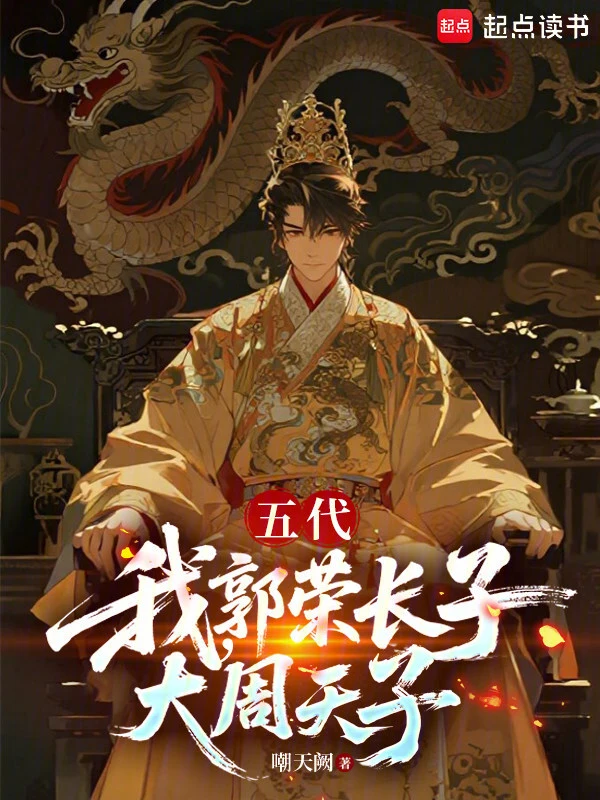
Five Dynasties: I, the Eldest Son of Guo Rong, the Emperor of Zhou Dynasty!
五代:我,郭荣长子,大周天子!
- Status
- Ongoing
- Length
- 143k Words
- Genre
- Historical
- Audience
- Male
- Subgenre
- Five Dynasties Ten Kingdoms
- Updated
- 2mo ago
- Source
- Qidian
Stats
0Monthly votes
661Recommends
14Fans
61Chapters
Tags
Synopsis
Reader comments
Readers also read
 Fu Ming 1627
 Red Mansion: Start Escaping and Farming from the Equipment Bar
 Northern Qi, Sage Khan
 After Lying in Bed for Three Years, He Was Forced to Help the Han Dynasty
 On My First Day at the Police Station, I Ate Imported Candy from a Police Beauty.
 I Am Song Shizu
 Daming: Emperor Chenghua Is Here to Ascend the Throne First!
 My Girlfriend Cheated on Her and Got Pregnant, and I Ran Away Nine Months Later
 During the Republic of China, I Baoguowei Huangpu Phase I
 Damn It, I Will Become the Ling Emperor of the Han Dynasty
 Grandmother, Please Abdicate. I Want to Be the Crown Prince.
 Seizing the Direct Descendant in the Prosperous Tang Dynasty
It's much better to dress as Brother Yi than to dress as Guo Zongxun. Guo Rong was almost 20 when he died. As long as he avoids Liu Chengyou's butcher's knife and practices under Guo Wei and Guo Rong, he can become the emperor and show off his talents. Even if he dresses as Guo Zongxun and acts smart, those warriors will not surrender to a seven-year-old child.
After checking the information, I realized that I was ignorant...
The core meaning of the word "" in the temple name is "succession from father to son and inheritance from generation to generation", while "lineage transfer (succession from side branches)" is only an additional meaning derived from it in a specific historical context, and is not the only standard. The original meaning of "Shi" is "inheritance and promotion from generation to generation" In the earliest temple name system (such as the Shang Dynasty), "Shi" represented "sacrifice from generation to generation". In later generations, "Shizu" gradually evolved into a very high evaluation, specially awarded to those emperors who carried forward the achievements of their ancestors and served as a link between past and future. As long as an emperor has made major pioneering achievements during his reign (such as opening up territories, unifying the world, and reforming the system), even if he is the eldest son who succeeds to the throne normally, he is fully qualified to be called the "ancestor". * Typical examples: Emperor Yang Guang of the Sui Dynasty (the ancestor of the Sui Dynasty) and Emperor Taiwu of the Northern Wei Dynasty Tuoba Tao (the ancestor of the Northern Wei Dynasty). They are all normal father-to-son successors, but because Yang Guang established the imperial examination and Tuoba Tao unified the north, they both made huge "pioneering contributions", so they deserve the title of "ancestor". "Shizu" has a very high gold content and is often linked to "the founding of the country" In history, "Shizu" is often regarded as the top temple title after "Taizu/Gaozu". The actual founding emperor of many dynasties (the person who completed unification or established a new dynasty) would use "Shizu". * Typical examples: Sima Yan, the founder of the Jin Dynasty (forced Wei to surrender and unified the three kingdoms), Kublai Khan, the founder of the Yuan Dynasty (established the Yuan Dynasty and destroyed the Southern Song Dynasty), Emperor Shunzhi, the ancestor of the Qing Dynasty (the Qing army entered the pass and settled the Central Plains). For these people, although they inherited the legacy of their fathers and ancestors (such as Sima Yan inherited Sima Yi and Sima Zhao), in terms of legal system, they completed a qualitative change "from 0 to 1", so using "ancestor" to highlight their achievements in opening a new era has nothing to do with whether there is a "lineage transfer". "Lineage transfer" is indeed an important factor, but it is mostly used for "Sejong" The "lineage transfer" you mentioned (that is, the small sect succeeds the big sect, and the side branch inherits the throne) is indeed an important consideration in the temple name with the word "Shi", but this is more common and obvious in the temple name "Sejong". * Sejong: More emphasis is placed on "the unification begins from this time and is the sect of the whole generation", which is very suitable for those Shoucheng orders who succeeded the great unification as side branches and worked hard to govern. For example, Emperor Shizong of the Ming Dynasty Zhu Houcong (Emperor Jiajing, succeeded by his cousin), Emperor Shizong of the Qing Dynasty Aixinjueluo Yinzhen (Emperor Yongzheng, not the intended eldest heir of Kangxi). * Shizu: Although Liu Xiu, the founder of the Han Dynasty, is the most classic case of "lineage transfer" (recreating the Han Dynasty as a distant branch clan), this is a special case in the meaning of "shizu". Because Liu Xiu not only succeeded to the throne as a side branch, but also accomplished the super feat of "rebuilding the dynasty", his "lineage transfer" attribute was overshadowed by his "creative contribution". To summarize: The evaluation criterion for "Shizu" is "merit > bloodline". As long as the merits are great enough (whether it is the expansion of territory after normal succession, or the resurgence of the ZTE dynasty after the succession of a side branch), one can be called the "ancestral ancestor". Therefore, the normal "ancestors" you see who are succeeded by fathers and sons are because their achievements during their reign are enough to "bring prosperity to the future", and they are worthy of this top temple title that represents "connection between the past and the future, and continuation from generation to generation".
What's wrong, the emperor didn't think he was going to be a eunuch?
No challenge. Why not travel through time and become Guo Wei's biological son? Isn't this very challenging? How to restrain Guo Rong and make him your Zhao Kuangyin?
Controversy about the protagonist's temple name
Regarding the controversy over the temple name, I would like to respond here and explain why I insist on using 'Shizu'. First of all, in this book, Guo Rong's temple name is not necessarily Sejong, because there are two lines in the outline of my book, one of which is to increase Guo Rong's life. I also hope everyone will actively participate in the discussion on this line. Secondly, the fundamental principle of temple names has always been as stated in "Gongyang Zhuan" that "the ancestors have merits and the clan has virtues". If the merit is enough to create a new one, then even if one inherits the family and is called the ancestor, it is also a courtesy; If the virtue is enough to maintain it, then even if the direct descendant is called the ancestor, it is also a courtesy. Seniority has never been the determining factor in temple titles, merit is. The so-called 'ancestor', the consensus between official history and ritual system is very clear - inheriting the legacy of the ancestors, and having the merit of mixing. This is not a saying invented by later generations, but an iron rule recognized by ritual officials of all ages from the Han and Wei dynasties to the Sui and Tang Dynasties. The most classic precedent is Tuoba Tao, the founder of the Northern Wei Dynasty: he was the eldest son of Taizong Tuoba Si. He succeeded to the throne as a prince and legitimately succeeded without any transfer of lineage. He was revered as the ancestor of the Northern Wei Dynasty because of his unparalleled achievements in conquering the Sixteen Kingdoms and unifying the north. Emperor Xiaowen even issued an edict to make it clear: "The ancestors have the merits of entrepreneurship, and the ancestors have the virtue of pioneering. It is appropriate to be the ancestors and will not change for a hundred generations." In this case, no historian has raised any objections for more than a thousand years. Many people confuse "Shizong" and "Shizu". The meaning of the word "Shi" in these two temple names is completely different. Shizong's 'shi' refers to 'lineage'. After the Wei and Jin Dynasties, it was often used to imply the transition of the imperial line and the succession of branches; In other words, the life of King Sejong and the life of King Shizu have the same meaning, but they also have differences. The two are not the same. According to my setting in this book, the protagonist will not only complete the unification that has not been seen in more than a hundred years since the late Tang Dynasty, but also "move the capital to Dingding", opening a new era. In the ancient official context, moving the capital was never a simple move, but a symbol of "defining the Central Plains and rebuilding the world", which itself had a pioneering nature. It is not only mixed within the sea, but also the new capital. Although he is the successor king, he has indeed made pioneering contributions. It is reasonable to call him 'ancestor'. Let's talk about the top of the temple names: Tai, Gao, Zhong and Shi. As for the three characters Taizu, Gaozu and Zhong, Taizu and Gaozu are exclusive to the founder of a country. The former refers to the creation of a dynasty from nothing, while the latter generally refers to the creation of a dynasty with a foundation. Zhongzu needs to rebuild the dynasty for the second time. The person who best fits this situation in history is actually Liu Xiu. However, even Liu Xiu used Shizu, and no one in later generations dared to use it. Moreover, when the protagonist creates many achievements in civil and military affairs, he is not trying to recreate the dynasty for the second time, but to achieve unification based on the predecessors. At this time, it is difficult to use the temple name Zhongzu. So overall, 'Shizu' is the only temple name that fits the protagonist's merits. Regarding Guo Rong's temple name, it is indeed an important plot point in this book. There will be a special court debate in the follow-up. As an aside, a controversial book is a good book. Whether it is the title, introduction or content, the author welcomes everyone to discuss rationally!
It takes too long to write one thing, and I can't finish it
Well, wasn't it Guo Wei's child who was executed? Why is Guo Rong involved again?
The quality is average and the details are substandard. The author might as well settle down a little more.
This book is very good. Why is it a eunuch?