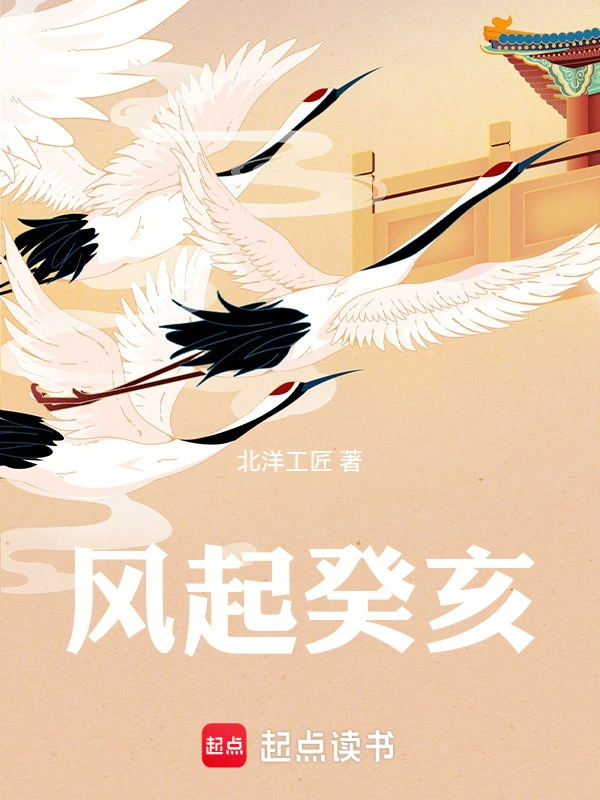
The Wind Rises in Guihai
风起癸亥
- Status
- Ongoing
- Length
- 415k Words
- Genre
- Historical
- Audience
- Male
- Subgenre
- Song-Yuan-Ming Dynasties
- Updated
- 2d ago
- Source
- Qidian
Stats
0Monthly votes
52Recommends
0Fans
165Chapters
Synopsis
Reader comments
Readers also read
 Fu Ming 1627
 Northern Qi, Sage Khan
 After Lying in Bed for Three Years, He Was Forced to Help the Han Dynasty
 Red Mansion: Start Escaping and Farming from the Equipment Bar
 Things About the Two Song Dynasties
 The Ashes of the Southern Ming Dynasty
 The New Tang Dynasty Began with the Anshi Rebellion
 Everyone Is Responsible
 Ming Dynasty Endgame 1645
 In 1990, He Started to Make a Fortune from Mariculture.
 The Ministers of the Great Zhou Dynasty
 Gongtang
It is recommended to refer to "Bian Jiang" when writing about military households.
Thank you to the author for your hard work, come on! ! !
I saw the author's Amway post and the author's Amway reply in other people's posts on the historical novel bar, and I learned about this novel. I searched Qidian and found that not many people had paid attention to this novel. There are only two posts by the author in the discussion area, so I decided to send a response to the author. Judging from the introduction, it is quite to my liking, but I haven't started reading it yet. I plan to read it after I have gained some weight. I hope the author will write with great concentration. I wish you a good flow of literary thoughts and better writing skills. Work hard! ! !
Preview of the military setting of subsequent chapters
—The military lessons of the bloody battle at Hunhe and the tactical shift of the new army in Dengzhou The bloody battle at Hunhe in the first year of Tianqi was the logical starting point for the birth of the tactical system of the new army in Dengzhou. In this battle, Qi Jin led 3,000 Zhejiang soldiers to set up a vehicle formation on the south bank of the Hun River, using Fo Lang machine, general cannon, and bird cannon in turn. After two rounds of attacks by the Jin cavalry, more than 3,000 people were killed and injured, but they failed to break through the car formation. However, when the gunpowder was exhausted, the vehicle array was reduced from a "mobile firepower fortress" to a "fixed wooden fence." All three thousand Zhejiang soldiers were wiped out. The core problem exposed in this battle was not that the firearm density of the Qi Army was insufficient, but that the entire tactical system was based on the assumption of "positional defense." The design logic of Qi Jiguang's car camp is: the enemy comes from the front, I output firepower in the car formation, and after the enemy is weakened by the firepower, the infantry and cavalry rush out from the formation to pursue. This logic holds true for Japanese pirates - Japanese pirates are mainly infantry and have limited impact. But in front of the Hou Jin Cavalry, the prerequisite for establishment was removed. Hou Jin has three advantages: first, the impact and mobility of the cavalry are far beyond the Japanese infantry. Once the defense line is broken, the infantry has almost no reaction time; second, the Hou Jin is highly mobile at the strategic level and can gather troops at any section of the coastline or border and choose the weakest point to break through; third, the Hou Jin does not follow the Ming army's script - instead of attacking the firepower point with a dense formation, it spreads out in small groups and penetrates in multiple directions, so that your firepower cannot be concentrated. The lessons of the bloody battle at Hunhe can be summed up in one sentence: competing with Houjin for firepower density and formation stability is a dead end. Hou Jin's advantage was the impact power and mobility of the cavalry, while its disadvantages were limited troops and unstable rule in the occupied areas. Therefore, the tactical shift of the Dengzhou New Army must answer a core question: Facing an enemy that is faster and more ruthless than you, but has limited troops, you should not try to confront it at the time and place of its choosing. You should use smaller combat units, faster maneuvering speeds, and a more autonomous decision-making system to intersperse in its gaps, mobilize it, consume it, and wear it down. The core conclusion of this tactical shift is: the Dengzhou New Army and Houjin do not engage in positional warfare, but only intervening warfare. The core tactical principle is sixteen words: disperse its momentum, mobilize its shape, ambush its gaps, and leave immediately after the attack.
On the historical logic of the background setting of "The Wind Rises in Guihai"
In the grand narratives of the late Ming Dynasty, we are used to focusing on the flames of war outside Shanhaiguan or the turmoil inside the Forbidden City. However, the novel "The Wind Rises in Guihai" takes a different approach, firmly anchoring the growth of a descendant of the Qi family army, the rise of a new army, and the struggle of an empire in Denglai, a seemingly marginal region. This is not an accidental choice by the author. On the contrary, it accurately touches on the most fatal military dilemma in the late Ming Dynasty and the only possible breaking point. After reading the novel, you will have a profound understanding: in that era, it was not the fortress advance in the Western Liaoning Corridor that could subvert the Hou Jin Dynasty militarily and rewrite history, but the Denglai Navy's penetration behind enemy lines. 1. The "one muscle" dilemma in the late Ming Dynasty: Why single-line combat must lead to death In the early days of the war between the Ming and Qing Dynasties (Later Jin Dynasty), the main battlefield of the Ming army was locked in the Liaoxi Corridor for a long time. From Sun Chengzong to Yuan Chonghuan, the core of the empire's strategy was "fortress advancement" - relying on strong cities and powerful artillery to build cities eastward from Shanhaiguan step by step, trying to "pile" a road to Liaodong at a high cost. This tactic seems to be safe, but in fact it falls into the rhythm that Hou Jin is best at. The Hou Jin Dynasty mainly used cavalry, which was highly mobile and good at "sieging cities and providing reinforcements". On the vast plains of western Liaoning, the Ming army's grain transport teams and reinforcements became living targets for the Hou Jin cavalry. The Ming Dynasty consumed its national power on a single front preset by the enemy, and the final result was that it "cannot afford to waste it." Behind every great victory was a further financial collapse. This is a straight but destined road to the abyss. 2. Denglai's breaking point: the "second front" forgotten by history The only way to break the deadlock in single-line combat is to open a second front and let Houjin be attacked from both sides. The Denglai region is the best and only fulcrum to realize this strategic concept. · Unique geographical location: Denglai (the current seat of government is Penglai) is across the sea from Lushunkou on the Liaodong Peninsula. It was the Ming Dynasty's closest strategic base to the enemy's rear in Liaodong. It's like a dagger hanging on Houjin's back. · Irreplaceable naval power: The Denglai Navy can quickly maneuver in the Bohai Sea and deliver elite infantry to any weak point on the Liaodong Peninsula or the Korean coast. Warships were faster than war horses, which meant that the choice of battlefield could be in the hands of the Ming army. ·Concrete presentation of the novel: In the novel, through the plots of the protagonist group's "three-level delivery system" and "Liaoxi interspersion", this strategic concept is made concrete and practical. What we see is no longer a strategy on paper, but a "special operations" force that can land behind enemy lines at any time and quickly evacuate from the sea after completing its mission. This is the uniqueness of the novel. It uses stories to prove that Denglai is not a "supporting role" on the stage, but the only core chess eye that is possible to achieve "advancing both land and water and strategic subversion".
The background of the protagonist team's first trip to North Korea
On the night of March 12th in the third year of Tianqi (1623 AD, the year of Guihai), a military coup that determined the future direction of East Asia broke out in Seoul, the capital of North Korea - known as Injo Anyway (also known as Guihai Jingshe) in history. 1. The cause of the coup: internal and external troubles, dual outbreaks - Internal: Party strife and royal power chaos During the reign of King Gwanghae Gun Ri Hun, he reused the Daebei faction, imprisoned his aunt Princess Inmu, killed his brothers Linhai Lord and Yongchang King, purged dissidents, and caused complaints between the government and the public. The opposition forces headed by the Western People's Party (Jin Yao, Li Gui, Shen Jingzhen, etc.) Have been suppressed for a long time and are determined to seize power. - Foreign: "Dangerous Neutrality" in the Crack between the Ming and Qing Dynasties After the Battle of Saarhu, the Later Jin Dynasty emerged in Liaodong. In order to protect himself, Lord Gwanghae pursued two-sided diplomacy: on the surface, he respected Ming Zhengshuo, but secretly exchanged letters with Hou Jin, maintaining ambiguity, and refused to fully support Ming Dynasty in resisting Jin. North Korean scholar-officials were deeply influenced by the Confucian "Spring and Autumn Righteousness" and the Ming Dynasty's "reconstruction grace" after the Imjin Japanese Rebellion. They regarded it as "disloyal to the Ming Dynasty" and became the strongest moral excuse for the coup. 2. The course of the coup: Change of ownership overnight The Westerners supported Ayanggun Lee Joo, Gwanghaegun's nephew, and led hundreds of people to attack Changdeokgung Palace at night. Because the Seoul defender Li Xingli was instigated to rebel, the coup troops successfully entered the palace and set fire to the palace. Kwanghae-kun fled in panic, was immediately arrested and exiled to Ganghwa Island; all the important officials of the Daebei faction were executed. Li Jie ascended the throne in the name of Princess Inmu and was the ancestor of Joseon. 3. Historical influence: Completely rewriting the pattern of East Asia in the late Ming Dynasty 1. Diplomatic sharp turn: from "neutral" to "pro-Ming and anti-Kin" As soon as Injo came to power, he completely broke off diplomatic relations with Hou Jin and restarted loyalty to Ming: - Fully supported Mao Wenlong's anti-gold activities in Dongjiang Town (Pi Island) in North Korea - Opening grain roads, providing ordnance, and allowing the Ming army to farm directly intensified the conflict between the Jin Dynasty and North Korea, paving the way for the Ding Maolu Rebellion (1630) seven years later. 2. Affecting the Denglai-Dongjiang War situation The coup triggered short-term turmoil throughout North Korea: food routes were disrupted, the army collapsed, and local areas lost control. At the same time, the Denglai Navy and Dongjiang Town of the Ming Dynasty went to North Korea to transport grain, recruit troops, and buy horses, but they were repeatedly obstructed by rebels and pushed back by the government. This is the true historical background of "Yongning City encountered chaos in pursuit of grain" in your novel. 3. Ming Dynasty canonization and East Asia chain The Injo regime urgently sent envoys to Dengzhou and Beijing to request the Ming Dynasty to formally canonize. Although the Ming court had doubts, it finally recognized Injo in the fifth year of Tianqi (1625), which stabilized the Ming-Dynasty-Dongjiang triangle anti-gold system.
Written after Volume 1
A story about "how a boy grows up" At the core of this story, there is no system, no time travel, and no golden finger from the sky. Just a twelve-year-old boy, he picked up a piece of broken iron from Dengzhou Pier, experienced the world step by step, and finally walked alone into the wind and snow in Liaodong. Some book friends may be wondering, why do I insist on creating a protagonist who makes mistakes? Qi Huan practiced swordsmanship hard for three years, but was still defeated and humiliated in a street fight. He deduced the case based on what he saw and heard, and his logic was smooth, but in the end he came to a completely wrong conclusion. In the race track of the late Ming Dynasty where there were invincible and cheating streams, writing a protagonist who did not go smoothly was an adventure in itself. Everyone has long been accustomed to the pleasure of reading along the way and going smoothly. Why do people want to follow such a plot of being beaten, hitting a wall, and misunderstanding their loved ones? I have always felt that the truest growth for a young man is never to simply become strong, but to learn to grit his teeth and bear all the wind and rain. After being defeated and humiliated, he recognized the gap and worked hard; when he made a mistake in judgment, he frankly admitted his mistake and reflected on himself; when he was reckless and got into trouble, he dared to face the consequences and bear the consequences alone. Never give up when you are frustrated, dare to look back when you know your mistakes, and dare to take responsibility when encountering difficulties. This is the true meaning of growth that I want to write down. The most profound words in the book are left to traditional fathers like Qi Chongxian. He is not good at words and rarely defends himself. Even if he is misunderstood by his close relatives, he never says a word. All the planning, protection, and thoughtfulness are all hidden in silent actions, silently providing the truth for the younger generation, quietly waiting for the young man to see through the world for himself and walk out on his own path. There is no absolute opposition between good and evil. Only in troubled times, two generations care about each other and help each other. Amid misunderstandings and companionship, they slowly complete their respective lives.
The land route across the Korean Peninsula will begin soon, and the first military operation will begin.
I have read many stories about the late Ming Dynasty in which time travelers strategize at the beginning, but the protagonist of this book is a descendant of the Qi family army. He has no time travel, no system, no golden finger, and is a real indigenous boy of the Ming Dynasty. This book takes a lot of space to write about the protagonist's "first time" - the first time to lead a team independently, the first time to repeatedly deduce the terrain before the battle, the first time to turn the learned combat examples into his own tactical decisions, and the first time to go from nervous to calm when facing the enemy. He didn't suddenly become stronger, he didn't suddenly become capable of everything. Under the guidance of his seniors, he squatted on the ground and drew arrowheads with branches, and deduced it over and over again before he came up with everything that followed. You will see how a young general can turn the knowledge inherited from his family into his own skill. You will see his first actual battle - not crushing, not instant killing, but using carefully designed tactics, using repeatedly deduced plans, and leading a group of equally green partners to fight a convincing battle. The reaction after the war was also very real. Some people couldn't control their physiological nausea, some hesitated when aiming, and some replayed the feeling in their minds repeatedly after making the first cut. No one is a born warrior. They all did what they had to do despite fear and hesitation. It does not give the protagonist any tricks, but only gives him a group of brothers who can fight side by side and a heart willing to bear the consequences. Every step of the protagonist's growth is traceable. The protagonist's first actual combat experience will be released in the next few days. If you also want to see how an ordinary boy grows bones inch by inch in troubled times, start watching.
Thanks to book friends for their recommendation votes
Thank you book friends for your recommendation votes for two consecutive days. It is the first time I have received so many recommendations. I am deeply flattered.
"Use tactics to write about people, use swords to discern souls"
The next few chapters to be released are the battle scenes in front of Yongming City, and the growth process of the young general: Qi Huan went from a boy observing the draft of the ship to a commander strategizing in Huangcaoling. The maturity of his tactical awareness (such as avoiding mistakes in the Battle of Shangzhou) became the core of the character arc. Textbook of cold weapon warfare: From stealth, ambush, terrain utilization to psychological warfare, every battle is a miniature model of ancient military wisdom, with both technical authenticity and narrative appeal. The fusion of history and fiction: In the shadow of historical facts such as the Wanli Korean War and the bloody battle of Hunhe, the fictional Taibai Mountain March has become a prism for examining the ethics of war - when Qi Huan said "it cannot be circumvented" (Chapter 48), it was both a tactical choice and a moral responsibility. The chapters that will be released soon are the key stages in the novel's protagonist's growth from an adventurous boy to a young general. They are the core chapters that shape the protagonist's military style and thoughts. Book friends who are interested in military operations can also read it for some guidance.
Poster
Volume 1 Poster
Why is this novel not about the struggle in the court, but about it from the perspective of the bottom?
Many readers are accustomed to the narrative mode in which the time traveler or reborn person holds the highest power and denounces Fang Qiu as soon as they appear. The appeal of this model is that it allows readers to quickly gain the pleasure of "changing history." But there is also a deep paradox: a time traveler with absolute power, every decision and decree he makes will directly change the direction of history. Once he successfully bypasses the disaster that would have occurred, what he will face later will no longer be the "original history." He solved a problem that was modified by himself, so how can he prove that his solution can really solve the dilemma that once existed and troubled the late Ming Dynasty for decades? This is the fundamental reason why "The Wind Rises in Guihai" chooses to start from the bottom perspective. It allows the protagonist to start from the specific and limited identity of "descendants of the Qi family army" - instead of directly leveraging the levers of history, he first squats at the Dengzhou Pier, starting from a scrap of iron and a waterline, to touch the most authentic texture of that era. 1. The supreme power will "reset" the problem rather than "solve" the problem A protagonist who travels to Chongzhen can reorganize the cabinet in the court, implement fiscal and tax reforms, and win over Donglin to suppress the eunuch party. These methods may temporarily stabilize the situation, but they are already part of the "new history" - the protagonist avoids certain mistakes with modern knowledge, but at the same time they make historical variables too complex to evaluate. In real history, the problems faced by the late Ming Dynasty were never just the question of who would be in power in the court, but a deeper institutional dilemma: the financial system was hollowed out by land annexation and gentry privileges, the military system was weakened by the guard system and generals were privatized and disintegrated, the maritime ban policy locked the development of civilian maritime power, and any reform caused by party strife was likely to be smashed by political opponents with moral sticks. These cannot be solved by changing the emperor and killing a few traitorous ministers. 2. The bottom-level perspective retains the "real pressure" of history Qi Huan has no time travel, no system, and no modern knowledge. He only knew that the Qi family's army was wiped out in the bloody battle of Hunhe River three years ago; he only knew that his grandfather squatted on the floor of the nave and covered his face and said, "loyalty and bravery cannot fill the stomach of party strife"; he only knew that someone was transporting iron at Dengzhou Pier, and the pass issued by his father appeared on the same smuggling boat as the Qi family's ordnance. Every choice he made was made under the constraints of real historical conditions. The firearms technology brought by the stranded Dutch ship, the shipbuilding timber provided by the North Korean lumberyards, the cavalry horses raised by the Jeju Island horse ranch, and the tactics honed on the frozen soil of the Western Liaoning Corridor - these are not golden fingers, but "another possibility" that already exists in history. He used these gaps to move forward inch by inch, and every step was extremely difficult, but because of this, what he proved was not just "the halo of the protagonist can change everything", but "under the same historical conditions, if someone made different choices, would the results be different?" 3. Only by solving problems from the bottom can we really get out of the predicament The predicament of the late Ming Dynasty cannot be solved by one person's decision-making. It requires a group of people to work continuously in the same direction - it requires the chamber of commerce to provide money, it requires craftsmen to cast cannons, it requires sailors to draw nautical charts, and it requires Liao people to stand in line on the black sand beach of Jeju Island until their legs do not shake. These cannot be changed by a time traveler with a single decree. They are institutions, systems, and capabilities built brick by brick. When Qi Huan was training troops in Jeju Island, the reality he faced was that these Liao people crawled out of starvation, their bodies were empty, "there was no bone in their waist and back." This sentence seems to be about the body, but it is actually about the dilemma of the late Ming Dynasty - an empire that has been hollowed out cannot stand up again with a genius emperor. It requires countless people working in the same direction, using their own hands, to regrow that bone inch by inch. 4. Why is the protagonist not a time traveler? Because only the "indigenous" protagonist can truly "touch" the issues of that era. The time traveler comes with the benefit of hindsight. He knows that Wei Zhongxian will fall, that Chongzhen will hang himself, and that Li Zicheng will invade Beijing - this "knowing" makes him unable to truly understand why people of that era made those choices. But Qi Huan didn't know. He only knew that his father might be a traitor, so he could only squat in the corner and wait for his father to come out, and use his own way to investigate, break into, and burn a ship. Every growth of his comes with a price - it is these costs that give his growth weight. 5. Conclusion: Discovering another possibility in the gaps of history "The Wind Rises in Guihai" is not a novel that "changes history", it is a novel that "discovers another possibility in the gaps of history". Instead of having a time traveler sit on a dragon throne and scold Fang Qiu, it had a young man squatting on the Dengzhou Pier, starting from a piece of broken iron and pushing forward inch by inch. What it wants to answer is not "What would history be like if we traveled to Chongzhen?" But "What would be their story if there were a group of ordinary people on the edge of the empire, using their only resources to try to build a way to survive?" This kind of story may not be as gratifying as the court struggle, but it is closer to the true texture of history. It allows us to see that historical changes do not necessarily come from one person - it comes from countless "Qi Huan" regrowing the bone inch by inch in their respective positions. This is the reason why "The Wind Rises in Guihai" chooses the bottom perspective. That's why it's worth reading.
This book "The Wind Rises in Guihai" took a long time from the beginning to the completion. Chapter 176 of the first part is about a twelve-year-old Dengzhou boy who started from burning a ship, went to Jeju Island to train troops, went to Liaoxi to take risks, went to Kunyu Mountain to temper, and went to Korea to fight fiercely - he thought his father was treason, so he carried it alone; he couldn't carry it, so his friends helped him carry it; they lost, but they stood firm. I've already written all of this. There is a complete archive of manuscripts, which can be updated stably on a daily basis. If any readers ask "Will updates be discontinued?" - No. The last line of this story has long been written. I'm going to post it slowly here, and you can take your time and read it. The bell is still ringing, and the ship has left the port. If you are willing, please leave a footprint in the book review area. I'll check back after I update every day.
On why Lin Feng sang "Only if you love to fight will you win"
Why would a young man from Fujian in the late Ming Dynasty repeatedly hum a modern Hokkien pop song? This is indeed not a mistake in research, but something I deliberately retained when writing. I always believe that it is not because of this song that people in Fujian learned to hum these few sentences; it is because Fujian people have lived like this in the wind and waves for thousands of years. They must have always hummed these few tunes to survive in the wind and waves, and later someone wrote this song. "Third points are destined, seven points depend on hard work." The way of expression may be modern, but the kind of lonely courage to survive in the stormy waves, the kind of stubbornness that puts one's life on a small boat and refuses to admit defeat or believe in fate, is something that I think is in the blood of this ethnic group. It is actually old enough, older than any song. "The Wind Rises in Guihai" pursues a very rigorous foundation of historical materials. The rituals of Mazu rituals, the regulations of sea ships, and organizational structures at all levels are all sourced. The story also completely follows the real historical process. But when it comes to the specific details of individual characters, it is necessary to use imaginary history. For example, Lin Fengheng's two sentences are one of the few times I have allowed the text to temporarily break away from the "Apocalypse Years" era shell, and directly touch the heart of the sailor boy in a way that is most resonant to modern readers. I hesitated when I wrote it and finally left it. Looking at it now, I don't regret it. If it can make you feel for a moment the mood of that Fujian boy standing on the deck, holding a compass and facing the entire sea, then its mission has been accomplished.
When the world is accustomed to living in temples as time-traveling prophets, rectifying the situation of the government, and defying heaven and saving the world, we might as well change to a colder and more realistic question: If there were no prophets from heaven and no golden fingers of emperors, history would move forward along its original trajectory. How much of the legacy of generals, craftsmen, sailors, and young folk scattered in the gaps between mountains and seas, with their character and mortal bones, could they regain the backbone of the declining world? This book is a possibility when the butterfly wings keep flapping.
If you have also thought about whether historical novels can have "another possibility"
Dear book friends, I am the author of "The Wind Rises from Guihai". The pace of this book is not fast, and the protagonist does not have modern memory and golden fingers. From the beginning to now, thank you to every friend who is willing to stay and read this story. At the beginning of writing, I was thinking about a question: When many wonderful stories choose to have the protagonist have a prophetic vision and change everything from the top of the empire, what is the other possibility of historical novels? This is what I wanted to try in "The Wind Rises Guihai". I don't write "If there is an omniscient and omnipotent person sitting on the dragon throne", What I want to write is – if that person never appears, how far can a group of ordinary people struggling in the gaps of history, relying on their own bones, go. So, this story begins with a twelve-year-old boy. He is a descendant of the Qi family army. He has no system and no vision for the future. He only has a waist knife with a curled edge. He checked for a piece of broken iron at Dengzhou Pier, broke into hell on the reef off the coast of Korea, and moved forward inch by inch in the ice and snow of Liaodong. He doesn't want to change history, he just wants to clear his family's name, find a way to survive for his partners, and regrow the broken backbone on the eve of the empire's collapse. This is not a "shuangwen" narrative logic. This is a narrative logic about "carrying" - "If you push it wrong, push it back. If you can't carry it, grow it until you can carry it." I know that this approach is not easy, and it may not be so "enjoyable". But I believe that among thousands of historical novels, there are always book lovers who are willing to read this "another possibility". If you are interested in such a story, or have any thoughts or criticisms, please feel free to leave a message below this post. I will read every comment and am willing to discuss it with you. The goal of this book has never been to write the most "enjoyable" book, but to write a book worth re-reading three times. Thanks again to every book friend who clicked in.
Zhu Jin
Zhu Jin
Naval battle
The first climax is about to begin
The writing style of this novel feels weird