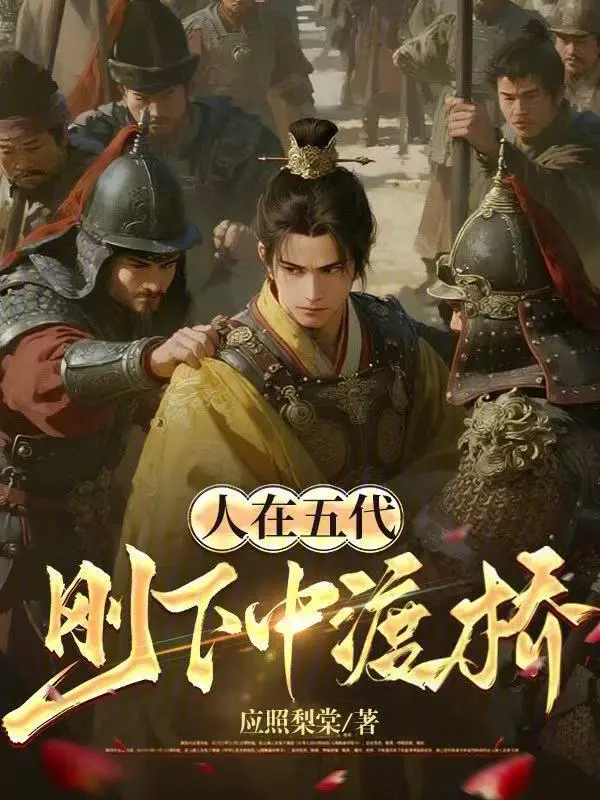
I Lived in the Five Dynasties and Just Stepped Off the Zhongdu Bridge
人在五代,刚下中渡桥
- Status
- Completed
- Length
- 1.0M Words
- Genre
- Historical
- Audience
- Male
- Subgenre
- Five Dynasties Ten Kingdoms
- Updated
- 1mo ago
- Source
- Qidian
Stats
8Monthly votes
19.8kRecommends
61.8kFans
358Chapters
Tags
Synopsis
Reader comments
In booklists 1

Readers also read
 At the Beginning, Please Ask Chongzhen to Abdicate!
 Fu Ming 1627
 Red Mansion Xiaoke
 I Am a Tyrant in Nanming
 Daming: Attack, Emperor Yongle!
 Overlord
 Liu Song Is Not Doing Well
 I Get a New Character Every Week
 Transform into Tang Monk and Become Stronger Starting from Covering the Sky to Obtain Scriptures
 Return to the Prosperous Tang Dynasty and Become the King of Sui Dynasty
 Emperor Ning Has the Guts
 Three Kingdoms: Crossing the River by Touching the Sima Family
The summary should not be written like this. Now the starting point is higher than Zhao Er. When Guo Rong dies, at least one of the governors and Jiedu envoys will be needed. Even the deputy governor can take Zhao Er's position. What kind of five hundred axe-hands will directly harm me...
No, I read 400,000 words and still don't understand what kind of character the author wants to give the protagonist. . . I want to portray a hero with a sense of loyalty and a clear sense of reason. I also want to portray a person with a strategic mind and a wise plan. I also want to portray a person who is timid and a cruel and powerful general... Brother, can you do something serious? What you are writing is the history of the Five Dynasties. Although it is a novel, don't write some plots that serve as frames and erection of archways. There is no problem that this book looks good, but it may jump at any time. The jump is not the plot, but the portrayal of the protagonist's character. It's weird, sometimes like a giant baby, sometimes like a warlord.
What mistakes are easy to make in historical novels❓
Before the Ming Dynasty, the emperor was not called "Emperor". In the Song Dynasty, he was mostly called "Guanjia", and in other dynasties, he was often called "Your Majesty". In the Ming Dynasty, the emperor was occasionally called "Emperor", and in most cases he was called "Your Majesty". After Kangxi of the Qing Dynasty, people began to be generally called "Emperor". Princes and princes call themselves: Princes in the pre-Qin and Han Dynasties can be called "Gu", and a few can be called "Ignores". After the Wei, Jin, Southern and Northern Dynasties, the title of "Ignores" gradually became exclusive to the emperor, and princes, princes and princes can only be called "Gu" or "I". Song, Yuan and Ming called themselves "I" or "I". Before the Qing Dynasty, princes and princes rarely called themselves "this king". Starting from the Kangxi year of the Qing Dynasty, princes generally called themselves "this king". In ancient times, women called themselves: "nujia" was a modest name for women after the Song Dynasty. Women in the Han and Tang Dynasties more often called themselves "concubine", and noble women could call themselves "I" and "I". Before the mid-Ming Dynasty, most dynasties used copper coins for daily transactions, with very little gold and silver. It was only in the mid-to-late Ming Dynasty that silver became the mainstream currency. -In the late Ming Dynasty, "meeting votes/deposit checks" appeared among the people. There were no unified rules. Most of them were deposits and withdrawals/exchange receipts from acquaintances or local circulation, and were not legal currency. In the early years of Daoguang in the Qing Dynasty (1823): Rishengchang Bank was established, and private banks began to issue standardized banknotes, focusing on cross-regional exchange. They were only circulated in Shanxi merchant trade circles and major commercial ports, and were not yet popular. In the third year of Xianfeng in the Qing Dynasty (1853): the official issued the Ministry of Revenue official banknotes (official banknotes), which were forced to circulate nationwide. At the same time, the network of private banknotes expanded to the whole country, and official and private banknotes ran parallel. The use of banknotes entered an explosive period and became the "starting point of popularization." High-leg tables and chairs only completely replaced the low tables for sitting on the floor in the Song Dynasty. During the Han and Tang dynasties, people knelt and sat on the tables to eat and discuss matters. The furniture was mainly low tables and couches. The memorial system was only established during the Kangxi period of the Qing Dynasty. Officials in the Tang and Song Dynasties used "memorials", "tables" and "statements" when submitting memorials, while in the Ming Dynasty they used "memorials" and "memorials". There is no such thing as "memo" or "zhezi". In ancient formal occasions, the hand-over gesture was performed with the left hand outside and the right hand inside. The right hand outside was a special "unlucky gift" for funerals. "Better greetings" is a unique etiquette of the Qing Dynasty. It was mostly used by subordinates to superiors and juniors to elders. During the Tang and Song dynasties, people often performed cross-hand salutes and bows to greet greetings when they met, and there was no such thing as "sending greetings". Before the Yuan Dynasty, subordinate officials rarely called superior officials "adult". In some dynasties, subordinates called eunuchs "adult", and in some dynasties, they called their parents and elders "adult". Beginning in the Yuan Dynasty, lower-level officials would occasionally call officials of second-rank and above "sir". From the middle and late Ming Dynasty, only officials of third-rank and above would be called "sir" by their subordinates. Officials with lower ranks could not be called "sir". However, in the late Ming Dynasty, there began to appear a few cases where officials above the fourth rank were called "adult". Before the mid-Qing Dynasty, following the rules of the Ming Dynasty, only officials of third rank or above would be called "adult". Starting from the mid-Qing Dynasty, calling officials "adult" gradually became common for lower-level officials. Attention! ! ! What is mentioned above is that lower-level officials refer to higher-level officials. No matter which dynasty, it is absolutely impossible for higher-level officials to call lower-level officials "sir". Some novels even write about emperors or nobles calling other officials "sir". This is simply contrary to Tiangang! ! ! Finally, let's talk about the problem of civilians calling officials Before the middle and late Qing Dynasty, civilians in various dynasties and generations called officials differently, and most of them called them "officials" and "masters". From the middle to late Qing Dynasty, civilians also called officials "adult". {"NickName":"Restriction and Supervision","UserId":417773267}
What do you mean
Inexplicably, he attacked Hedong. Inexplicably, he wrote that thousands of his elite were wiped out, and then ran away without giving a damn. You are a human being.
Questions about the current book.
I've read all the feedback about the protagonist. It's not that the protagonist is weak. As a time traveler, suddenly in the troubled times of the Five Dynasties and Ten Kingdoms, it's normal to only rely on the original's bravery and luck to fight, isn't it? If the protagonist had everyone bowing to him when he came up, and his temperament was like that of Du Chongwei, who didn't care about the life and death of the people, then it would be impossible to write it from my pen. The art of war will naturally improve over time. Please give me some time and give Shen Lie some time. Finally, after all, it is a new book for a newcomer. PK is very popular to read now, so please take some time to read it!
Has the author watched the recent Taiping Year TV series? Although there are some adaptations, it is rigorous in terms of history. Please refer to it, or is it the information you searched for yourself?
Two hundred chapters have just been written. Less than a year? Wow, it will take nearly 12 years before the yellow robe is added, and it will take nearly 15 years to unify the world even if it is 3 years faster. This looks like a bad job or a eunuch, and the protagonist has already been the commander of the imperial palace in the later Han Dynasty. And then add Guo Wei's power from the dragon to the commander of the bodyguards and soldiers. What will he do to win over the protagonist after Chai Rong succeeds to the throne? Also, Chai Rong, who serves as the imperial army, is not allowed to take away the protagonist before he dies? I even doubt whether the author can write about wearing a yellow robe. The span in the middle is too long and I'm afraid the author will collapse when writing.
What does the author depict Liu Chong like?
Seeing Liu Chong commit suicide, I completely don't understand why Liu Chong wanted to let the Khitans enter Taiyuan? If Liu Chong just wanted to survive, he could surrender to Guo Wei. Guo Wei surrounded Taiyuan because he already knew that his family members were not dead, so he cooperated with Shen Lie's actions. Guo Wei did not attack Taiyuan to kill Liu Chong. If Liu Chong just wanted to survive after being surrounded, then according to Guo Wei's character, Guo Wei would have persuaded Liu Chong to surrender, unless Liu Chong wanted to establish a country and proclaim himself emperor according to history, but Liu Chong in history was at least the overlord of one party. The current way of writing is purely to force Liu Chong's wisdom, and to write Liu Chong as a tool to open the door for the Khitans, or a disposable tool.
If you go there and play tricks with the ancients, you might be seeking death.
You won't let Yang Jiye go, right?
For example, Yang Jiye killed an army of the protagonist? If Yang Jiye is still recruited later, will I really give up my book?
The author disappointed me so much. It would have been a small climax for Lao Guo and his family to be rescued, but in the end they just left it alone. After saving it for more than half a month, when I saw the plot I was looking forward to, the author just jumped at it!
Does the author really want to write the protagonist as a loyal minister who assists Liu Laoer? Liu Laoer slaughtered Guo Wei's whole family, not just the people around him!
How on earth does the author of this novel plan to write this situation? There is no need to wait for Guo Rong's death before Meng Dynasty usurps the throne. He is already Guo Wei's adopted son, and his status is higher than Guo Rong now. Zhao Kuangyin is just his subordinate. He can use this to rebel and become the emperor. I don't understand it. I don't understand it at all. Now the protagonist holds the power of the imperial army. Oh, I don't understand it. How could the emperor have Dong Guowei's whole family? Just order the protagonist to rebel and become the emperor.
I tell the truth. It is not a good thing to wear a yellow robe. It seriously harms the mystery of imperial power. It makes the warriors think that you can rise to the top. It is all thanks to them. If you make them unhappy, they dare to rebel. Only the top-down approach is the right way. But anything from the bottom up is not a good thing.
It's okay, but I was so angry that I lost my life in Thief's Wolds and won purely by luck. This little ingenuity is a bit too much.
People who follow the reading can't bear it at all, they force feed it💩 and then break the chapter
I can't catch up anymore, it's getting more and more muddled.
If you want to fight in the north, go for it. Even when portraying the protagonist, you still have to be more vivid and don't try too hard to express the truth. After all, they should all be human beings. They don't need to rely on their mouths over and over again. It's boring to watch. When you become emperor, you will have to make some institutional progress and learn from the Ming and Qing Dynasties. Then there will be the development of the sea, the promotion of science and technology, commerce, and agricultural progress. In order to avoid seclusion and getting beaten, it would be best if you can write about attacking Japan. Anyway, Japan has a lot of gold and silver mines, so don't make the protagonist too great and upright. Some shortcomings, hobbies, etc. Are not bad. There is no such thing as a perfect person. After spending some time later, you can't find muskets, gunpowder, and explosives from the artillery headquarters. This also saves troops and unified time, and can fight farther.
The value of force is that you can't survive without a strong body.
How can pig's feet be sure to ensure the safety of the Guo family?
For example, this crazy criticizing emperor has no brains to kill his ministers like this. How can the pig's feet be so confident that the old, weak, women and children of the Guo family will not be killed? In the case of adding insult to injury, the executor's understanding is wrong, the time is not stuck, and other accidents cannot be guaranteed! Taking a step back, killing the minister in this way would be self-defeating and venting anger in revenge. The pig-footed old Guo has raised an army, so there is no possibility that the emperor will vent his anger and kill the Guo family?
The writing is quite good. At least I can keep reading. I don't know why so many people are attacking this book.
Finally, vote for a monthly ticket. It's too boring to chase after you leave.
The country title is too long, you can use Yuan, Ming, or Yong.
I feel like I wasted more than ten dollars
Suddenly I am about to go to Beijing. The main feeling I have is that it is not cool but not cool, and it is real but unreal. I feel very torn. As for the old men of the Later Han Dynasty, there is not a single loyal minister among the ten who is just protecting the food. The Jiedu outside is also ready to rebel at any time. In such a world, if the emperor is not the emperor, he will not be able to sit still at all. The Qian family will be lost in the Central Plains, and it will be in vain. This makes people feel untrue. They are not good people. Why are they pretending? After passing Guo Wei in the following week, Guo Rong dealt with him like this. Zhao Kuangyin rebelled just because he said he wanted to rebel. That is to say, Zhao Kuangyin mentioned Guo Rong's bonus, and the Jiedu envoys in the world were greatly dealt with. In this way, Zhao Kuangyin has to choose to pass the throne to his younger brother. This is the inertia of the times. The car god has begun to drift, and everyone in the future has begun to establish a new king. Don't be afraid. Writing these things in this era is too fragmented. The main character has a fighting power that is independent of Wushuang and can be used by tens of thousands of people with just one Wushuang. It would take ten years. It would be enough to activate Wushuang in three years. Two of them are still on the way.
I gave you the monthly ticket, please update more, it's not enough 😭
The promised update?
Climax, more updates