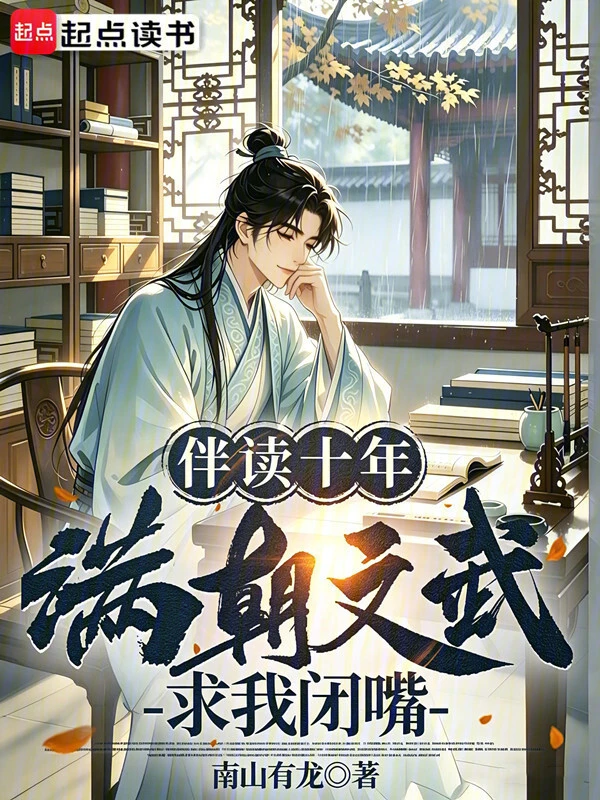
After Studying with Me for Ten Years, the Civil and Military Officials of the Manchu Dynasty Begged Me to Shut Up.
伴读十年,满朝文武求我闭嘴
- Status
- Ongoing
- Length
- 1.1M Words
- Genre
- Historical
- Audience
- Male
- Subgenre
- Song-Yuan-Ming Dynasties
- Updated
- 2d ago
- Source
- Qidian
Stats
274Monthly votes
19.1kRecommends
43kFans
452Chapters
Tags
Synopsis
Reader comments
In booklists 1

Readers also read
 Fu Ming 1627
 After Lying in Bed for Three Years, He Was Forced to Help the Han Dynasty
 Red Mansion: Start Escaping and Farming from the Equipment Bar
 Northern Qi, Sage Khan
 On My First Day at the Police Station, I Ate Imported Candy from a Police Beauty.
 Daming Grass Bag Guogong
 Travel Through the Ming Dynasty and Train Lao Zhu to Become a Sailing Emperor
 What Should I Do If I Ascend to the Wrong World?
 My Girlfriend Cheated on Her and Got Pregnant, and I Ran Away Nine Months Later
 Wild Emperor of the Ming Dynasty
 Datang: How to Become the Chief Planner of Xuanwu Sect
 The First Sword of Ming Dynasty
 Ask the Emperor to Die
 Daming: I Want to Be a Powerful Minister
 You Offer Peace to Heaven, but I Start a Rebellion
 Shouninghou of the Ming Dynasty
 At the Beginning of Tumu Fortress, the Ming God of War Was a Little Panicked
 Little Xianggong of Ming Dynasty
 Travel Through Chongzhen and Kill All the Ministers in the World
I remember that "If you hear the truth in the morning, you can die in the evening." It doesn't mean that if you find out the way to your home in the morning, you can die in the evening. ?
The main character's presence is on the roadside.
What mistakes are easy to make in historical novels❓
Before the Ming Dynasty, the emperor was not called "Emperor". In the Song Dynasty, he was mostly called "Guanjia", and in other dynasties, he was often called "Your Majesty". In the Ming Dynasty, the emperor was occasionally called "Emperor", and in most cases he was called "Your Majesty". After Kangxi of the Qing Dynasty, people began to be generally called "Emperor". Princes and princes call themselves: Princes in the pre-Qin and Han Dynasties can be called "Gu", and a few can be called "Ignores". After the Wei, Jin, Southern and Northern Dynasties, the title of "Ignores" gradually became exclusive to the emperor, and princes, princes and princes can only be called "Gu" or "I". Song, Yuan and Ming called themselves "I" or "I". Before the Qing Dynasty, princes and princes rarely called themselves "this king". Starting from the Kangxi year of the Qing Dynasty, princes generally called themselves "this king". In ancient times, women called themselves: "nujia" was a modest name for women after the Song Dynasty. Women in the Han and Tang Dynasties more often called themselves "concubine", and noble women could call themselves "I" and "I". Before the mid-Ming Dynasty, most dynasties used copper coins for daily transactions, with very little gold and silver. It was only in the mid-to-late Ming Dynasty that silver became the mainstream currency. -In the late Ming Dynasty, "meeting votes/deposit checks" appeared among the people. There were no unified rules. Most of them were deposits and withdrawals/exchange receipts from acquaintances or local circulation, and were not legal currency. In the early years of Daoguang in the Qing Dynasty (1823): Rishengchang Bank was established, and private banks began to issue standardized banknotes, focusing on cross-regional exchange. They were only circulated in Shanxi merchant trade circles and major commercial ports, and were not yet popular. In the third year of Xianfeng in the Qing Dynasty (1853): the official issued the Ministry of Revenue official banknotes (official banknotes), which were forced to circulate nationwide. At the same time, the network of private banknotes expanded to the whole country, and official and private banknotes ran parallel. The use of banknotes entered an explosive period and became the "starting point of popularization." High-leg tables and chairs only completely replaced the low tables for sitting on the floor in the Song Dynasty. During the Han and Tang dynasties, people knelt and sat on the tables to eat and discuss matters. The furniture was mainly low tables and couches. The memorial system was only established during the Kangxi period of the Qing Dynasty. Officials in the Tang and Song Dynasties used "memorials", "tables" and "statements" when submitting memorials, while in the Ming Dynasty they used "memorials" and "memorials". There is no such thing as "memo" or "zhezi". In ancient formal occasions, the hand-over gesture was performed with the left hand outside and the right hand inside. The right hand outside was a special "unlucky gift" for funerals. "Better greetings" is a unique etiquette of the Qing Dynasty. It was mostly used by subordinates to superiors and juniors to elders. During the Tang and Song dynasties, people often performed cross-hand salutes and bows to greet greetings when they met, and there was no such thing as "sending greetings". Before the Yuan Dynasty, subordinate officials rarely called superior officials "adult". In some dynasties, subordinates called eunuchs "adult", and in some dynasties, they called their parents and elders "adult". Beginning in the Yuan Dynasty, lower-level officials would occasionally call officials of second-rank and above "sir". From the middle and late Ming Dynasty, only officials of third-rank and above would be called "sir" by their subordinates. Officials with lower ranks could not be called "sir". However, in the late Ming Dynasty, there began to appear a few cases where officials above the fourth rank were called "adult". Before the mid-Qing Dynasty, following the rules of the Ming Dynasty, only officials of third rank or above would be called "adult". Starting from the mid-Qing Dynasty, calling officials "adult" gradually became common for lower-level officials. Attention! ! ! What is mentioned above is that lower-level officials refer to higher-level officials. No matter which dynasty, it is absolutely impossible for higher-level officials to call lower-level officials "sir". Some novels even write about emperors or nobles calling other officials "sir". This is simply contrary to Tiangang! ! ! Finally, let's talk about the problem of civilians calling officials Before the middle and late Qing Dynasty, civilians in various dynasties and generations called officials differently, and most of them called them "officials" and "masters". From the middle to late Qing Dynasty, civilians also called officials "adult". {"NickName":"Supervision and Restriction","UserId":406440657}
The language in this version is so spicy that I really have no motivation to watch it.
Let me ask you, can't you write? Nothing but water is still water.
You can use the free chapters as you wish. There are several paid chapters now, so don't you need to pay the water fee?
In this era, it is impossible to read anything about the Ming Dynasty.
The twelve-year-old prince didn't know what it meant to persuade people with virtue. He wanted to ask the protagonist for advice. The protagonist said that the four words "to persuade people with virtue" were in traditional Chinese, which gave him a headache. Is there any great master who can write down the traditional Chinese method of persuading people with virtue, so that I can gain some insights? The explanation given is: When it doesn't make sense, just use an ax to chop!
The best part is the free chapters, after subscribing it sucks.
Good looking, recommended
It is not a conventional historical text, it is a refreshing text ✓. The author has a strong ability to write stories✓, but it is too hasty and the rhythm and writing style are not interesting. Overall, it's worth a read✓ Your writing style is not suitable for the historical track. I suggest the author change the subject and have a explosive look✓
Why is it so close from Beijing to Juyongguan? You can go back and forth in one day
Knock on the blackboard…………Little Sunflower Classroom
1. If you are interested in history, read this book (your head will be smashed, and the coffin board will not hold it down) 2. If you are interested in entertainment, please read this book. If you are interested in comedy, read this book. It is humorous, funny and unreasonable. (Bo Jun smiles🤣🤣🤣🤣🤣🤣) Grain and grass are suitable for the brainless - watch (coke?) When eating and don't stick garlic in your nose (😂😂😂😂😂😂)
The explanation in the introduction that he would die if he heard about it in the morning or evening was too far-fetched. . .
Author, where did you find the information? Bricks could not be made by adding limestone to ancient saline-alkali soils. I checked from Qianwen and Doubao. In ancient times, saline-alkali land could only be fired into bricks by repeatedly soaking in water to remove the salt. Adding limestone or river mud would cause the bricks to fall apart.
Like 💕More updates soon
Author
Will you start reading novels about the Three Kingdoms and Water Margin in the future?
Zhu Houzhao Ma Zaiwen
Personally I don't like it a little but it's okay, but after flipping through it, I haven't changed the emperor in more than 300 chapters, so I stopped reading.