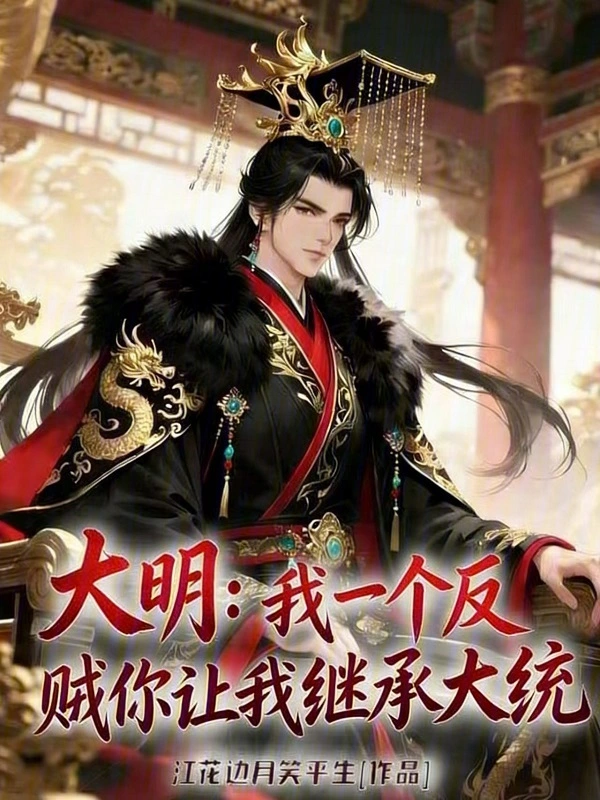
Daming: I Am a Rebel and You Let Me Inherit the Throne
大明:我一个反贼你让我继承大统
- Status
- Completed
- Length
- 48k Words
- Genre
- Historical
- Audience
- Male
- Subgenre
- Alternate History
- Updated
- 7mo ago
- Source
- Qidian
Stats
0Monthly votes
28Recommends
1Fans
18Chapters
Tags
Synopsis
Reader comments
Readers also read
 Seizing the Direct Descendant in the Prosperous Tang Dynasty
 Traveling Through the Ming Dynasty, I, Zhu Gaoxu, Am Not a Chicken in a Crock Pot
 What's Wrong with Me, Zhu Changluo, Being a Bit Shabby?
 1914 Begins with the Rejection of the Schlieffen Plan
 Writer's Manual
 Cultivation, I Have a Book of Eternity
 I Was Certified as a Master Restorer in 1982
 Gou Zai Tian Starts from the Dark Buddhism Gate
 Lao Ji, Help Me Become an Immortal
 I Am in Charge of Becoming a God in a Mysterious World
 Naruto, What Should I Do If There Are No Plug-Ins and No System?
 Steam World: Become a God from Daily Information
 Rent a Female Ghost to Go Home for the New Year
 Weird Story: After Cultivating the Demon Lord, He Accidentally Entered a Strange Dungeon
The beginning of an epic that reconstructs history and ignites passion.
1. Intention: Injecting a strong medicine into the "difficulty of settling down" history "What would have happened to the Ming Dynasty if Emperor Chongzhen had not been hanged on Meishan?" This hypothesis is the eternal "difficulty in settling down" in the hearts of all Ming history lovers and readers of historical novels. "Add a yellow robe!" "The Rebellious Prince Is Actually the Chongzhen Emperor" captures this collective emotional pain point and reconstructs the turbulent history of the late Ming Dynasty in a highly imaginative way. The most fundamental innovation of the novel is that instead of allowing modern people to travel through time and become Chongzhen, a young leader of the rebel army who is "anti-Ming" himself is forced to become Chongzhen. This setting cleverly solves the two major dilemmas of traditional historical time-travel novels: one is why the protagonist can transcend the limitations of the times, and the other is why the historical trend can be completely changed. The protagonist Zhu Cixin's "rebel origin" and "prince's bloodline" constitute a natural identity tear. His "anti-Ming motive" has become his strongest internal motivation to change the fate of the Ming Dynasty - because the person who wants to overthrow the court the most knows best where it is rotten. 2. Setting: the historical tightrope of interweaving three identities Zhu Cixin's three identities construct the most solid dramatic tension in the novel: The first level: the prince forgotten by history. As the only bloodline of Emperor Tianqi, he was secretly raised outside the palace. This setting not only conforms to the historical outline of "Apocalypse has no children", but also opens up a new narrative space. Emperor Tianqi's seven-year "tacit observation" gave this identity reversal the depth of political intrigue - this was not a simple trick of fate, but a secret game between two generations of emperors. The second level: the "young master" of the rebel army. As the adopted son of Gao Yingxiang, he has a base of 100,000 rebels. This setting allows him to avoid the traditional Chongzhen dilemma of "no one to use and no troops to adjust". Even better, the transformational tension between the resources of the rebel army and the orthodox imperial power has become the core engine driving the plot. The third level: the secret leader of the White Lotus Sect. This is the most subversive setting. The "cult" that is stigmatized in history textbooks becomes the protagonist's hidden force in the novel - it has funds, connections, intelligence networks, and even technical workshops. This not only explains the protagonist's source of economic and military resources, but also lays the foundation for the profound hidden danger of "religious forces intervening in politics." These three identities are like three strands of a rope twisted together, sometimes pulling together, sometimes tearing apart each other, making every choice full of double moral and political dilemmas. 3. Opening: Textbook-level narrative rhythm The opening of the novel can be called a model of historical theme rhythm: Chapter 1, three parallel lines: the slave soldiers are approaching the city (foreign invasion), the rebels are about to revolt (internal response), and the Jin Yiwei raids (identity exposed). In just a few thousand words, the time (New Year's Eve), place (Beijing), characters (protagonist and all parties), and conflict (triple crises) are all captured. The information density is extremely high but not confusing. Chapter 2, wearing a yellow robe. The most exciting thing here is the psychological portrayal of "being forced to ascend the throne" - the protagonist is not ecstatic, but "confused" and "rejected" because he clearly knows what the position of "Chongzhen" means in history. This sense of fear based on historical foreknowledge turns the "prophet advantage" of the time-travel/rebirth genre into a heavy psychological burden. Chapter 3 to 8, the attack and defense of the capital. This is a concentrated test of the author's writing skills, and the novel has delivered high scores: it has both macro strategic layout (Sun Chengzong's city defense system) and micro tactical innovation (fire gun raised and fired half an inch); there are bloody battles on the battlefield and psychological games in the court; there are both the heroic appearance of famous historical generals (Yuan Chonghuan, Man Gui) and the tragedy of little people. What is particularly commendable is the organic integration of historical knowledge. For example, Sun Chengzong's achievements in building the city and Yuan Chonghuan's defense of the Liao Dynasty were not introduced through stiff narration, but through the memory flashback of the protagonist reading "Those Things in the Ming Dynasty", which not only served the plot but also paid tribute to the original work. 4. Group portraits: a new interpretation of famous historical generals In the creation of historical characters, the novel achieves "respecting the core of historical facts and giving new life to literature": Sun Chengzong is no longer just the name in the textbook for "building the Guanning Defense Line", but a hard-core veteran who "knelt down on one knee and waited for the word 'accurate'" at the head of the city. When he said, "Your Majesty, you are truly a rebel...", The admiration and instant fear that came out of his mouth made this character instantly full of flesh and blood. Gao Yingxiang's image has been subverted the most. In the traditional narrative, he is the "bandit leader", but here he is the "adopted father" who understands justice well. He devoted ten years of his efforts to fight for his adopted son. When he learned that his adopted son had become the emperor, he smiled bitterly and decisively turned the wheel of "Who should he rebel against? Against his own son?", Completing the magnificent transformation from "anti-thief" to "loyal minister". Wei Zhongxian and Shen Lian represent the dark and bright sides of the conspiracy. Nine Thousand Years Old's assessment of the situation at a turning point in history, and the professional ethics of the commander of the Royal Guards between loyalty to the emperor and protecting the country, all jumped out of the stereotype. The most interesting thing is the relationship between the protagonist and history. The book "Those Things in the Ming Dynasty" in Zhu Cixin's mind was both a golden finger and a curse - he knew that Yuan Chonghuan would be Lingchi, he knew that Wei Zhongxian would be destroyed, he knew that Huang Taiji would die in the shelling, and he knew that he (Chongzhen) would have been hanged on Meishan. This setting of "foreseeing but resisting fate" gives every choice a tragic and epic feel. 5. Writing style: modern writing of cold weapon aesthetics The language style of the novel is unique: The cold picture sense: "The copper ring of the embroidered spring knife glows coldly under the snow light", "The snow on the beam rustles and falls", "The dragon robe is heavy on the shoulders" and other images, constructing the unique chilling aesthetics of the late Ming Dynasty. Relaxed rhythm: the dialogue in the court is concise and powerful, the description of the battlefield is dense and intense, and the psychological monologue is delicate and true. For example, in the Deshengmen city defense battle, the seamless switching from the macro battle situation to individual combat allows readers to overlook the entire battlefield and feel the reality of the blade licking blood. Appropriate sense of modernity: The protagonist's occasional inner complaints ("Oh my God, this is a deviation from official history") not only alleviates the heaviness of historical themes, but also strengthens the conflict between "modern consciousness and ancient bodies". This kind of humor is not about the frivolity of joking about history, but about the absurdity of human nature in desperate situations. 6. The wisdom of historical reconstruction: walking the tightrope between reality and imagination The "adaptation" of history in the novel reflects rigorous thinking: 1. Key historical facts remain unchanged: major events such as the death of Tianqi in the seventh year, the change of Jisi, Huang Taiji's invasion, Yuan Chonghuan's rescue, etc. Are all retained, and only the details and results are changed. 2. The characters' abilities are consistent with historical facts: Sun Chengzong is good at guarding, Yuan Chonghuan is good at cavalry, Mangui is brave, and Huang Taiji is resourceful. These historical evaluations have been transformed into specific battlefield performances. 3. Respect the limitations of the times: The real difficulties of the late Ming Dynasty, such as insufficient firearm range, reliance on fast horses for communication, and logistical support difficulties, have all become reasonable obstacles to the advancement of the plot, rather than being easily smoothed over by "Golden Finger". 4. Reasonable deduction of the Butterfly Effect: Due to the intervention of the protagonist, Huang Taiji was defeated in the Marco Polo Bridge ambush, which would inevitably trigger a series of chain reactions - the internal power struggle of the Later Jin Dynasty, the re-alignment of the Mongolian tribes, the morale boost of the Ming Dynasty's main war faction, etc. These subsequent developments have been foreshadowed in the updated chapters. 7. Potential Theme Depth: The Nature of Power and the Possibility of Redemption Through the lively plot, the novel has revealed a profound theme exploration: Where does the legitimacy of power come from? Is it blood (prince), force (rebels), faith (White Lotus Sect), or popular support (national salvation)? The moment Zhu Cixin was forced to put on the yellow robe, he had to face this ultimate problem. Can history be changed by personal will? The protagonist tries to use modern knowledge and historical foresight to fight against the "destiny" of Ming's demise, but greater historical inertia (natural disasters during the Little Ice Age, deadlock in land annexation, and corruption in the bureaucratic system) is still waiting ahead. This tragic heroism of "knowing that something is impossible but doing it" is the most touching part of the novel. The dialectic between "rebels" and "loyal ministers": Gao Yingxiang's rebellion against the Ming Dynasty for his adopted son was "loyal", and protecting his adopted son's reputation was also "loyal"; Zhu Cixin's overthrow of the corrupt imperial court was "righteousness", and saving the world's common people was also "righteousness". The novel is building a moral evaluation system that transcends the traditional binary opposition between loyalty and evil. 8. Chapters worth looking forward to and potential challenges Judging from the chapters that have been released, there are at least the following explosive points worth looking forward to in the future: 1. The White Lotus Sect line detonated: When the Shandong church members learn that the "Ming King" has become the Ming Emperor, how will the conflict between faith and reality break out? 2. Civil strife in the Shaanxi Rebel Army: How to deal with uncle Gao Yingen's ambition? This will be the first major test of the protagonist's "family love and imperial power". 3. The struggle between reform and counter-reform: When the protagonist tries to implement the New Deal, the Donglin Party, Shanxi Merchant Group, and vested interests will surely fight back. 4. The final showdown with Huang Taiji: Historically, Huang Taiji died in shelling. How will the novel reconstruct this key node? At the same time, the novel also faces some creative challenges: how to balance "historical reality" and "plot needs"? How to deal with the growing number of powerful groups? How to make the process of "converting anti-bandit resources into national strength" both refreshing and reasonable? Judging from the completed chapters, the author has demonstrated the ability to control complex narratives, which makes people confident in the subsequent development.
Author's self-evaluation
The original intention of writing this historical text of the Ming Dynasty is very simple - I want to try something "anti-routine": not to pile up cheats, not to use facial makeup characters, not to write suspended court dramas, but also to use the story to touch the difficult meaning hidden in the hearts of many people - Chongzhen died for his country. In order to make the story come true, I spent a lot of effort on the details. From the boundaries of the powers of the seventh-rank magistrate, the monthly ration standards for the guardsmen, to the process of court proceedings and the tactics of the border army to suppress bandits, we have gone through a lot of historical materials and notes, striving to make every official position, every conversation, and every conflict fit the logic of that era. Especially when describing the court of the Chongzhen Dynasty, I can't help but think about the feeling of suffocation: outside, Hou Jin is eyeing him, and inside there are refugees everywhere. Chongzhen is diligent but suspicious, and his ministers are either cunning or pedantic. They want to save the building from falling, but they can only watch helplessly. This sense of powerlessness is the root of why Chongzhen died for his country and became difficult to reconcile. I wanted to write this true heaviness into the book instead of passing it over lightly. In terms of plot tension design, I did not follow the old path of "cheating all the way", but instead placed my bet on the information gap and contrast. The protagonist knows the direction of history and the ending of the old locust tree in Meishan. This prophetic feeling is not a golden finger, but a shackle - he wants to save, but doesn't know where to start; he wants to change, but has to work step by step in the cracks of all forces. In a seemingly desperate situation, there is room for change; a small official who seems to be in favor of others may actually be guarding the bottom line of a scholar. I want readers to "walk the tightrope" with the protagonist. Every decision has risks, and every reversal has foreshadowing. This kind of "suspicious" reading experience is actually an attempt to make up for some regrets about that era through fictional stories. In terms of language, I have been deliberately restrained - use less redundant metaphors, write less written piles, and try to use short colloquial sentences to advance the plot. I am disgusted with the kind of words that are gorgeous but empty, and have complicated descriptions but fail to grasp the key points. A good story should "use the fewest words to say the most powerful thing." Especially when writing about a history full of blood and tears, you should not use fancy words to dilute its weight. Of course, the shortcomings of this book are also obvious. The advancement of some branch plots is delayed, the growth arc of the supporting characters is not full enough, and occasionally the interpretation of historical events is slightly simplified in order to highlight the fun points. I will slowly polish these issues in subsequent updates - cut off redundant branch plots and add more words to the supporting characters so that their choices and growth can truly integrate with the main plot; I will also more carefully balance the sense of excitement and the weight of history, so as not to let the uneasy feeling turn into a light "cool counterattack". It is an unexpected joy for me to be able to sign a contract with QQ Reading and be seen by readers and editors. The road is still long, and I always remember my original intention: to write a refreshing article with a historical quality, so that readers can remember the turbulent Ming Dynasty and the difficult feelings about Chongzhen and the country while staying up late to catch up on updates. Thanks to every reader who followed the update, and also to the editor for his guidance. In the future, I will continue to be serious, continue to polish, and live up to this love.
Discuss with the author
1. The protagonist knows the outcome of Meishan, should he try his best to save Chongzhen? Will saving him change his destiny, or will he drag Ming Dynasty into an abyss of chaos? 2. Which supporting character in the book shocked you the most? Is it a small official who seems to be greedy for money but sticks to the bottom line, or an old minister who talks about benevolence but secretly forms a clique? 3. Do you think the "information gap" in the protagonist's hand is a golden finger or a shackle? Isn't the frustration of knowing the direction of history but being trapped everywhere more satisfying than cheating all the way? 4. Let's talk about the historical details in the book that make you feel the most "real"? Is it the monthly ration standard for guardsmen, or is it the etiquette and propriety of court affairs?