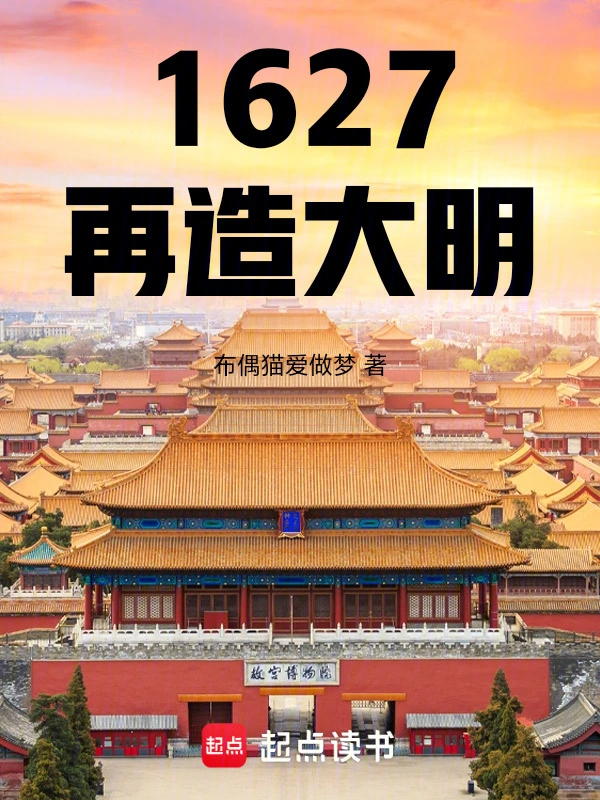
1627 Rebuilding the Ming Dynasty
1627再造大明
- Status
- Ongoing
- Length
- 257k Words
- Genre
- Historical
- Audience
- Male
- Subgenre
- Song-Yuan-Ming Dynasties
- Updated
- 6mo ago
- Source
- Qidian
Stats
0Monthly votes
338Recommends
4Fans
122Chapters
Tags
Synopsis
Reader comments
Readers also read
 Fu Ming 1627
 Red Mansion: Start Escaping and Farming from the Equipment Bar
 Northern Qi, Sage Khan
 After Lying in Bed for Three Years, He Was Forced to Help the Han Dynasty
 Criminal Investigation Notes 2: Buried Corpse in Songhu
 I Am a Tyrant in Nanming
 At the Beginning, Please Ask Chongzhen to Abdicate!
 Leader
 The Black Witch's Journey to Another World
 Daming: Emperor Chenghua Is Here to Ascend the Throne First!
 The Ashes of the Southern Ming Dynasty
 Gongtang
A Guide to Extending Life in the Ming Dynasty by Traveling to Chongzhen
Traveling to Chongzhen, it is actually relatively easy to extend the life of the Ming Dynasty (not to mention, extend the life for thirty to fifty years). The core idea is two cores + one key point: Core 1 Making money (from the upper class of society) Ming died mainly from financial bankruptcy. The long-term vision of making money is of course to reform fiscal and tax revenue (collect more commercial taxes, reduce the scope of tax exemptions, crack down on tax evasion, and even make the gentry pay taxes as one); but the short-term operation can be to achieve huge short-term fiscal revenue by killing pigs (in the late Ming Dynasty, the country was poor and the "people" were rich, but the landlords, gentry, clans, officials, and wealthy businessmen had plenty of money). Let the Eunuch Party and the Donglin Party fight, and the bad guys will be pulled out and the house will be ransacked. Big fat pigs like the vassal king have little strength (no ability to rebel), and even have a bad reputation. The bureaucrats and gentry class will not support them. As long as the emperor does not care about his reputation, it should not be too easy to kill him. Then there are traitorous smuggling groups like Shanxi merchants and their protective umbrellas that must be severely cracked down on... Core 2 Training the New Army The 17th century was an era when firearms gradually replaced cold weapons. The general trend around the world is that the balance of power between civilization and barbarism is the expansion of the advantage of the civilized side. The main purpose of making money is to have money to support soldiers. Organizing and training the new army directly under the emperor can, on the one hand, enhance the Ming Dynasty's mobile field strength, and on the other hand, it can gradually reduce the size of the old army and reduce the scope for warlords to exist. The ultimate goal is to completely reform the military system. The guard system in the late Ming Dynasty has been completely destroyed. It is necessary to implement a new type of army based on the recruitment system, instead of adopting the servants to fight after policy compromise, but the servants become the general's private soldiers. With the army at his command, the emperor can raid homes and make money as he pleases, and with money, he can better train his troops. The two complement each other. As long as a new army of 100,000 people is organized and trained, neither bandits nor slaves will be able to make big waves! One important point: save your life Since the middle and late Ming Dynasty, many emperors died in mysterious circumstances. A big reason is that the palace was seriously infiltrated by various forces. The protagonist can lay off the palace staff on a large scale in the name of reducing palace expenses and loving the people and setting an example. First reduce the staff, and then gradually replace it with people you can control. You can even learn from the Qing Dynasty emperors who lived in palaces or gardens outside the city. On the one hand, they could personally participate in the construction and training of the new army. On the other hand, they could also greatly reduce the threats to the emperor's life and safety from various forces. Only when these two cores and one key point are achieved first, can the protagonist have the energy to carry out in-depth political and social reforms. A little insight, I hope it can give the author some reference🙂
The last paragraph of the introduction is particularly good. Many people always want to rely on one person to complete a grand mission, and the end result is that their good cards will turn into shit. Do what you can and leave it to future generations.
About Donglin Party
In the late Ming Dynasty, the gentry representing Jiangnan belonged to the Zhejiang Party. The Zhejiang Party began to dominate the court in the middle of Wanli (when the leader of the Zhejiang Party, Shen Guanyi, became the chief minister), Qi Chukun and other parties also had good relations with the Zhejiang Party. The party struggle in the Ming Dynasty began with the "Beijing Cha" of the Zhejiang Party. The most capable minister in the late Ming Dynasty, Yuan Keli, was dismissed from office for 28 years because of his opposition to the Zhejiang Party. The Donglin Party is the representative of small and medium-sized landowners and rich farmers across the country. The Donglin Party advocates stopping land annexation and collecting commercial taxes. As for Wei Zhongxian, who many people boast, advocates exempting commercial taxes, but his butt is with the Jiangnan gentry.
This is an idea from Ming history.
When the Ming Dynasty was established in 1368, years of wars had led to desolation of the land, a sharp decline in population, and a serious lack of social productivity. Recuperation and recuperation were a must-have national policy. In 1371, Ming Taizu issued the "Sea Ban", which prohibited all Chinese ships from going to sea and severely punished private traders and ship owners. In 1374, the Baobao Promotion Department was established, and the Ming Dynasty Baobao was officially issued the following year. Initially, it was put on the market through financial channels such as salary and military pay, and the paper currency standard was enforced and the circulation of gold and silver was prohibited. (Precious metals like gold and silver have not required state power to give them credit value since ancient times. Since the Song Dynasty, a large amount of precious metals in society have been no longer in the hands of the court. After years of development of the Maritime Silk Road, bureaucratic capital and private families have accumulated a large amount of gold and silver in hard currency. The newly established Ming Dynasty court has almost no gold and silver reserves. If gold and silver are used directly As a national currency, it means that the country voluntarily gives up its monetary sovereignty. The imperial court is left with only an empty frame and exists in name only. If paper money is forcibly implemented as the national currency, the country will still be destroyed if the national credit overdraft is clean) In 1381, Ming Taizu further strengthened the maritime ban policy and issued the "Daming Huidian", which required all merchant ships to go to sea with government approval. (While prohibiting private overseas trade, the tribute trade system was used to establish maritime trade monopolized by the central royal power. Earning overseas gold and silver provided credit support for the Ming Dynasty treasure banknotes. Hedging bureaucratic capital and private capital used hoarded gold and silver to seize the country's monetary sovereignty. All foreign trade was settled with treasure banknotes. The Ming Dynasty purchased precious wood and spices. , Foreign luxury goods, foreign trade silk, porcelain, iron pots, prices were all set by the Ming Dynasty) In 1402, Emperor Yongle ascended the throne. In addition to continuing to maintain Zhu Yuanzhang's national policy, he also sent Zheng He on seven voyages to the West from 1405 to 1433 (expanding trade routes, destroying pirates and escorting merchant ships, and monitoring private smuggling). Zhu Yuanzhang established the rules of living for the people when he founded the country, and set the tax rate at a very low level. Emperor Yongle was able to move the capital to Beijing, build the Forbidden City, build the Ming Tombs, conduct five expeditions to Mobei, conduct an expedition to Vietnam, repair the Great Wall, and dredge the North-South Grand Canal. Compiling the Yongle Grand Canon, any of the above items would be enough for the entire government to drink (such as Emperor Yang of the Sui Dynasty and Emperor Wu of the Han Dynasty), but if the Yongle Dynasty did all these things, then he must have the money to do these things, and where does this money come from? It can only go to the West. Earned from trade, otherwise there is no way to explain the national finances (the vassal states at that time all accepted the Ming Dynasty treasure banknotes. Zheng He used such depreciating banknotes to exchange for a large amount of gold, silver and various physical objects. The Ming Dynasty treasure banknotes can be printed as much as you want, but the Ming Dynasty does not need them. Worried about inflation, Zheng He sold high and bought low on both sides. Ming historians estimate that Zheng He made seven voyages to the West, earning 720,000 taels of gold and 12.76 Million taels of silver. This is the total income. At the same time, he spent a total of 6 million taels of silver on his seven voyages. This is the total cost. When Zhu Jianshen became emperor, there were still 2.4 Million taels of silver in the warehouse) In 1435, the 37-year-old Ming Xuanzong died, and the 8-year-old Ming Yingzong succeeded to the throne. He was assisted by the Queen Mother and ministers. The newly succeeded Ming Yingzong, among the ministers. Amid the cry of "wasting people, hurting money, and useless to the national economy", all data and information related to the maritime trade in the Western Sea and the maritime fleet were basically destroyed, causing the central finance of the Ming Dynasty to shrink significantly. Even with the support of the wealth accumulated in previous maritime trade, the national credit of the Ming Dynasty's banknotes began to gradually decline and depreciate. (From the epitaph of Guo Yan, we can learn that in the eighth year of the Zhengtong reign of Emperor Yingzong of the Ming Dynasty (1443), he was ordered to supervise the construction of 120 "Xiafan sea ships" and was appointed as the "chief dispatcher of the eight prefectures". Due to his good supervision, "the military and the people benefited from it" and the completion Later, "tens of thousands of military and civilian officials from the eight prefectures came to pay their respects", which confirmed the national plan of Emperor Yingzong of the Ming Dynasty to restart the Western Ocean trade. After the ship was built, it was first put on hold due to the civil uprising, and then in 1449, the Tumu Fort Incident occurred. A few months after the restoration of the Ming Dynasty, Emperor Yingzong of the Ming Dynasty wanted to launch a voyage to the Western Ocean. Zhang Zhao opposed it. In order to clean up the mess of his predecessor, he stopped the voyage to the Western Ocean. Later, Liu Daxia burned the sea charts and completely lost the ability to return to the Western Ocean.) In 1567, Longqing Emperor Zhu Zaihou was forced to shut down the ship due to the increasing national financial deficit. Bureaucratic capital and private capital began to encroach on the ocean trade that was originally a monopoly of state-owned enterprises in the Ming Dynasty. With the massive inflow of wealth and silver, most of the tax revenue went into the hands of bureaucratic capital and private capital, except for the imperial court. The amount of silver in private circulation also increased massively, and the monetary sovereignty of the Ming Dynasty was gradually being eroded. Emperor Longqing Zhu Zaihou is an adult and knows the harm involved. Silver must not be allowed to become the legal currency of the Ming Dynasty. However, this is the last step for bureaucratic capital and private capital plutocrats to steal the monetary sovereignty of the Ming Dynasty. It started from the death of Ming Xuanzong at the age of 37 to the ascension of Emperor Longqing to the throne. It was 131 years, and it was 132 years when Emperor Longqing switched the power. How could the century-old plan of bureaucratic capital and private capital plutocratic groups stop progressing and fall short? Therefore, Emperor Longqing had to die of lust for beauty and lust 5 years after the switch, in order to ensure that the 10-year-old Emperor Wanli ascended the throne. In 1581, Zhang Juzheng promoted a whip law to abolish treasure banknotes and use silver as the national currency. As a result, the country lost its monetary sovereignty, and its economic lifeline gradually fell into the hands of bureaucratic interest groups who controlled large amounts of gold and silver. The gentry and maritime merchants in the south of the Yangtze River began to get rid of the control of the central royal power. After Zhang Juzheng's death, Emperor Wanli liquidated him on charges of "autocracy and chaos", deprived him of his title and ransacked his home. Wanli once ordered "dissection of coffins and slaughter of corpses", intending to dig graves and whip corpses to vent his anger. However, due to the strong persuasion of officials such as Chief Assistant Shen Shixing, this was not actually implemented. In the Chongzhen period, there were no eunuchs to check and balance, and Chongzhen could only borrow money from ministers to pay military salaries. Until the Manchu Qing Dynasty, selected by the capital tycoons, entered the customs in 1644, and the Southern Ming Dynasty perished in 1662.
Let me ask you, do you have no memory of your predecessor during this time travel?
It's a good subject, but it's a pity that it can't be compared to the previous ones.
Stickers
,, ?
It's a bit different from the regular novels of the late Ming Dynasty. The main reason is that the upper level thinking is different. I feel like I don't quite understand why I did it that way. Maybe I read a little too fast.
Author
Will you start novels with multiple female protagonists in the future?
Author
It would be very poisonous to write about my son's beauty story, don't you know?
Author
For (Ming) novels, you should choose to read Xu Miaoyun's (Ming) novels and Zhang Yan's (Ming) novels, which will easily attract interest in reading the novels.
Author
Do all the novels you open have multiple female protagonists?