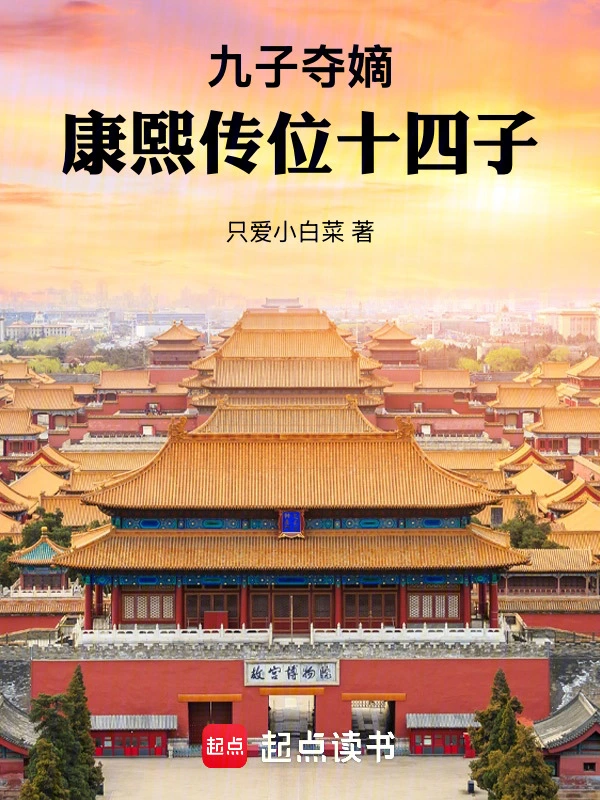
Nine Sons Seize the Throne, Kangxi Passes the Throne to Fourteen Sons
九子夺嫡,康熙传位十四子
- Status
- Completed
- Length
- 962k Words
- Genre
- Historical
- Audience
- Male
- Subgenre
- Qing & Republican Era
- Updated
- 4mo ago
- Source
- Qidian
Stats
0Monthly votes
5.6kRecommends
18.8kFans
360Chapters
Tags
Synopsis
Reader comments
Readers also read
 1914 Begins with the Rejection of the Schlieffen Plan
 In the Red Mansion: Escort Daiyu to Beijing at the Beginning
 Talker in the Song Dynasty
 Please Call Me Your Majesty the Tsar
 When I Turned Thirty, My Mother Started Introducing Me to Widows.
 The Princes of the Sui and Tang Dynasties, Starting from the Capture of Guanzhong
 Northern Song Dynasty: Starting from the Interception of Hu Zhaoji's Throne
 Become a God from a Dungeon Fighter
 American Comics, My Left Hand Insists That It Is Batman
 He Lived in the Northern Song Dynasty and Married Sheng Minglan at the Beginning.
 Datang: They Force Me to Be Emperor, Right?
 My Father, Cao Cao, I Really Don't Want to Seize the Legitimate Son.
The top two books on the new history book list are all about evoking the souls of the Manchu Qing Dynasty. . . . Ha ha
Did you come here from a female channel? It's full of words like "Qing Duo Di Di" and it smells pickled.
Wearing the Qing Dynasty to seize the direct descendant is a rebellion.
What's the origin of the sentence after "wearing the truth but not rebelling"?
There are so many books promoting the Qing Dynasty, there is a pair of invisible hands
There are so many remnants of the Manchu Qing dynasty that TV is no longer allowed to film them. I have begun to conquer the novel.
I'll come
So disgusting! The cannibals who traveled through time and became Tunguska are also invincible
Do you want to write about it? If you don't write about it, you are not respecting history. 🙄
Looking at the history of the Qing Dynasty is like digging shit. Slavery is extremely disgusting
Qing Dynasty braids
From the TV series Dashengkui, a story about the later years of Kangxi and the Yongzheng period, the details are very restored 🙂
A eunuch and slave, you asked Shi Shi what he did and what he said? Is this slave eunuch the father or the teacher of Old Fourteen?
The electric drill is ready, the author is coming soon
There's something wrong with this picture, it feels tacky
🙂
Wearing the Qing Dynasty and not rebelling? Or a Manchu prince? Have you watched too many braid dramas?
500,000 Words. Not a single woman. Kangxi acted like a psycho. He has a deep hatred for all the princes. If there really was one, he would not know who the emperor was until his death. It's because he won't reveal his preferences. He knows how to balance all kinds of relationships, he can turn a blind eye, and he allows you both to fight. To tell the truth, dozens of officials will be killed for one official, and tens of thousands and millions of taels will be corrupted. For him, it will not affect his judgment on the prince.
Abandon the pit
I've given up on it. The last few I've seen are a bit disgusting. Author, have you forgotten the title of your book? In the last few pictures of you like this, let me see how you can go back to the round shape and escape with your mouth? Rely on Xuanwu Gate?
I can't write anymore. I have so many sons, and I have to give Hongli so many roles. I'm disgusted too. I don't know how to write anymore, haha.
Your line is not a historical line at all, but a "Yongzheng Dynasty" line. You must have realized later in the writing that the setting of the TV series is too ridiculous. Since you have been using history to make up for it, why not just throw away the setting of the TV series?
What mistakes are easy to make in historical novels❓
Before the Ming Dynasty, the emperor was not called "Emperor". In the Song Dynasty, he was mostly called "Guanjia", and in other dynasties, he was often called "Your Majesty". In the Ming Dynasty, the emperor was occasionally called "Emperor", and in most cases he was called "Your Majesty". After Kangxi of the Qing Dynasty, people began to be generally called "Emperor". Princes and princes call themselves: Princes in the pre-Qin and Han Dynasties can be called "Gu", and a few can be called "Ignores". After the Wei, Jin, Southern and Northern Dynasties, the title of "Ignores" gradually became exclusive to the emperor, and princes, princes and princes can only be called "Gu" or "I". Song, Yuan and Ming called themselves "I" or "I". Before the Qing Dynasty, princes and princes rarely called themselves "this king". Starting from the Kangxi year of the Qing Dynasty, princes generally called themselves "this king". In ancient times, women called themselves: "nujia" was a modest name for women after the Song Dynasty. Women in the Han and Tang Dynasties more often called themselves "concubine", and noble women could call themselves "I" and "I". Before the mid-Ming Dynasty, most dynasties used copper coins for daily transactions, with very little gold and silver. It was only in the mid-to-late Ming Dynasty that silver became the mainstream currency. -In the late Ming Dynasty, "meeting votes/deposit checks" appeared among the people. There were no unified rules. Most of them were deposits and withdrawals/exchange receipts from acquaintances or local circulation, and were not legal currency. In the early years of Daoguang in the Qing Dynasty (1823): Rishengchang Bank was established, and private banks began to issue standardized banknotes, focusing on cross-regional exchange. They were only circulated in Shanxi merchant trade circles and major commercial ports, and were not yet popular. In the third year of Xianfeng in the Qing Dynasty (1853): the official issued the Ministry of Revenue official banknotes (official banknotes), which were forced to circulate nationwide. At the same time, the network of private banknotes expanded to the whole country, and official and private banknotes ran parallel. The use of banknotes entered an explosive period and became the "starting point of popularization." High-leg tables and chairs only completely replaced the low tables for sitting on the floor in the Song Dynasty. During the Han and Tang dynasties, people knelt and sat on the tables to eat and discuss matters. The furniture was mainly low tables and couches. The memorial system was only established during the Kangxi period of the Qing Dynasty. Officials in the Tang and Song Dynasties used "memorials", "tables" and "statements" when submitting memorials, while in the Ming Dynasty they used "memorials" and "memorials". There is no such thing as "memo" or "zhezi". In ancient formal occasions, the hand-over gesture was performed with the left hand outside and the right hand inside. The right hand outside was a special "unlucky gift" for funerals. "Better greetings" is a unique etiquette of the Qing Dynasty. It was mostly used by subordinates to superiors and juniors to elders. During the Tang and Song dynasties, people often performed cross-hand salutes and bows to greet greetings when they met, and there was no such thing as "sending greetings". Before the Yuan Dynasty, subordinate officials rarely called superior officials "adult". In some dynasties, subordinates called eunuchs "adult", and in some dynasties, they called their parents and elders "adult". Beginning in the Yuan Dynasty, lower-level officials would occasionally call officials of second-rank and above "sir". From the middle and late Ming Dynasty, only officials of third-rank and above would be called "sir" by their subordinates. Officials with lower ranks could not be called "sir". However, in the late Ming Dynasty, there began to appear a few cases where officials above the fourth rank were called "adult". Before the mid-Qing Dynasty, following the rules of the Ming Dynasty, only officials of third rank or above would be called "adult". Starting from the mid-Qing Dynasty, calling officials "adult" gradually became common for lower-level officials. Attention! ! ! What is mentioned above is that lower-level officials refer to higher-level officials. No matter which dynasty, it is absolutely impossible for higher-level officials to call lower-level officials "sir". Some novels even write about emperors or nobles calling other officials "sir". This is simply contrary to Tiangang! ! ! Finally, let's talk about the problem of civilians calling officials Before the middle and late Qing Dynasty, civilians in various dynasties and generations called officials differently, and most of them called them "officials" and "masters". From the middle to late Qing Dynasty, civilians also called officials "adult". {"NickName":"Supervision and Restriction","UserId":406440657}
He has a son, and he plans to pass the throne to Qianlong, the source of all evil and the real source of the decline of the Qing Dynasty.
I accidentally took first place!
Hey hey hey hey hey
This book is no longer interesting to write like this😔, it's over
View history correctly. National prejudice is the greatest disrespect for great men.
So poisonous!
Chapter 2: Someone next to me spoke out what was in his heart, returning to his previous life, scripts, etc., But they didn't understand it Chapter 3: Addressing a minor official as "sir", the conversation between the tenth and the fourteenth, calling himself "grandfather" to his younger brother 🚗
The author has to repeat a hundred times that he bases his judgment on historical data. No one can be so persistent in searching for a sword.