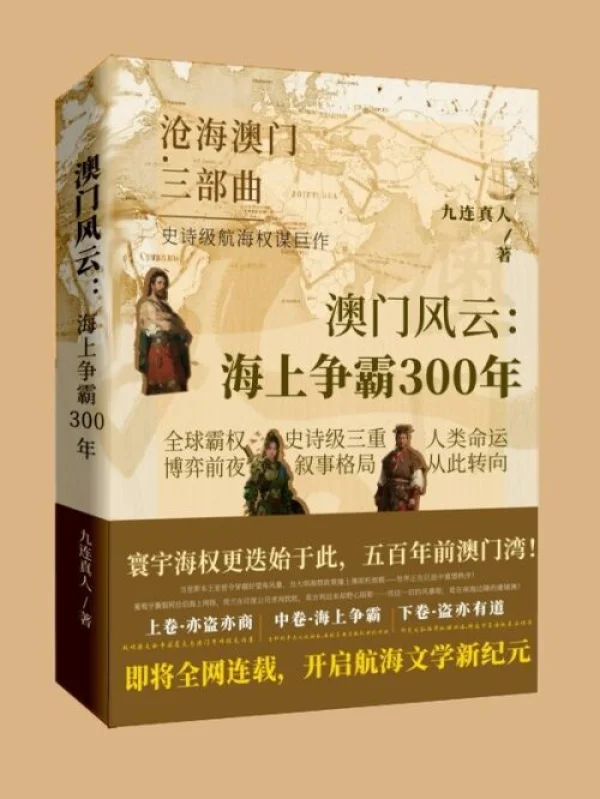
Macau Storm--300 Years of Maritime Hegemony
澳门风云--海上争霸300年
- Status
- Ongoing
- Length
- 474k Words
- Genre
- Historical
- Audience
- Male
- Subgenre
- Alternate History
- Updated
- 8mo ago
- Source
- Qidian
Stats
0Monthly votes
65Recommends
10Fans
196Chapters
Synopsis
Reader comments
Readers also read
 Fu Ming 1627
 After Lying in Bed for Three Years, He Was Forced to Help the Han Dynasty
 Northern Qi, Sage Khan
 Red Mansion: Start Escaping and Farming from the Equipment Bar
 Criminal Investigation Notes 2: Buried Corpse in Songhu
 With a Daily Payment of 10 Million, I Will Build a Special Zone in Dashan
 The Ministers of the Great Zhou Dynasty
 Leader
 The Black Witch's Journey to Another World
 Ming Dynasty: the First Assistant of a Poor Family
 When Nao's Flowers Fall
 Douluo: Destruction Comes
Triple Destiny: Hegemony, Civilization and Undercurrent The most fascinating thing about this book is its multi-layered dissection of history. Level 1: Game of Thrones From Portugal's eastward advance, the rise of the Dutch East India Company, to the chain reaction of Britain's expansion in the Far East, the change of sea power is like a chess game without gunpowder. Macau, a place called the "eye of the storm" by the author, has become a stage for competition between various forces. It is not a passive historical supporting role, but a fulcrum that promotes the historical process. Second Level: Civilized Dialogue The book does not simplify the encounter between China and the West into "invasion and resistance", but goes deep into the negotiation table of Chinese and Portuguese officials and the trading scene of silk and muskets to show the temptation, misunderstanding and integration in civilized contact. As the author writes: "Humanity's longing for the ocean and desire for freedom transcend the boundaries of all civilizations." The third level: the dark side of the world In addition to the official narrative, the book also outlines a maritime world full of gray areas: the smuggling network of Shuangyu Port, the "Eighteen Zhi" alliance that is both business and thief, and the pirate plunder like the Black Hawk hurricane... These undercurrents are the background of the real ocean order.
Literary Breakthrough: A New Era of Maritime Narratives "300 Years at Sea" is also very ambitious in structure. It adopts the trilogy structure of "Volume 1·Both Pirates and Merchants—Volume 2·Struggle for Hegemony at Sea—Volume 2·Thieves and Traders", and reconstructs the narrative logic of maritime literature based on the context of "South China Sea-Hegemony-Jianghu". What is even more rare is that the author creates a strong sense of historical immersion through details such as "the saltiness of the waves, the fragrance of spices, and the smoke of Franco machine shells". Readers seem to be able to "close their eyes and hear the ocean currents five hundred years ago." This is the transcendence of historical research in literary writing. 5. Echoes of History: Why should we reread the ocean? The value of this book goes far beyond telling a wonderful past event. It allows us to see: the ocean is not the edge, but the center of history; Macau is not a small city, but a microcosm of the world system. From the Portuguese Age of Navigation to today's "Belt and Road Initiative", human exploration of the ocean has never stopped, and the understanding of sea power still profoundly affects the evolution of the global pattern. As the author asks at the end: "When the mast sank into the deep sea five hundred years ago, will mankind's courage to cross the barriers of civilization still echo in the tide?" Conclusion "300 Years of Maritime Hegemony" is not a historical work in the traditional sense, but an "epic experiment" that uses literature to activate history. It breaks the land-based view of history and uses the ocean as a mirror to reveal a complex picture of the integration of civilizations. If you are interested in maritime history, if you like the characters who write their destiny in the wind and waves, if you are willing to think about the deeper human propositions behind "globalization" - then this book is worth your reading. It is not only a three-hundred-year history of struggle for hegemony, but also a mirror that reflects the world today.