"He Xiu Man Qingchuan" tells the legendary story of Du Qinghe, a concubine who was demoted from an official family, who rose up in the desolate ancestral fields and used her body as a woman to shake up the millennium-old farming system.
18-Year-old Du Qinghe returned to his hometown with his father and saw that the fertile farmland was abandoned, so he wanted to farm. Although she was suppressed by her aunt and ridiculed by her family as "a woman helping the plow is unruly," she relied on her ancestral farming book, wisdom and unyielding will to issue a military order on three acres of thin farmland. She improved the curved shaft plow, created a rice divider, formed a women's farming team, outwitted the harsh tax, harvested the first harvest of crops amidst ridicule, and gained a foundation for her career.
But the road ahead is difficult. The gentry covets the land, the clan chiefs seize the ancestral land, the wealthy merchants secretly make secret plans, and there is even the danger of flash floods destroying embankments. Du Qinghe shouldered a huge burden with her flexible shoulders: she restored ancient irrigation canals that had been destroyed by the previous dynasty, diverted living water to moisten thousands of hectares of barren fields; she developed pine tobacco vinegar and cloud servant girl powder, and created a women's workshop industry chain; she took in abandoned sisters, protected homeless women and children, and built a cooperative into a self-reliant home for women. Song Yan, a craftsman who had been demoted as a prisoner, helped with all his resources, Zhang Lie, his loyal and brave old corps, followed him to the death, and thousands of benefited villagers became his solid backing.
When the imperial envoy came in person, she was injured and helped the plow. Her plowing skills were not inferior to those of a strong man, and she won the title of "female plowman". Faced with the honor of entering the palace as an official, she held on to the jade gui given by the emperor and resolutely refused to enter the palace, sticking to her hometown: "The foundation of farming lies in the streets, and it cannot be accomplished without temple documents!"
Finally, in the golden autumn, the towering "Twenty-Four Solar Terms Farming Monument" stands in the fertile fields of Qingchuan. The inscription inscribes the crystallization of wisdom such as the Shidai method, irrigation with barrel carts, double-cropping of rice, and breaking the cold in the greenhouse. It also shows a road to develop agriculture that adapts to the weather and cultivates the land deeply. Du Qinghe opened the "Women's Farming and Weaving School" to teach students and broadcast fire.
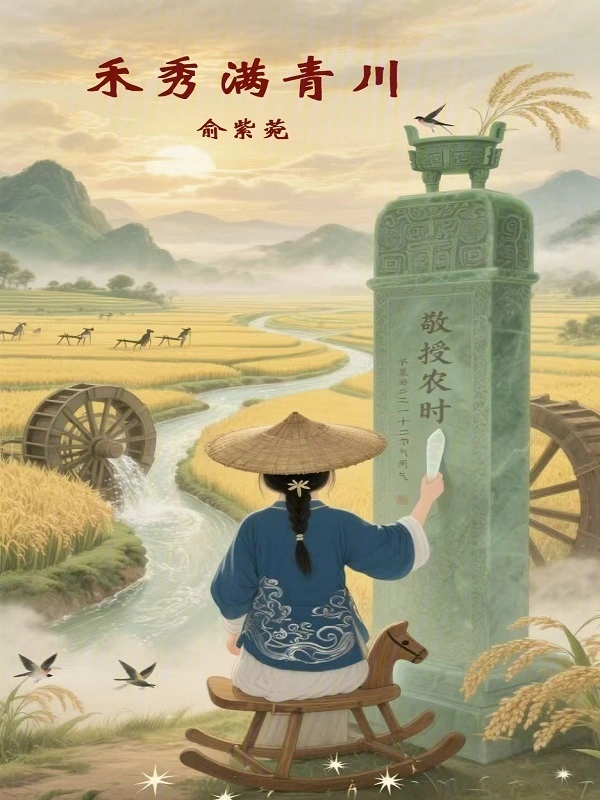
 Pastoral Fun in Space
 Agricultural Embroidery
 My Uncle, He Has All the Power in the World
 The Auspicious Time Has Arrived
 Beast Control Starts from Zero Points
 Song Tan's Notes
 Zheng Loves a Person with One Heart
 Abandoned Wives Are at Ease
 Quickly Wear It: I Just Want to Farm
 Northern Song Life Consultant
 Fight Between Famous Girls
 Houfu
Houfu
 Weaving Life into Stars
 The Mystery of Lily of the Valley
 Neon Clothes Remains