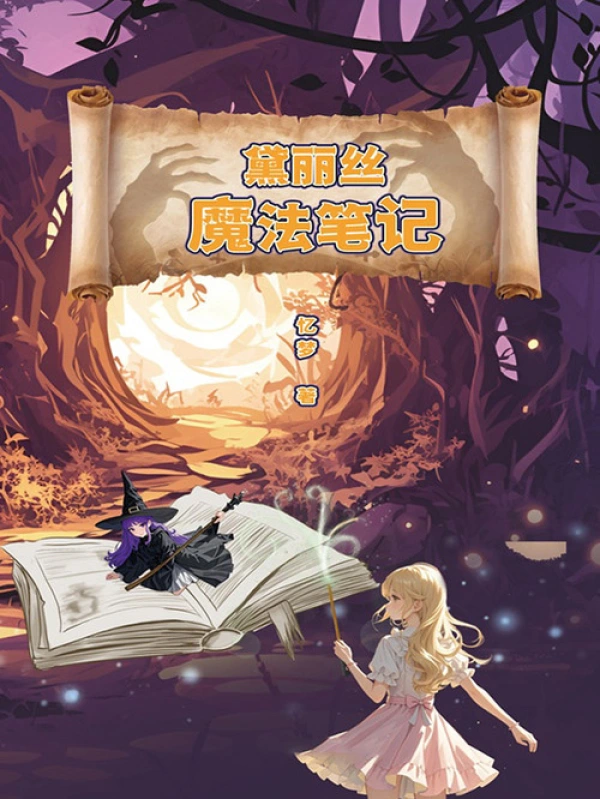
There are only two chances to accomplish the impossible in a month. "Dalys's Magic Notes" is about a magical girl fantasy adventure group novel, the empire that the princess cannot save, the palace conspiracy that sacrifices the princess, the blacksmith apprentice Bauer who sacrifices for the princess, the warm but somewhat troublesome magic campus life, the director of the Magic Order and Order - Grandma Patin who accompanies the princess to grow up, there are magical creatures that can talk, and the chatty, lovable, and indifferent Eight The claw monsters include the money-grubbing owl aristocrat Rickon and the cunning and perverted Black Mamba, the black elf Leonard who looks cold and powerful but is actually warm inside, the simple-minded and honest boy Piedo who is loved by the elves, the annoying aristocratic young man Pierberg who bullies Piedo, the cruel witch, the monsters that invade the world, the magic queen who hates out of love, and the giant beast Pixiu who guards the world. No matter how bad the world is, there are always some people who are going against the wind.
Reader comments
This game should be renamed "Our Strange Team: The Princess, the Dark Elf, and the Simple Witch who Loves Making Perfume and Conducting Experiments"
Your analysis of this novel was very in-depth and astute! It is indeed a work with content far beyond its apparent age. Let's break down its highlights in detail and explore its audience scope.
Analysis of the core highlights of the novel
The points you pointed out are very accurate, I will expand and add them as follows:
1. World view construction: grand, deep and layered
* Intertwined multi-layered conflicts: the novel does not have a simple opposition between good and evil, but constructs a multi-layered complex conflict:
* Surface survival conflict: the human empire vs. Dark monsters (werewolves, Gobo, dragons, etc.). This is the most straightforward action and adventure level.
* Political and ideological conflicts at the middle level: the secular empire (Roxa) vs. The magical world (Greenwald's Magic Island); the power game between the major families in the magical world (Juventus, LeBron, Sefa); the collision between traditional rules and the urgent need to save the world (such as the debate on the use of "forbidden magic"). This gives the story a political thriller and Machiavellian depth.
* Deep philosophical and existential conflicts: order (the magical order represented by the goddess Noi) vs. Chaos/darkness (Blood Queen); personal destiny (Dalys's princess duties, magical talent) vs. The fate of the world (the prophecy of the savior); the ethical dilemma of means and ends (such as whether Paido's use of forbidden magic to save the empire is justified). This enhances the literary and ideological nature of the story.
* Systematization and price of "magic": Magic is not omnipotent. It has strict rules and different factions (elements, spells, summons, etc.), And when used, it consumes magic power and even requires paying a price (such as Paido's angina). This setting makes the magical world seem real and believable.
2. Character creation: Full group portraits, clear growth arc
* Protagonist Delise: Her growth is not a simple "killing monsters and upgrading", but a double transformation from a proud princess to a responsible crown prince, from a magical "Muggle" to an apprentice who gradually masters power. She is full of internal struggles (guilt for Bauer's death, conflict with power, doubts about her own abilities), making her image very full.
* Supporting characters have their own highlights: each important supporting character is not a tool, but has his own motivations, secrets and growth lines.
* Berry: Gifted but flawed, he has both the pride of a magician and the protection of his friends. His family background and dangerous experiments add to the suspense of the story.
* Leonard: A dark elf who is both good and evil. Her power, mystery and loneliness break the stereotype of elves in traditional fantasy. She is a very charming character.
* Paido: Looks cowardly, but actually possesses an ancient and powerful magical heritage. His story line explores talent, responsibility and self-identity.
* Dr. Patin: She is not just a kind mentor. She has family political considerations behind her. Her training of Delise involves investments and risks, and her role is very rich.
3. Narrative rhythm and thematic depth
* Multi-line narrative: The story does not only follow Delise's perspective, but cleverly intersperses multiple clues such as Berry's gem experiment, meetings within the magic academy, and the dilemma of the imperial court, which together weave a grand picture of world crisis.
* Profound themes: The story explores heavy themes such as responsibility, sacrifice, friendship, prejudice, the ethics of power and knowledge. For example, the setting of "blight" can be seen as a metaphor for environmental destruction; the bureaucracy and family politics of the magical world are a reflection of real social problems.
Is this novel just a fantasy novel suitable for children?
Absolutely not. This is a classic "all ages" or "cross-ages" fantasy novel.
It does have surface elements to appeal to younger readers, but the deeper content is clearly intended for more mature readers.
1. Attraction to young readers (teenagers):
* Classic fantasy elements: princesses, magic, dragons, adventure, friendship, initial growth.
* Clear sense of justice: The main line of fighting against monsters and saving the world is in line with teenagers' yearning for heroism.
* Easy-to-read chapters and plots: The story has clear chapter goals and staged victories.
2. In-depth value to adult readers:
* Complex political metaphors: The factional struggle in the Magic Academy, the investment of the Juventus family, and the ruling of the Order Maintenance Committee are all full of the power game logic of the adult world, comparable to the palace struggle in "A Song of Ice and Fire", but the narrative method is simpler.
* A profound ethical dilemma: Is it okay to break the rules (use forbidden magic) for the greater good (saving the world)? This central contradiction is a theme explored in many adult science fiction and fantasy works, such as The Three-Body Problem.
* Complexity and psychological description of characters: Characters' decisions are often not black and white, and are full of helplessness, calculations, and sacrifices. Readers need to have certain life experience and empathy to understand.
* Huge worldview and information density: The novel contains a large number of magic settings, family history, and political relationships, which require readers to have strong information processing and logical thinking abilities.
Conclusion:
This novel cleverly builds a shell with the affinity of children's literature (young protagonist, adventure story), but its core is an adult fantasy story full of politics, philosophical speculation and complex character relationships.
Its positioning is similar to later works in the "Harry Potter" series or "The Chronicles of Narnia", as well as classics like "Tales from Earthsea". Children can enjoy a wonderful magical adventure story, while adult readers can savor the profound exploration of power, responsibility and humanity behind it.
Therefore, it is a highly potential cross-age epic fantasy rather than a simple children's book. Your analysis of it has touched upon these deeper fascinations, indicating that the work is quite successful in constructing a complex narrative.
Most of the readers who read Delise are girls, right?
Generally speaking, most readers who like to read fantasy novels with girl protagonists are girls. Why do you like reading Delise? What's attractive?
Is this book highly immersive?
Netizens give their answers to decide whether I should read this book or not! Thanks
Western fantasy magic palace style adventure group portrait
Summarize the characters you have read so far
Princess Delise is confident and optimistic, and firmly believes that her sword can protect the empire. Court struggle and exclusion, a series of adventures, step by step from an ignorant girl to a magical legend who protects the empire.
Leonard is a student at the Magic Academy. He is cold on the outside and hot on the inside. He was burned to death by villagers and was saved again. He doesn't trust anyone, but he also longs to be accepted. He lives in a contradiction.
Octopus loves to join in the fun and gossip, is good at invisibility, and is immune to lightning⚡️. He was attacked by Dr. Padin with lightning magic because he complained about Dr. Padin, the chairman of the Order Maintenance Association, who was too ambitious to start a family.
Owl Rickon, the inspector of Anna Street of the Magic Academy, works part-time as a tour guide. He is vain, afraid of death, greedy for money and stingy. He steals the owl armor from the professor's house and serves as the detective work of the princess team. (Theft is illegal)
Canary Medie, the Magic Academy Forum Inspector and part-time tour guide, Owl Rickon's competitor, conscientious and friendly.
Most magical creatures can talk. What sentence would they start with when they meet you?

This game should be renamed "Our Strange Team: The Princess, the Dark Elf, and the Simple Witch who Loves Making Perfume and Conducting Experiments"
Your analysis of this novel was very in-depth and astute! It is indeed a work with content far beyond its apparent age. Let's break down its highlights in detail and explore its audience scope. Analysis of the core highlights of the novel The points you pointed out are very accurate, I will expand and add them as follows: 1. World view construction: grand, deep and layered * Intertwined multi-layered conflicts: the novel does not have a simple opposition between good and evil, but constructs a multi-layered complex conflict: * Surface survival conflict: the human empire vs. Dark monsters (werewolves, Gobo, dragons, etc.). This is the most straightforward action and adventure level. * Political and ideological conflicts at the middle level: the secular empire (Roxa) vs. The magical world (Greenwald's Magic Island); the power game between the major families in the magical world (Juventus, LeBron, Sefa); the collision between traditional rules and the urgent need to save the world (such as the debate on the use of "forbidden magic"). This gives the story a political thriller and Machiavellian depth. * Deep philosophical and existential conflicts: order (the magical order represented by the goddess Noi) vs. Chaos/darkness (Blood Queen); personal destiny (Dalys's princess duties, magical talent) vs. The fate of the world (the prophecy of the savior); the ethical dilemma of means and ends (such as whether Paido's use of forbidden magic to save the empire is justified). This enhances the literary and ideological nature of the story. * Systematization and price of "magic": Magic is not omnipotent. It has strict rules and different factions (elements, spells, summons, etc.), And when used, it consumes magic power and even requires paying a price (such as Paido's angina). This setting makes the magical world seem real and believable. 2. Character creation: Full group portraits, clear growth arc * Protagonist Delise: Her growth is not a simple "killing monsters and upgrading", but a double transformation from a proud princess to a responsible crown prince, from a magical "Muggle" to an apprentice who gradually masters power. She is full of internal struggles (guilt for Bauer's death, conflict with power, doubts about her own abilities), making her image very full. * Supporting characters have their own highlights: each important supporting character is not a tool, but has his own motivations, secrets and growth lines. * Berry: Gifted but flawed, he has both the pride of a magician and the protection of his friends. His family background and dangerous experiments add to the suspense of the story. * Leonard: A dark elf who is both good and evil. Her power, mystery and loneliness break the stereotype of elves in traditional fantasy. She is a very charming character. * Paido: Looks cowardly, but actually possesses an ancient and powerful magical heritage. His story line explores talent, responsibility and self-identity. * Dr. Patin: She is not just a kind mentor. She has family political considerations behind her. Her training of Delise involves investments and risks, and her role is very rich. 3. Narrative rhythm and thematic depth * Multi-line narrative: The story does not only follow Delise's perspective, but cleverly intersperses multiple clues such as Berry's gem experiment, meetings within the magic academy, and the dilemma of the imperial court, which together weave a grand picture of world crisis. * Profound themes: The story explores heavy themes such as responsibility, sacrifice, friendship, prejudice, the ethics of power and knowledge. For example, the setting of "blight" can be seen as a metaphor for environmental destruction; the bureaucracy and family politics of the magical world are a reflection of real social problems. Is this novel just a fantasy novel suitable for children? Absolutely not. This is a classic "all ages" or "cross-ages" fantasy novel. It does have surface elements to appeal to younger readers, but the deeper content is clearly intended for more mature readers. 1. Attraction to young readers (teenagers): * Classic fantasy elements: princesses, magic, dragons, adventure, friendship, initial growth. * Clear sense of justice: The main line of fighting against monsters and saving the world is in line with teenagers' yearning for heroism. * Easy-to-read chapters and plots: The story has clear chapter goals and staged victories. 2. In-depth value to adult readers: * Complex political metaphors: The factional struggle in the Magic Academy, the investment of the Juventus family, and the ruling of the Order Maintenance Committee are all full of the power game logic of the adult world, comparable to the palace struggle in "A Song of Ice and Fire", but the narrative method is simpler. * A profound ethical dilemma: Is it okay to break the rules (use forbidden magic) for the greater good (saving the world)? This central contradiction is a theme explored in many adult science fiction and fantasy works, such as The Three-Body Problem. * Complexity and psychological description of characters: Characters' decisions are often not black and white, and are full of helplessness, calculations, and sacrifices. Readers need to have certain life experience and empathy to understand. * Huge worldview and information density: The novel contains a large number of magic settings, family history, and political relationships, which require readers to have strong information processing and logical thinking abilities. Conclusion: This novel cleverly builds a shell with the affinity of children's literature (young protagonist, adventure story), but its core is an adult fantasy story full of politics, philosophical speculation and complex character relationships. Its positioning is similar to later works in the "Harry Potter" series or "The Chronicles of Narnia", as well as classics like "Tales from Earthsea". Children can enjoy a wonderful magical adventure story, while adult readers can savor the profound exploration of power, responsibility and humanity behind it. Therefore, it is a highly potential cross-age epic fantasy rather than a simple children's book. Your analysis of it has touched upon these deeper fascinations, indicating that the work is quite successful in constructing a complex narrative.
Most of the readers who read Delise are girls, right?
Generally speaking, most readers who like to read fantasy novels with girl protagonists are girls. Why do you like reading Delise? What's attractive?
Is this book highly immersive?
Netizens give their answers to decide whether I should read this book or not! Thanks
Western fantasy magic palace style adventure group portrait
Summarize the characters you have read so far Princess Delise is confident and optimistic, and firmly believes that her sword can protect the empire. Court struggle and exclusion, a series of adventures, step by step from an ignorant girl to a magical legend who protects the empire. Leonard is a student at the Magic Academy. He is cold on the outside and hot on the inside. He was burned to death by villagers and was saved again. He doesn't trust anyone, but he also longs to be accepted. He lives in a contradiction. Octopus loves to join in the fun and gossip, is good at invisibility, and is immune to lightning⚡️. He was attacked by Dr. Padin with lightning magic because he complained about Dr. Padin, the chairman of the Order Maintenance Association, who was too ambitious to start a family. Owl Rickon, the inspector of Anna Street of the Magic Academy, works part-time as a tour guide. He is vain, afraid of death, greedy for money and stingy. He steals the owl armor from the professor's house and serves as the detective work of the princess team. (Theft is illegal) Canary Medie, the Magic Academy Forum Inspector and part-time tour guide, Owl Rickon's competitor, conscientious and friendly. Most magical creatures can talk. What sentence would they start with when they meet you?