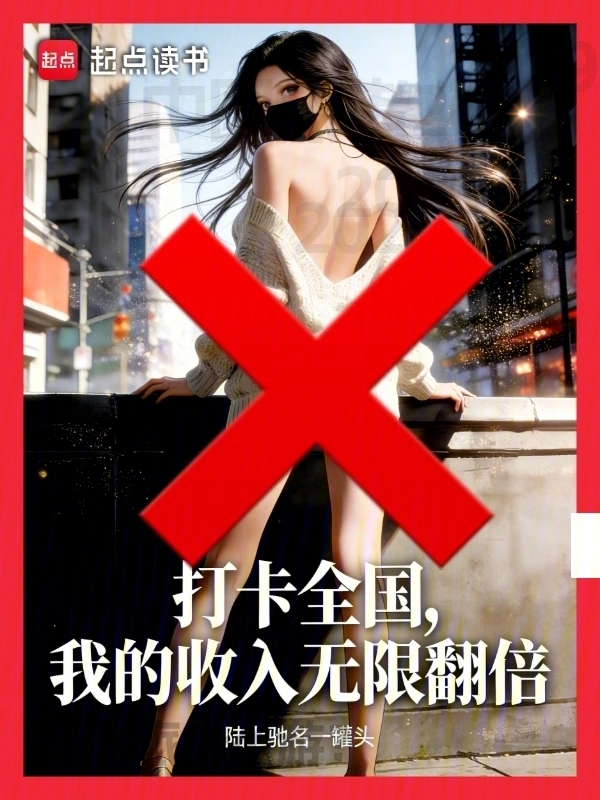
Check in Nationwide and Your Income Will Double Infinitely
打卡全国,我的收入无限翻倍
- Status
- Completed
- Length
- 1.2M Words
- Genre
- Urban
- Audience
- Male
- Subgenre
- Urban Life
- Updated
- 2mo ago
- Source
- Qidian
Stats
0Monthly votes
31.8kRecommends
88.4kFans
398Chapters
Tags
Synopsis
Reader comments
In booklists 2



Readers also read
 1979 Once Upon a Time in the Northwest
 Peninsula: the Insomniac Artist Is Connected
 Is There Any Limit to This Engineer's Military Research and Development?
 What Do You Mean I Am a Warmonger!
 Never Walk Alone!
 Earning a Million Dollars a Day: I'm Turning the County into a First-Tier City
 Becoming Rich as a Daddy
 Daming: Have I Become Wanli's Portable Grandfather?
 I Am Drawing a Hot-Blooded Episode in the Zhiyu Episode!
 I Am a Traveler!
 There Are Rewards for Going on Blind Dates. I Became the Richest Man by Going on Blind Dates.
 Shenhao Settlement List
 Take the College Entrance Examination, and Then Adopt a Magical Girl Every Month
The financial system will collapse. I just checked that there are 333 cities above prefecture level in China. There is no need to go abroad to complete the transfer of China. The money in the world combined is not enough to pay the protagonist 😅
Staying in one place for three days is just passing by.
I've always wanted to travel, but I still haven't been outside the province.
I probably did the math.
Project Goal: 10 million Goal: 100 billion Goal: 720 trillion (2024 global GDP) RMB 175,921,860,444.16 720,575,940,379,279.36 This is the distinguished percentage! ! ! ! ! !
Numerical values about the protagonist's exponential growth
0.01 Yuan per day, doubled every three days to a new prefecture-level city, 5.12 Yuan per day on the 30th day; 5242.88 Yuan per day on the 60th day, 5,368,709.12 Yuan per day on the 90th day, 5 per day on the 120th day , 497,558,138.88 Yuan, 5,629,499,534,213.12 Yuan per day on the 150th day, 5,764,607,523,034,234 yuan per day on the 180th day. The exponential level is so terrifying! Five thousand two per day on the sixtieth day, 5.36 Million per day on the ninetieth day, 5.49755 Billion per day on the 120th day, 5629.49953 Million per day on the 150th day, 5764 trillion 607.5 Billion per day on the 180th day. This money can flood the whole world. The protagonist earns RMB 5,200 per day on the sixtieth day, and more than RMB 5 million per day on the ninetieth day. He can do whatever he wants.
We calculated that each city is doubled
Good guy, it doubles every three days. If you double it forty times, it will exceed tens of billions.
? ? ? ? Why did you finish reading it in such a short time? Are you not writing hard enough? Have you worked hard to update it these days?
Live travel articles are written with new ideas, food and grass. The talent of Eye of Cost is pretty good so far, but it should be overly described to prevent it from deviating from the main line. Also, to be honest, staying in each city for three days is a bit tight. What will happen to Xinjiang later?
This system cannot go abroad, and it must be broadcast live, but no one who travels has nothing to do to broadcast live every day. They are all shopping, taking photos and posting videos
References
Measuring the land of the motherland, doubling your income is a surprise gift, and the warm encounters along the way are the most touching background.
Does the author have a misunderstanding about how rich people spend their money?
Isn't this mission to spend money really funny? After reading carefully, there is no rule about not letting others know. If you make the request yourself at the bank, dozens of financial advisors will be able to list ABCD options for you in a few hours. Charlotte asked not to be known by others, so she was so tired.
Don't dare to look. Who is the experienced driver to teach me whether to play tricks on people behind the system? For example, when you turn to 1024 points a day, you suddenly find that the protagonist is cheating, and you will be deducted points and fined?
Using Guibao to promote books, "Happiness God" is also known as "I can make money when I feel happy" A reward of 5,000 is awarded for making a short video and laughing, 8,000 is awarded for winning a game, and 10,000 is awarded for appreciating beautiful women... From then on, Li Qi went straight to the road of wealth and freedom, no longer needing to look at people's faces, and a wonderful life quietly came! Sorry for disturbing you, please contact us to delete
Chapter 386, have you arrived in Guangdong? ? ?
Good reading, Chen Shang Jian Tu, please read it! Come often
One chapter a day, do you still want to grow? Nowadays, things are fast-paced, and not many people are patient 🈶️; only by increasing efficiency can we get recommendations and monthly tickets; or can we accumulate more;
Even!
Why are you so embarrassed to take a break? How many people are waiting for you alone?
When will you arrive in Henan? Have you not read the novel yet?
Writing this book is like walking on thin ice, because everyone here can ask me a question with confidence...
Have you been in Beijing|Tianjin|Shanghai|Chongqing|Shijiazhuang|Tangshan|Qinhuangdao|Handan|Xingtai|Baoding|Zhangjiakou|Chengde|Cangzhou|Langfang|Hengshui|Taiyuan|Datong|Yangquan|Changzhi|Jincheng|Shuozhou|Jinzhong | Yuncheng | Shun|Benxi|Dandong|Jinzhou|Yingkou|Fuxin|Liaoyang|Panjin|Tieling|Chaoyang|Huludao|Changchun|Jilin|Siping|Liaoyuan|Tonghua|Baishan|Songyuan|Baicheng|Yanbian|Harbin|Qiqihar|Jixi |Hegang|Shuangyashan|Daqing|Yichun|Jiamusi|Qitaihe|Mudanjiang|Heihe|Suihua|Daxinganling|Nanjing|Wuxi|Xuzhou|Changzhou|Suzhou|Nantong|Lianyungang|Huai'an|Yancheng|Yangzhou|Zhenjiang|Taiwan Prefecture|Suqian|Hangzhou|Ningbo|Wenzhou|Jiaxing|Huzhou|Shaoxing|Jinhua|Quzhou|Zhoushan|Taizhou|Lishui|Hefei|Wuhu|Bengbu|Huainan|Ma'anshan|Huaibei|Tongling|Anqing|Huangshan|Chuzhou|Fuyang | Suzhou | Lu'an | Bozhou | Chizhou | Xuancheng | Fuzhou | Xiamen | Putian | Sanming | Quanzhou | Zhangzhou | Nanping | Longyan | Ningde | Nanchang | Jingdezhen | Pingxiang | Jiujiang | Xinyu | Yingtan | Ganzhou | Ji'an | Yichun | Prefecture|Shangrao|Jinan|Qingdao|Zibo|Zaozhuang|Dongying|Yantai|Weifang|Jining|Taian|Weihai|Rizhao|Linyi|Dezhou|Liaocheng|Binzhou|Heze|Zhengzhou|Kaifeng|Luoyang|Pingdingshan|Anyang|Hebi | Xinxiang | Jiaozuo | Puyang | Enshi|Changsha|Zhuzhou|Xiangtan|Hengyang|Shaoyang|Yueyang|Changde|Zhangjiajie|Yiyang|Chenzhou|Yongzhou|Huaihua|Loudi|Xiangxi|Guangzhou|Shaoguan|Shenzhen|Zhuhai|Shantou|Foshan|Jiangmen|Zhanjiang|Mao Name|Zhaoqing|Huizhou|Meizhou|Shantou|Heyuan|Yangjiang|Qingyuan|Dongguan|Zhongshan|Chaozhou|Jieyang|Yunfu|Nanning|Liuzhou|Guilin|Wuzhou|Beihai|Fangchenggang|Qinzhou|Guigang|Yulin|Baise|Hezhou| Hechi|Laibin|Chongzuo|Haikou|Sanya|Sansha|Danzhou|Chengdu|Zigong|Panzhihua|Luzhou|Deyang|Mianyang|Guangyuan|Suining|Neijiang|Leshan|Nanchong|Meishan|Yibin|Guang'an|Dazhou|Ya'an|Ba Zhong|Ziyang|Aba|Ganzi|Liangshan|Guiyang|Liupanshui|Zunyi|Anshun|Bijie|Tongren|Qianxiong|Qiandongeast|Qiannan|Kunming|Qujing|Yuxi|Baoshan|Zhaotong|Lijiang|Pu'er|Lincang|Chuxiong|Hong River | Wenshan | Xishuangbanna | Dali | Dehong | Nujiang | Diqing | Lhasa | Shigatse | Qamdo | Nyingchi | Shannan | Nagqu | Ali | Xi'an | Tongchuan | Baoji | Xianyang | Weinan | Yan'an | Hanzhong | Yulin | Ankang | Shangluo | Lanzhou | Jiayuguan | Jinchang | Baiyin | Tianshui | Wuwei | Zhangye | Pingliang | Jiuquan | Qingyang | Dingxi | Longnan | Linxia | Gannan | Xining | Haidong | Haibei | Huangnan | Hainan | Guoluo | Yushu | Haixi | Yinchuan | Shizuishan | Wuzhong | Guyuan | Zhongwei | Urumqi | Karamay | Turpan | Hami | Changji | Bortala | Bayingoleng | Aksu | Kizilsu | Kashgar | Hotan | Ili | Tacheng | Altay | Hong Kong |Macau|Taipei|New Taipei|Taoyuan|Taichung|Tainan|Kaohsiung|Keelung|Hsinchu|Chiayi|Yilan|Hsinchu|Miaoli|Changhua|Nantou|Yunlin|Chiayi|Pingtung|Taitung|Hualien|Penghu|Kinmen|Lienjiang people? Some things are scribbled and taken for granted.
Shanghai's "Economic Liberation"
The economic war in the early days of Shanghai's liberation in 1949 was a smoke-free war of fate between the new people's power and speculative capital. This war started with the "Battle of Silver Dollar" and centered on the "Battle of Rice and Cotton". It finally achieved a comprehensive victory, and its significance was evaluated by Mao Zedong as "no less than the Battle of Huaihai". 1. The background of the outbreak of the economic war: a mess "riddled with holes" When Shanghai was liberated, it faced an extremely difficult economic situation left by the Kuomintang government: Hyperinflation: During the Kuomintang's rule, the excessive issuance of banknotes for a long time led to inflation to an incredible level. From 1937 to 1949, the issuance of legal tender increased by hundreds of thousands of times, and prices increased by trillions of times. The reform of gold yuan coupons was a complete failure. By the eve of liberation, gold yuan coupons had become useless paper, and the people completely lost trust in paper money. Extreme shortage of supplies: Shanghai is an industrial center, but food, cotton, coal and other livelihood supplies rely heavily on external inputs. At the time of liberation, the city's grain stocks were only enough for half a month, coal stocks were only enough for seven days, and cotton stocks could only last about one month. Industrial production has almost stagnated, and the operating rate of major industrial industries is less than 30%. Rampant speculative capital: Long-term hyperinflation has spawned huge speculative capital. Tens of thousands of people are engaged in financial speculation in Shanghai. The Securities Building is a base for speculation, and 24 commodity trading markets are used for speculation. They clamored that "the People's Liberation Army can enter Shanghai, but the RMB cannot enter Shanghai", intending to subvert the new regime through economic chaos. 2. "Silver Dollar War": Establishing the Legal Status of RMB After the liberation of Shanghai, the People's Government's first task was to allow the RMB to occupy the market, but it immediately encountered strong resistance from speculative capital. The First Stage: Economic Means Frustrated On May 28, 1949, the Shanghai Military Control Commission announced that the renminbi was the only legal tender and gold yuan bonds were banned within a time limit. However, speculative forces took advantage of people's fear of banknotes and instead speculated on silver dollars, gold and foreign currencies. In just over ten days, the black market price of silver dollars nearly tripled, driving up overall commodity prices. The government tried to sell silver dollars to stabilize the situation, but the 100,000 silver dollars it put into the market on June 5 were completely swallowed up by speculative forces and failed to prevent the price of silver dollars from continuing to rise. The second stage: administrative thunderous measures After conventional economic measures failed, the central government decided to take tough measures. On June 10, the Shanghai Military Control Commission took decisive action: Seized the speculation base: The Shanghai Securities Building was sealed, more than 200 speculators were arrested, and a large amount of silver dollars, gold and foreign currencies were seized. Issue a control decree: promulgate the "East China Gold, Silver and Foreign Currency Management Measures", prohibiting the free circulation and pricing of gold, silver and foreign currencies, and listing them for exchange by the People's Bank of China. Open circulation channels: stipulate that railways, taxation, municipal utilities, etc. Must use RMB, and strongly open up the use scenarios of RMB. The effect is immediate. On the day of the seizure, the price of silver dollars plummeted from RMB 2,000 to RMB 1,200 per coin. Subsequently, the RMB quickly established its market currency status, and the world of "gold (gold), silver (silver), and green (US dollar bills)" came to an end. 3. The "War of Rice and Cotton": Comprehensive control of material speculation Although the "War of Silver Dollars" was won, the foundation of speculative forces was not damaged. They quickly turned their targets to grain, cotton yarn (two white) and coal (one black), that is, "two white and one black", setting off a new trend of price increases. 1. Careful preparation: a nationwide chess game of material distribution Chen Yun, director of the Central Financial and Economic Commission, was ordered to take command in the face of danger. He profoundly pointed out: "The problem in Shanghai is whether there is rice or cotton, and the key is whether there is transportation capacity." Therefore, the core strategy is "the whole country supports Shanghai, and Shanghai supports the whole country": Concentrated transportation of materials: Emergency transportation of large quantities of grain, cotton cloth, and coal from Northeast, North China, East China and other places. For example, one train of grain was transported from the Northeast to China every day, and grain was stored in public at the Temple of Heaven in Beijing to show that the reserves were sufficient and to deter speculators. Unified deployment of actions: It was decided to unify time and actions in major cities across the country to sell materials intensively so that speculative capital has nowhere to hide. 2. The moment of decisive battle: precise use of economic means On November 25, 1949, the decisive battle began. Chen Yun instructed trading companies in major cities across the country to act in unison: Selling at high levels: When prices reached their peak, they began to sell grain, cotton and other materials in large quantities. Tightening money: It is stipulated that all funds of state-owned enterprises should be deposited in the national bank, and loans from private banks are not allowed; taxation should be stepped up, money should be tightened, and the source of funds for speculative capital would be cut off. Administrative cooperation: Ban underground banks, investigate and punish illegal firms, and squeeze the speculation space from both ends of the capital and market. Speculators rushed to buy in at first, thinking that prices would continue to rise. However, state-owned companies continued to sell off and cut prices, and the capital chain of speculators quickly broke. They had to compete to sell and hoard supplies, causing prices to plummet and many speculators to go bankrupt. 3. Follow-up Consolidation: Establishing a New Economic Order After the decisive victory, the People's Government took a series of measures to consolidate the results: Unification of Finance and Economics: In March 1950, the Government Affairs Council issued the "Decision on Unifying National Financial and Economic Work" to unify national fiscal revenue and expenditure, material dispatch and cash management, fundamentally ending the inflation situation for more than ten years. Discounted Savings: Launch "Discounted Savings", where deposits are linked to the prices of rice, cloth, oil, coal and other physical goods to protect the interests of depositors and stabilize public sentiment. Resume production: Help private industry and commerce resume production, stabilize employment, and fundamentally solve economic difficulties through the granting of loans, processing and ordering, etc. 4. The historical significance and enlightenment of economic war The victory of this economic war has far-reaching significance far beyond a military victory: Consolidating the new political power: It proved that the Chinese Communist Party can not only fight wars, but also manage the economy well, win the hearts and minds of the people, stabilize society, and lay the foundation for national financial and economic unification. Ended long-term inflation: In one fell swoop, it ended the hyperinflation that had lasted for more than ten years since the Anti-Japanese War, allowing the national economy to recover and develop in a stable environment. Taking control of economic leadership: Through this struggle, the state-owned economy controlled the financial lifeline and major material markets, established its leadership position, and created conditions for subsequent socialist transformation. Provides a model of governance: creating a successful experience of using economic means as the mainstay, administrative means as a supplement, and concentrating efforts to accomplish major things in a game of chess across the country, demonstrating superb economic governance wisdom. In short, the economic war in Shanghai in 1949 was a major test faced by the Chinese Communist Party in the early days of the founding of the People's Republic of China. Through a series of decisive and scientific struggles such as the "War of Silver Dollars" and "War of Rice and Cotton", the new regime successfully stabilized the market and controlled prices. It not only saved Shanghai's economy, but also laid a solid foundation for the stability and development of New China's economy. It was the first great victory on the economic front of New China.
Isn't it possible to accumulate fans purely through live streaming?
What should I say, I have read several chapters. The protagonist has been trying to make a minimum guarantee on his card. As a hiking blogger, if I just broadcast for a while every day, there should be no living people at all. And as a short live broadcast time, it feels like content promotion is not possible. I feel like it would be more reasonable if the live broadcast was turned into a video release
I have read the first 30 chapters. The writing is good and the book cover is too tight. In addition, the credit card loan has been blocked due to reduced progress. This can be directly borrowed for one year, and the annual interest rate is only 3%. But it's okay to press the schedule, but I'm afraid there will be too much money later. In fact, the golden finger should not double the money. The travel gift package feels better. All interpretation rights of the gift package belong to the author, which can better control the progress. I'm afraid that travel articles will be too big.
Su: Check in
Nanjing Zhongshan Scenic Area: Located at No. 7, Shixiang Road, Xuanwu District, Nanjing, it is a landmark scenic spot in Nanjing. There is the golden corridor of Wutong on Linggu Temple Avenue, the aerial photography of Meiling Palace can show the panoramic view of the "Heart of the Purple Mountain" necklace, and the staggered ginkgo and red maple on the Shixiang Road of Ming Xiaoling Mausoleum, the scenery is very charming.
Generally speaking, a deposit of 80,000 yuan in the early stage is enough for the protagonist to make a normal transition to the system and the daily salary will cover the expenses. However, the protagonist has no hard work and eats instant noodles and sleeps in the park. He does not understand it at all and cannot empathize with it at all.
The whole story of the separation of Yangtai family
How were Yangzhou and Taizhou separated? Let's talk about it in detail The day of separation: August 12, 1996 It was a sunny summer day. The State Council approved the city of Yangzhou to be "split" and the former county-level Taizhou City to "stand on its own" and be upgraded to the prefecture-level Taizhou City. From then on, Taizhou, the "second son" of the original "Yangzhou family", officially went solo, taking with him several younger brothers from Taixing, Jingjiang, Jiangyan (formerly Taixian County) and Xinghua. Yangzhou City "shrunk", leaving only "old base areas" such as Gaoyou, Baoying, Jiangdu, and Yizheng. Behind the separation: not "brothers at odds", but "really unable to carry the family" "Little horse and big cart" - Yangzhou cannot carry a large family In 1983, Yangzhou was promoted to a prefecture-level city, suddenly becoming a "parent", with 1 city and 9 counties in charge, but the strength and energy could not keep up. At that time, planning, investment, and key projects were all tilted towards Yangzhou urban area, while Taizhou and other brother cities and counties received very little "soup". Geographically, Yangzhou is far to the west and has weak radiation to the eastern Taizhou area. Some people complain that the "small horse-drawn cart" cannot run at all. Taizhou grievance: I am the "second boss", not a "little follower" Taizhou has a long history. It was the center of the Lianghuai salt industry in the Tang and Song Dynasties, and its economic and cultural status has long been as good as that of Yangzhou. Due to policy adjustments in 1964, Taizhou's urban area was compressed into "one of the smallest cities in the country". The population was so dense that "you can't even stand in a station", and the development space was severely squeezed. After the 1980s, Taizhou's industrial economy "rised against the trend", with GDP reaching 11.2 Billion yuan in 1996. However, due to its county-level status, development was restricted everywhere. Experts point out: Fei Xiaotong and others have spoken out many times Famous sociologist Fei Xiaotong and others have long pointed out: "Under the city-governed county system, Yangzhou cannot drive Taizhou. This is a 'small horse and a big cart.'" The province also conducted many surveys and finally made the decision: it is better to "set up separate branches" so that everyone can relax. After the separation: Who is more nourishing? Who is more hurt? Taizhou: Feeling proud and accelerating Upgraded to a prefecture-level city, Taizhou can finally independently plan and attract investment, and surrounding counties and cities can also "follow the right people" and develop together. Industries such as medicine and shipbuilding have caught up from behind, giving the city a completely new look and greatly increasing its economic vitality. The biggest advantage is: you no longer have to "look at Yangzhou's face"! Yangzhou: Short-term pain is inevitable, but it has not collapsed After the separation, Yangzhou's economic aggregate plummeted, once falling from the "Three Giants of Jiangsu" to the middle reaches. However, this also forced Yangzhou to "go into battle light", transforming into cultural tourism and high-end manufacturing, and instead embarked on a new path. Culturally, Slender West Lake and Daming Temple still attract fans, and Yangzhou's "soft power" is still well-known. Region: Competition and synergy coexist In the early days of the separation, the two places "each played their own game", resources were dispersed, and major projects were fought over. Later, with the rise of the "metropolitan area" concept, the two places slowly tried to cooperate, such as transportation and tourism linkage. This "family separation history" between Yangzhou and Taizhou is like two brothers who finally decided to "live alone" - one eldest brother felt that there were too many brothers and couldn't manage them, while the other younger brother felt that his wings were too strong and he should start his own business. After the separation, each has its own wonderful moments and its own regrets. Some people say "the sooner we separate, the better", and some lament that "we are stronger together", but no matter what, this "brothers' separation" rewrote the economic map of central Jiangsu, and also allowed Yangzhou and Taizhou to embark on different exciting lives! Reference sources: The detailed background and beginning of the separation of Yangtai and Taizhou in 1996 Historical origins and administrative division changes of Yangzhou and Taizhou
Jiangsu fan posts
When it comes to Jiangsu, the first thing that comes to mind is its bulk characteristics. Each of the Thirteen CPICs has its own merits and does not give in to each other. It has become a famous Internet meme today. This just illustrates a major feature of Jiangsu, that is, a hundred flowers bloom, each with its own strengths and historical heritage, and its development is relatively balanced. There is no one dominant phenomenon. This is actually relatively rare in various provinces in the country. After all, ordinary provinces can concentrate their efforts to develop one or two It is no longer easy for relatively developed cities, and cities with good economic development will naturally have a siphon effect on surrounding cities, further widening the gap between big cities. Jiangsu seems to have embarked on a different path. On the one hand, the provincial capital cannot be the only one. On the other hand, Jiangsu is located in the Yangtze River Delta. Each prefecture-level city is closely connected and maintains its own characteristics. They develop together and support each other, creating a vibrant provincial atmosphere.
Read Chapter 30, very good
It just feels like it's not bitter, so why don't you insist on taking advantage of the Eye of All Things?
Why is Wuxi called "Wuxi"?
Regarding the origin of the place name of Wuxi, Jiangsu, currently there are mainly the following explanations in academic circles and local history research, all of which have certain historical materials or academic basis. First, the most widely circulated theory is "the theory of Youxi and Wuxi". According to the Records of Huishan Temple written by Lu Yu of the Tang Dynasty: "Shandong Peak (referring to the east peak of Huishan, i. E. Xishan), produced a lot of lead and tin during the Zhou and Qin Dynasties, which was consumed by the Han Dynasty, so Wuxi County was created and belonged to Kuaiji. From the time of Guangwu to Xiaoshun, the tin fruit was exhausted, and Emperor Shun changed it to Wuxi County and belonged to Wu County." This theory holds that Xishan produced tin during the Zhou and Qin Dynasties, and the tin mines were exhausted in the Han Dynasty, hence the name "Wuxi". During the Xinmang period, tin mines came back, and the county name was briefly changed to "Youxi". In the early Eastern Han Dynasty, it returned to "Wuxi". This statement has been used in local chronicles of Wuxi throughout the ages, and has been supported by some archaeological discoveries. For example, mining sites from the Spring and Autumn and Warring States periods were discovered at the southern foot of Xishan Mountain. Secondly, in recent years, the Wuxi Archives and History Museum has proposed the "Wu Xu Theory", which believes that the name of Wuxi originated from the "Wu Xu" site of the ancient capital of the Kingdom of Wu. The Wu Kingdom once established its capital at Meili in present-day Wuxi. After Yue destroyed Wu, Meili fell into ruins and was called the "Wu Ruins". The pronunciation of "Wuxi" and "Wuxu" in Wu dialect are similar. When the county was established in the Qin and Han Dynasties, the official name was "Wuxi" based on the pronunciation of Wu dialect. This theory combines historical facts, documentary records, and language logic, and is considered by some scholars to be an explanation closer to the truth. Thirdly, some linguists and historical geographers advocate the "Old Vietnamese theory". They believe that "Wuxi" is a place name in the ancient Yue language, in which "wu" is a pronunciation word with no real meaning. The original meaning of "Xi" cannot be tested because the ancient Yue language is lost. Similar place names include Gusu, Yuhang, etc., Which are all homogeneous place names left over from the ancient Vietnamese language. They were later recorded in Chinese transliterations, and the original meanings were gradually lost. Fourthly, there is the "Wu Ci Theory", which believes that the "Xi" in "Wuxi" refers to "Ci", which originally refers to "Wu Ci Lake", that is, it is not used as a place for rewards. During the Warring States Period, Huang Xie, Lord Chunshen of Chu State, once "erected Wuxi Pond and governed Wuxi Lake", which shows that the name "Wuxi" was already there at that time. This statement is explained from the perspective of the ancient enfeoffment system and land exclusivity, but more documentary evidence is needed. In addition, there are folk legends such as "Kowloon fights for tin" and "If there is a fight for tin, Wuxi is peaceful", etc., But most of them are attached by later generations and lack serious historical data basis. To sum up, there is no single authoritative conclusion on the origin of the place name of Wuxi, but the "Youxi Wuxi theory" and "Wuxi theory" have the greatest influence, which can be found in "Huishan Temple Records" and Wuxi Archives and History Museum's special research respectively. Modern scholars prefer a comprehensive investigation from the perspectives of linguistics and historical geography, believing that "Wuxi" may originate from the transliteration of ancient Yue or Wu Xu, and its true meaning still needs further research. Main reference sources include: Lu Yu's "Records of Huishan Temple", Wuxi Archives and History Museum's "Analysis of the Origin of the Place Name "Wuxi" and its Humanistic Code", local chronicles and academic papers on place names in recent years, etc.