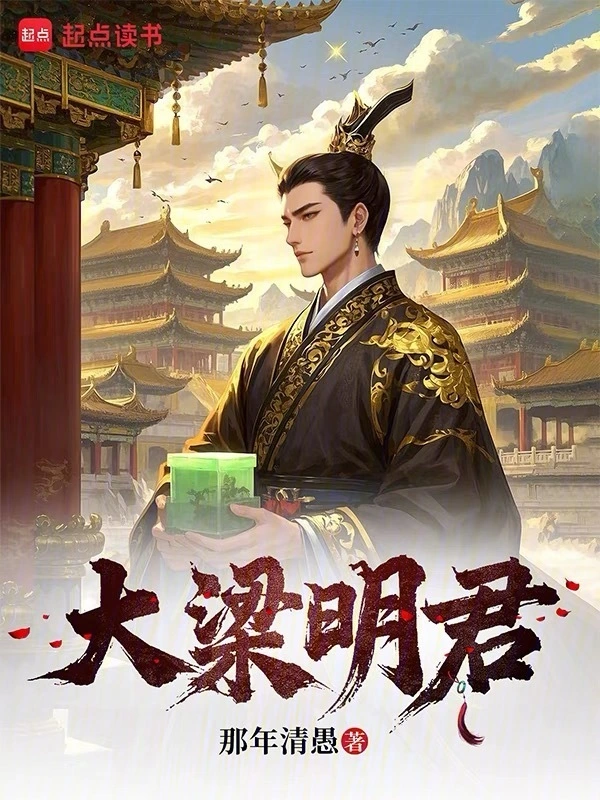
Daliang Mingjun
大梁明君
- Status
- Completed
- Length
- 602k Words
- Genre
- Historical
- Audience
- Male
- Subgenre
- Jin-Sui-Tang Dynasties
- Updated
- 1y ago
- Source
- Qidian
Stats
0Monthly votes
2.7kRecommends
5.7kFans
289Chapters
Tags
Synopsis
Reader comments
Readers also read
 Please Call Me Your Majesty the Tsar
 Talker in the Song Dynasty
 In the Red Mansion: Escort Daiyu to Beijing at the Beginning
 1914 Begins with the Rejection of the Schlieffen Plan
 Never Walk Alone!
 Late Tang Dynasty: Last Descendant of the Clan
 Northern Qi: My Father, Emperor Wenxuan
 Daming: Have I Become Wanli's Portable Grandfather?
 I Am Drawing a Hot-Blooded Episode in the Zhiyu Episode!
 Late Tang Dynasty: Father-In-Law Strategy Guide
 Emperor Ning Has the Guts
 Three Kingdoms: Crossing the River by Touching the Sima Family
 Wenkui of the Song Dynasty, Starting from the Child Prodigy Fang Zhongyong
The current situation is that of the three countries of the north and the south
The Qi and Zhou Dynasties divided the north together, and Liang unified the south. On paper, after several dynasties of development, the south had the strongest strength. However, due to the old monk's operation, the entire southern Liang failed. The main character should first take advantage of Hou Jing's rebellion and not let the north come to randomly divide the south. Then slowly wait for the humanoid monarch of the Northern Qi to come to the throne to destroy the Northern Qi and finally destroy the Northern Zhou.
Emperor Wu of Liang's anger
😅😅What's wrong with being a filial son?
I finally found one that wrote about the history of the Southern Dynasties, but I didn't expect it to be a piece of cake. If you don't know how to write it, just don't write it, okay?
Book list of the Three Kingdoms after the Southern and Northern Dynasties: "On the Political History of Medieval China" Mao Hanguang "Study on the Scholars who Migrated to the North in the Late Liang Dynasty in the Later Three Kingdoms" Hong Weizhong "Beizhen Power and the Political Culture of the Northern Dynasties" Su Xiaohua "Study on the Warlord Politics of the Late Northern Dynasties" Zeng Lei "Research on Prophecies and the Politics of the Northern Qi Dynasty" Jiang Wanglai "The Ruling Groups of the Eastern Wei and Northern Qi Dynasties" Wang Yichen "Research on the Political History of the Northern Qi Dynasty - An Investigation into the Causes of the Decline and Fall of the Northern Qi Dynasty" Lv Chunsheng "The Political Structure and Ethnic Issues of the Chen Dynasty" Lv Chunsheng "Guanlong Group" The evolution of the power structure - Research on the Political History of the Western Wei and Northern Zhou Dynasties" Lu Chunsheng "Northern Six Codes" Wang Zhongluo "Northern Zhou Geography" Wang Zhongluo "Northern Zhou History Manuscript" Lei Yiqun "Northern Qi Geography" Shi Hejin "Guanlong Generals and Zhou and Sui Dynasties" Quan" Zhang Weiguo "Hou Jing's Rebellion and the Political Situation of the Northern Dynasties" Li Wansheng "Study on the Evolution of the Social Status of the Powerful Chiefs in Six Northern Towns in the 5th and 6th Centuries" Xue Haibo "Yu Wenhu Caught in Political Conflicts" Long Botao "Chen Huiyao of the Southern Dynasties" Zhu Mingpan "The Rise and Fall of Chaos: Military Power and the Evolution of the Southern Dynasties" Zhang Jinlong "The Western Wei, Northern Zhou and Chang'an Civilization" Zhao Wenrun "Hedong in the War between Wei, Zhou and Qi" Song Jie "Regional Groups and the Politics of the Southern Dynasties" Zhang Yihe "Aristocratic Families and the Politics of the Northern Dynasties" Chen Shuang "Political History of China from the Sixth to the Ninth Century" Huang Yongnian "Chronology of Xiao Gang and Xiao Yi" Wu Guangxing "The Impact of Hou Jing's Rebellion on the Political Situation of the Southern and Northern Dynasties" Xu Gaoxiang "The King of Lanling Under the Mask: A Study of Gao Changgong, the Zhongwu King of Lanling in the Northern Qi Dynasty" Yan Hao "Collation and Annotation of Calligraphy of the Western Wei Dynasty" by Xie Qikun/Tang Xiejun "Collation and Annotation of Luoyang Jialanji" Zhonghua Book Company "History of the War of the Later Three Kingdoms" Taihai Publishing House "Supplement to the Texts of the Northern Qi and Northern Zhou Dynasties" "Supplement to the Texts of the Northern Wei, Eastern Wei and Western Wei" Sanqin Publishing House Chronology of Fangzhen in the past dynasties - Chronology of Fangzhen in the East, West, Wei, Northern Qi, Zhou and Sui Dynasties" Wu Tingxie "Compilation and Editing of Three Kingdoms Classics" Dongda Book Publishing House "The Rebellion of Hou Jing: The Twilight of the Six Dynasties" by Tadao Yoshikawa/Zhang Hengyi "Research on the Political History of the Western Wei and Northern Zhou Dynasties" Yoshitaka Maeshima
Regarding the title of the vassal king
Before starting the book, the author thought for a long time and examined many documents, historical materials, later novels, and dramas. The title "Prince" does not exist in the existing documents of the Southern and Northern Dynasties. Especially in the Northern Dynasties, it was influenced by the Hu culture. In the Hu culture, "ye" means father, which is a colloquial title. In many documents, it is roughly recorded as "Master". Therefore, in the Northern Dynasties, if the vassal king was called "Prince", it would mean "Prince Father". However, the Southern Dynasties, which traveled south in clothes and clothes, preserved Han culture and was not influenced by Hu Feng culture, more often called their fathers "Ah Father" and "Ah Dad". Furthermore, after the Sui and Tang Dynasties, the word "Prince" has been used in the romantic novels and dramas of the Southern Dynasty, as well as for the title of the feudal prince. Here, the author only chooses to use the title "Prince" to refer to the vassal king in order to distinguish the cultural differences and reading habits between the north and the south. I hope everyone understands.
During the Hou Jing Rebellion, the kings of Jiangzhou around Sanwu were waiting for Xiao Yan to die so that Jing could succeed to the throne. However, the kings of Jingzhou upstream also wanted to be followed by Huangque, and Yizhou further upstream also wanted to be a hunter. So the protagonist is located in Xiangyang, what needs to be done?
Xiao Qing in history
Xiao Qing has had great ambitions since he was a child and does not stick to trivial matters. Although he is jealous by nature, he knows people well and is kind to his soldiers, so he can get the best service from his subordinates. He doesn't like to drink, he lives in frugality and simplicity, serves his mother, and is known for his filial piety. He also dislikes music and female sex, and especially hates the sight of women. Even if he is a few steps away, he can smell the stench of women from a distance. He will never wear the same clothes he wore when he was in love with his wife. He also hates seeing people's hair, so he must cover it up whenever he speaks. When he was in Dongyangzhou, he was very indulgent. When reviewing documents, he liked to write teasing words, so he was ridiculed by the world.
5.1 Comments on the launch
After two rounds of recommendations, the results were not satisfactory. The new book has reached 200,000 words. The recommendation has been discontinued and can only be put on the shelves. Thank you for your support. The author promises that no matter what the results are, I guarantee that I will update it twice a day and that the outline can be written at a minimum of about two million words. If the results are satisfactory in the future, the author will consider writing it full-time. I hope everyone will support it. If the results are not satisfactory, it will not be unfinished. Keep two to three updates. It will be released on May 1st, two free chapters and two VIP chapters will be posted first, please be the first to decide! Ask for your first decision! Please make your first order! I wish all readers a fortune and all the best!
Without reading the introduction, I thought he was Zhu Wen's main character.
Finally found the book written about Xiao Liang
There are really not many people who write about the Southern Dynasties at the starting point, and even fewer people write about Xiao Liang. Come on, author! It must be supported on the shelves. Our goal is the Northern Expedition! Northern Expedition!
The subject matter is okay, the writing is okay, but the plot is boring and too boring.
It's so ugly that it's hard to describe in one sentence. The author's history needs to be strengthened. The historical attack is not good. The opening is not good. The protagonist only occupied a small place like Yongzhou. The protagonist is not the emperor's son. There are East and West in the north. Wei can't break the situation.
Take first place
Newcomers, if you have any comments, please leave a message and tell me.
How could the author Hou Jing dare to come to Jiankang to serve? He didn't worry about Xiao at all𣶹
The gentry policy of Emperor Wu of Liang wiped out all the gentry in the Southern Liang. Yan Zhitui, who had experienced the Taiqing Disaster and the Jiangling Incident, described the gentry in the Southern Liang in this way in his "Yan Family Instructions": This group of people usually have fine clothes and fine food, and are well-dressed. Wear clothes made of feathers, wear wooden clogs, hold feather fans and whisks, apply makeup and powder, have someone support you when you go in, and sit in a fancy car when you go out. There are books around you but you don't read them. When it's time to write an article, you find someone to write it for you. Like gods, when Hou Jing's attack came, none of them had the strength to bind a chicken and could not run away. Those who were proficient in the classics could still make a living as teachers for others, but these people could only wait for death by the ditch. Therefore, Yan Zhitui warned his descendants in the "Yan Family Instructions" that they must learn a lesson, participate in agricultural production, work, exercise their character and ability, and improve their talents, so as not to be unable to protect themselves when disaster strikes. "Yan Family Instructions" was written by Yan Zhitui based on his life experience and insights. Wei Rui's son Wei Fang was still a famous general, but when the Taiqing crisis came, Wei Rui's grandson Wei Can, Pei Sui's son Pei Zhili, Chen Qingzhi's son Chen Xin and other descendants of famous Southern Liang generals almost lost their father's military talents. All Emperor Wu of Liang could rely on was Yang Kan, a surrendered general from the north. Yang Kan was also old and died of illness in the army, which eventually led to the capture of Taicheng.
Getting better👍
Author's statement
The author accepts criticism and suggestions, but does not accept unwarranted accusations and slander. Otherwise, all improvements will be made.
Support with your first order! Come on
Already subscribed automatically, dare to update
Do you want to stack buffs and wait for Hou Jing's chaos?
Do you feel like the climax is coming?
Let's change the first one a little bit.
The AI smell is too strong, and the format has not been changed.
After glancing at the catalog, I saw that the author had a plan and was aiming for at least a million words, but I felt that the development was a little dull.
Isn't the author a bit off topic?
Recently, the protagonists in these chapters have been completely written offline. I can understand that the author wants to write a group portrait, but will it give too many roles to the supporting characters? The emotional drama has begun to increase, it is not impossible to write, but it looks like I am reading another book. The story of a family is for reference only 🙂
Come on
It's not too much to ask for more refinement
How dare this guard stay with you?
In the first ten chapters, as the protagonist's bodyguard, he made several fatal mistakes. The protagonist was still laughing and joking. It was really vicious. It reminded me of Israel's precise sniper attack on top Iranian officials.
Please vote, a well-written article is worth a monthly vote, come on, author
Send me a map of Nanliang😃
As soon as I break the starting point, the whole picture becomes blurry. This is the only way.
The subject matter is a good one. This style of writing was still popular ten years ago. Today's historical writings will not be successful if they cannot create a sense of atmosphere.
It's not interesting. It's the last years of Nanliang, and they are still fighting over building a tower. It's useless.
Does history still write about those miraculous villains? Do you think you are writing fantasy? Can't you tell who the protagonist is? Now that we have traveled through time and space, will we be as angry as the sun that day? Gao Huan waits to bow to the protagonist without bowing his head when meeting him? What more troops are needed? What more intrigues are needed?