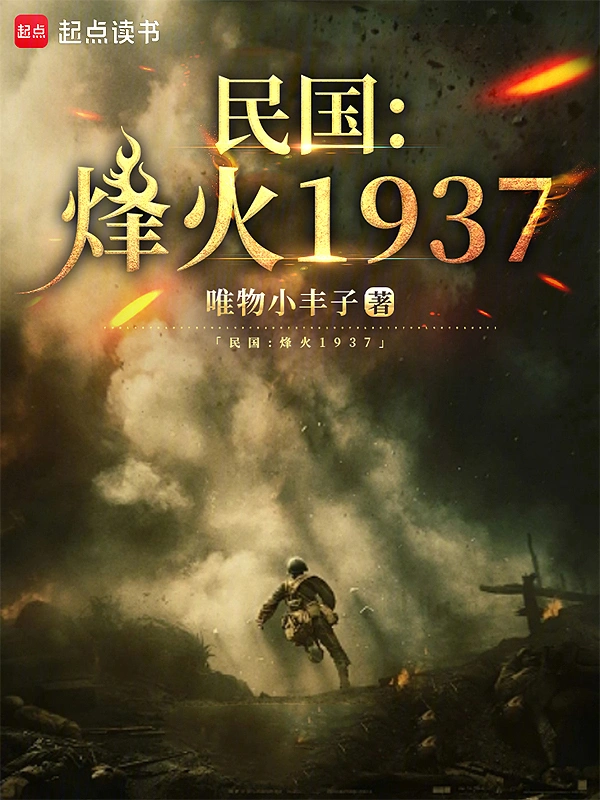
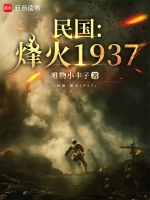
Republic of China: War 1937
民国:烽火1937
- Status
- Ongoing
- Length
- 4.2M Words
- Genre
- Military
- Audience
- Male
- Subgenre
- War of Resistance
- Updated
- 1d ago
- Source
- Qidian
Stats
Tags
Honours
Synopsis
Reader comments
In booklists 9

Starting Point Book List
It is good to relax with poems and books on the pillow, and the scenery in front of the door is beautiful when the rain comes. Here are all kinds of good books worth reading from Qidian. And a single owner who tirelessly recommends good books.

Writing Is King
Includes articles with relatively good writing style, Novels with novel plots can be ordered first. I also like imaginative writing, and you are welcome to recommend books.
History, City, Game, Fantasy; Hilarious, Passionate, Rigorous, Human Nature
2017.07.25:2000 Followers. Book selection criteria: 1. The views on world affairs and human nature are consistent with mine; 2. The writing is smooth and the characters are vivid and distinctive; 3. Books that have led the trend; 4. Recognized by the mainstream, such as good sales performance of physical books and adapted into movies and TV series. Of course, the most important thing is that it belongs to the style I like. There are always some books that suddenly lose contact, reminding me that

Interesting Book List
The writing, writing style, and creativity that I have read are books that I like very much, and I like them personally.

Recipes from an Endangered Bookworm
Personal preferred styles: history, science fiction, urban rebirth, personal themes, and fan fiction.

My Favorites List
I've seen it and I think the ones that look good will be included.
Starting Point Book List
This is a book list

Personal Writing History
Make a bookshelf with grain and above
You Can See Everything
This is a pure private place for people who read all kinds of articles.
Readers also read
 Bright Sword: Play the Entire Game Starting from Northwest Shanxi
 I Traveled Through Liangjian and Copied Equipment at Changjin Lake
 War of Resistance: the Roar of the King of War
 What the Hell Is a Bloody Battle at Hacksaw Ridge When Someone Is in the Special Forces?
 Siheyuan: Start by Picking up Attributes
 My Anti-Japanese War Years
 Republic of China: Ace Pilot
 Beastmaster: I Can See the Evolutionary Path
 Immortal Who Seizes the Body
 Entrepreneurship in the Late Tang Dynasty
 Far East Common Man
 Anti-Japanese War: Beginning with the Battle of Changde
 Fuhan
Fuhan
Update quickly, we can no longer raise pigs
Can't keep any more
The author's quality far exceeded my expectations
I thought it was another anti-Japanese anti-Japanese article from the military channel, but I didn't expect it to be so well written. The various xxx stories about bright swords really left me with a psychological shadow.
Looking at it from the back, it's good. It depicts a scene where a unit in the national military system has to live and die constantly. The frontal battlefield is so cruel, and it is necessary. Without the flesh and blood of two million casualties, there would be no chance of guerrilla warfare, and no chance of receiving the treatment of the Wuchang. The war of resistance is really difficult. There are command aspects, technical aspects, weapons and tactical literacy, and many aspects of morale. Why can hundreds of thousands of people come and go when fighting head-on, but once they retreat, many are hunted down and killed?
It's very normal for this kind of book to be sealed. The hat of historical nihilism is just right
I just watched it, why is the main character called this name? Bamboo Ishiki, 🐷shi, also looks a bit like a Japanese name.
Let's talk about Chiang Kai-shek. He liked to read the family letters of Zeng Wenzhenggong, who was Zeng Guofan. Ministers of the late Qing Dynasty liked to write letters to their families, containing some words of admonition and some great and upright words, and then let people spread them out to gain fame. Chiang Kai-shek liked this kind of thing, which shows the level and character of this person.
The book is a good book, the writing is online, and it describes the Republic of China before and after the All-out Anti-Japanese War very well. But (I also hate this word), as a native, Pig's Foot is unsystematic (in fact, I don't like it either), and he is still a small staff member of the Guo Army. How can he change the situation and save the world? I think it's hard for the author to be imaginative. After all, the Sino-Japanese War at that time was a war between a backward agricultural country and an industrial country. The gap between China and Japan is all-round, but in the final analysis it is the gap between productivity. If the industrial capabilities of China and Japan are similar, I think it is impossible for the small book to occupy most of China in more than a year at the beginning of the war. So I read this book with a very tangled mood. On the one hand, it is a good book, but on the other hand, I feel that it is difficult to write new ideas, because no matter how powerful a pig's trotter is, can it be more powerful than a once-in-five-hundred-year genius like a teacher?
There are too many debuffs in the national government and it is impossible to play without cheating!
The big warlords in the country are piggybacking on the smaller warlords, and the big domestic factions are piggybacking on the smaller factions. Although Japan is an industrial country, it is also a poor imperialist country. Japan also needs to have both land and sea. Leaving the eastern region, without the support of maritime railways and roads, the combat effectiveness and equipment of the Japanese army are not large enough to ignore the numerical advantage. However, after the 412 Qing Dynasty, the grassroots organizations of GM Dang no longer had the ability to mobilize. To be fair, if some idiot hadn't lost the fortress and the government had no time to prepare, Wuhan could still be defended. Japan would have been unable to defeat it in the later stage. If it had not gone south to seize the colonies of Britain, France and the United States, Japan would not have been able to mobilize all the resources.
Spark
The writing is quite good. I read Jinling Thirteen Hairpins the night before yesterday, and suddenly I wanted to read books about the Anti-Japanese War. All the old books have been sealed, and it is rare to see one that is still being written. The better books about this kind of subject are spy wars, and there are very few books about large army operations. Don't be afraid, I will order them all to support you.
I have read a lot of novels about the Republic of China and the Anti-Japanese War. This one can be called a masterpiece of "Born to Death" in the online literary world. The author knows where the red line is and will not run away to Shaanxi just writing about it. We all also know that the ending will be there, one day in 1945. Now I just want to see how the author arranges for the protagonist to make a reasonable exit. The last attack is hit by the last bullet. If the arrangement is reasonable, this is simply a perfect ending. This is a military simulation novel full of desire for survival.
Seeing the author describing the battles of large corps reminded me of a book I read many years ago
I once read a book called "Speculators of the Republic of China" in which the protagonist is named Zhuang Jihua. The author also wrote about the anti-Japanese war by describing the great battlefields, but the author wrote at the time when enrollment in Huangpu was just established. He entered the first phase of Huangpu, fought in the Northern Expedition, and had good relations with people from both the Kuomintang and the Communist Party. He later presided over the construction of Sichuan, and at the same time, he served as the commander of some theaters during the war. The writing is really good. There are political struggles, farm construction, and spy wars. The author also uses large corps to fight to present readers with a magnificent and tragic anti-Japanese scene. That book was written very early, about 10 years ago, but I think it was well written, so much so that I can still remember some details in the book.
Please collect, read, and invest (I want everything hehe)
The new book has ushered in the first round of recommendations, and the reading results are still critical to the development of subsequent books. I hope you will give me your support during the new book period 😁😁 Regarding this book, I also used this post to discuss and exchange some writing ideas with you, hoping to polish the book better. First of all, the positioning of this book must be based on describing the frontal battlefield. This book does not use online writing methods such as time travel, golden fingers, and systems. On the one hand, compared with the military zone that Xiao Fengzi read four years ago, the loss of big guys is serious. Many big guys I am familiar with have stopped updating. Most of the current works are written by the same author, so the book box adopts a more independent copy. , Establishing a new image will allow book lovers to discover some new perspectives and plots when experiencing the story of the Anti-Japanese War. On the other hand, due to the particularity of the theme of the Anti-Japanese War, Xiao Fengzi does not want the protagonist to be a simple king of soldiers, nor does he want the entire war to be like slaughtering pigs and dogs, but hopes to share with book friends the strategy, tactics, economic support, transportation logistics and other elements of the Anti-Japanese War. Finally, I would like to share with you the framework design of the current book. The protagonist Takeshi Qing is an indigenous civil servant. The main plot is actually the process of Takeshi Qing from being a clerk to leading the soldiers in the war of resistance. It is mainly divided into three periods, from the clerk period before the outbreak of the Anti-Japanese War, to the staff period on the eve of the all-out war, to the part where the protagonist leads the troops alone when the Anti-Japanese War further deepens. Since there is no golden finger in this book, a large number of settings have been added to help the protagonist grow, and at the same time, it can also present everyone with a comprehensive perspective of high-level, middle-level, and front-line. In addition, in addition to the battlefield, the book also mentions other elements of the Republic of China, such as economic reform, national logistics system, transportation line construction, institutional reform, the battle between direct and non-direct relatives, etc. Of course, they are all centered on the service of the Anti-Japanese War. Finally, I hope you can read it happily and I hope you can support me a lot. It would be better if you interact with me often 😄😄
It's very difficult to fight on the frontal battlefield. You need to have no shortcomings in all areas to be able to fight smoothly. The only thing that can be most personally controlled is the quality of individual soldiers and mutual cooperation. In addition to equipment, the military quality and fighting will of individual soldiers are also very important components. Especially the national army, which must fight positional warfare. Many times, if you fight head-on, you can still fight for a few rounds, but once you retreat, you will be defeated and easily dealt with. They can't flank like our army.
After reading the current chapter, it can be seen that the author has the idea of writing something beyond the stereotyped anti-war article. First of all, I can feel that the author has a relatively good grasp of the background of the times and some knowledge. This is quite good compared with some pure novels. The perspective chosen by the author is quite special, and there is no big scene battle at the beginning, so the pace of the book is generally slow. Deconstructing the entire Anti-Japanese War from an internal perspective is indeed a very novel point, and it can also bring some other perspectives to readers. So I think the author can continue the current style and be more stable. After all, anti-war articles are not only enjoyable but also emotional for everyone to read.
Is there a member of our party?
The Republic of China is afraid that it will be difficult to recover, and the Kuomintang Party is no longer good at its roots. 🙂 After the war is won, what will the protagonist do?
This book felt average at the beginning, but became more and more attractive after a hundred chapters.
1938 Recommendations for the formation of the Armored Forces of the Teaching Corps:
1. Purchase a large number of cheap Italian cv33/cv35 ultra-light tanks, replace them with Czech zb37 heavy machine guns (which can be removed and recycled after the tank is damaged) and weld on additional armor (required to be able to withstand Japanese 7.7 Machine gun bullets). Each battalion is equipped with an armored support company (12 cvs), and each regiment is equipped with an additional armored support reinforcement company (20 cvs) to strengthen the teaching corps and battalion-level attacks on Japanese infantry and cavalry. Strength 2. If you can still purchase it from Germany, buy a 20mm cannon modification of the Panzer 1 tank and mix it with a cv ultra-light tank 3. If you can purchase it from the Czech Republic, buy an Lt38 light tank to form a separate armored battalion to cooperate with the motorized troops 4. Get more assistance from the Soviet Union, the first choice is the T26 light tank, and form an independent armored regiment with the T26. Motorized units such as the Huben Battalion will cooperate with it for interspersed operations.
Well, I have a hunch that your book will be gone soon.
I just saw this novel, and everyone in the comment section had good reviews. However, I feel that the whole process is a struggle, and I hope to write some seasoning content, such as allowing some soldiers to return to the rear to recuperate, and describing the support of the masses in the rear for the war of resistance and the changes in people's lives.
Fill-in-the-line baby individual weapon improvement plan
Since a protracted war of resistance requires a large number of line-filling babies, a cheap, durable and individual weapon that is good at close combat is particularly important. The first recommendation is the VG1-5 assault rifle historically equipped by Germany at the end of World War II. It has low technical requirements and is easy to manufacture on a large scale. It uses 7.92 Rifle bullets to reduce logistical pressure. Although it has a short range, it is originally used for close combat. It can be widely equipped for line-filling babies In addition, the first choice of light machine gun is the Kai Lali machine gun. The Sichuan Arsenal has originally imitated it. The technical requirements and cost are relatively low. It is suitable for the baby who fills the line, and the ammunition is also 7.92
I just watched the Nanjing Massacre Memorial Hall. A thousand words can be said, but a gentleman's hatred can be avenged in a hundred generations. Don't surrender this time.
Suggestions for upgrading individual equipment of the Teaching Corps in 1938:
1. The civilian 24 heavy machine gun is water-cooled instead of air-cooled. Refer to the civilian 36 heavy machine gun. You can continue to use canvas belts, but the cooling tube uses a square cooling tube similar to mg42 to reduce production costs. This move can reduce the weight of the machine gun, increase the applicability of the machine gun in arid and semi-arid areas, and reduce production costs 2. The imitation zb26 light machine gun removes the heat dissipation ring, and refers to the Boran light machine gun. The 20-round magazine is changed to 30 rounds. If conditions permit, it can use a 100-round ammunition chain. This move can reduce production costs and enhance the fire suppression of the Japanese Type 96 light machine gun 3. Re-imitate the MP18 submachine gun, expand the magazine to 30 rounds and fire it under the gun body (refer to the MP18 imitated by Dagu Arsenal), and change the round cooling tube to a square cooling tube. This move can reduce production costs and strengthen fire suppression against the Japanese army that is not equipped with automatic weapons in large quantities 4. Purchase and imitate large quantities of 60mm mortars and 120mm mortars from the French Brown Company. This move can strengthen the suppression of Japanese grenades (coupled with the imitated 82mm mortar), and the mortar technology does not require high requirements and can be easily imitated 5. Imitation of the German 37mm anti-tank gun to combat the Japanese Xiaodouding war. Che 6. Make great efforts to manufacture and purchase gas masks, at least to ensure that the Central Army can defend against Japanese gas bombs 7. Make your own triangular spurs, which are extremely low-cost and easy to mass produce 8. Make flamethrowers to enhance offensive capabilities.
The starting reward is 20,000 coins. I'm fifth on the list. How much more can I add?
Can I add 20,000 words🙂🙂🙂
Suggestions on the formation of the teaching team
Command Center: Commander-in-Chief, Chief of Staff, Logistics Director, Communications Director, Field Director, etc. The units under the command center: several staff members, about 1,200 people in the supply camp, about 200 people in the communications company, about 50 people in the directly affiliated officer and infantry drill group, which are used for officer supplementation and daily drills and summary of tactics. The central guard force has about 200 people, the central reconnaissance force has about 300 people, the engineer battalion has about 600 people, the directly affiliated field hospital has about 300 people, and the directly affiliated special operations brigade has about 500 people, which are used to penetrate the frontal defeat of the defense line. The heavy artillery regiment is about 2,500 people, (artillery commander) The tank regiment is about 2,000 people, the supplementary infantry regiment is about 2,000 people, the mountain infantry regiment is about 1,500 people, which is better for mountain operations (can (optional) Field regiment (defense depth is 3 kilometers, defense width is 3 to 6 kilometers according to the terrain) It has an infantry commander (commonly known as the regiment leader) Other directly affiliated units Light infantry artillery company, about 150 people are used to cooperate with the rapid maneuvering of the infantry. Three infantry battalions The total strength should be around 3,500 people. The brigade-level command center includes about 500 people including staff surveyors and surveyors. A brigade consists of two to four regiments. (In wartime, the higher-level command center will allocate a certain amount of artillery tanks and other troops to the brigade level for combat) Generally, a brigade with two infantry regiments is enough to use one vanguard and one rearguard to strengthen the brigade's three field regiments, one of which serves as a reserve regiment for operations such as additional personnel. To sum up the above, the training regiment has been integrated. In the case of two brigades and six regiments, about 31,000 personnel, about 8,000 mules and horses, and several motor vehicles are needed (other accessories, long-distance operations require more than 60,000 civilians to cooperate with material transfer, etc., Including material protection troops, etc.). The teaching corps needs to consume more than 5 million kilograms of grain for one month of fighting. The overall food income is about 100 million. The teaching corps's consumption in one month accounts for about 5% of the country's total, not to mention other aspects. Fortunately, we are in peacetime, with all the personnel available, the teaching regiment has a battlefield area of 30 kilometers and a defense depth of more than 15 kilometers. If you have any different opinions or other questions, please let me know.
The writing is really good, and the author has a very deep background, especially the strategic map. I give you a thumbs up👍, this is the only novel that I have introduced the contents of the book to my friends. It's really good. Come on.
I haven't seen it in a long time and I've been hoarding it.
I gave the monthly pass, 20 this month, and subscribed to other books, but I don't think it's worth the monthly pass. Well written, I plan to save one and read it together at the end
Not enough to see not enough to see
I saved more than 60 chapters and read them all in one day 😭
According to the introduction, I am going to Japan. Maybe I will destroy Japan and build a new country, or maybe I will become the Emperor of Japan.
Quick update
Update quickly
I gave all 12 tickets, so there's no problem with adding more details.
Many votes and more votes🙂