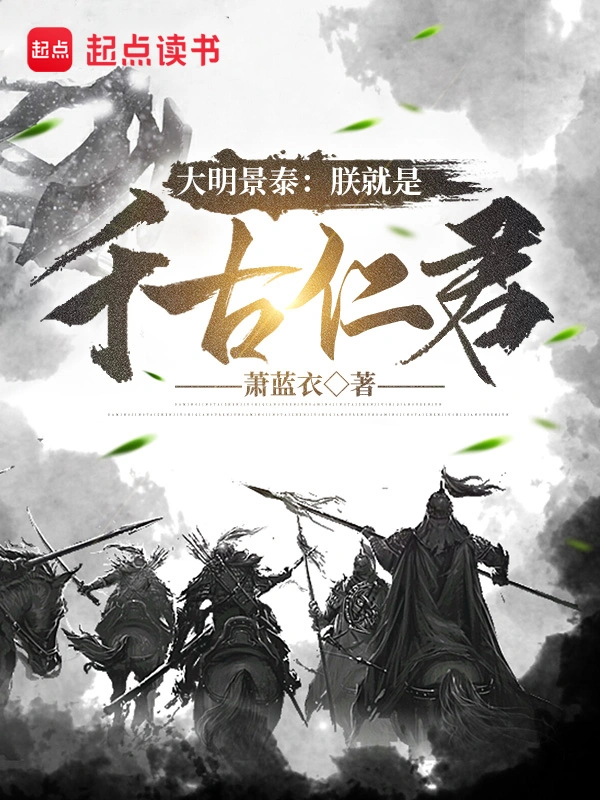
Jingtai of the Ming Dynasty: I Am the Benevolent King of the Ages
大明景泰:朕就是千古仁君
- Status
- Completed
- Length
- 4.5M Words
- Genre
- Historical
- Audience
- Male
- Subgenre
- Song-Yuan-Ming Dynasties
- Updated
- 2y ago
- Source
- Qidian
Stats
1Monthly votes
170.7kRecommends
421.4kFans
499Chapters
Tags
Synopsis
Reader comments
In booklists 1
Readers also read
 An Important Town in the Residual Tang Dynasty
 Chronicles of the Red Mansion
 Corpse Disaster 1916
 In the Ming Dynasty, the Days When the Cows and Horses Turned Over
 Simultaneous Time Travel: Become a Legend Before the Plot Begins
 When I Was in Hongwu, I Started by Rebelling Against the Party.
 Pingyang Fu of Red Mansion
 Start by Saving Manchester United
 All Heavens: Starting from the Dark Dungeon
 The First Uncle of the Ming Dynasty
 Huang Ming
 The Ming Dynasty Started with Taking Zhu Yuanzhang to Visit the Forbidden City.
The minister brought a crossbow into the palace to kill the emperor but was caught, and then went to court the next day without doing anything wrong Don't fall into the trap! Don't fall into the trap! Don't fall into the trap! Hurry up and leave after reading the previous chapters. The author is not writing about the Zhu family in the Ming Dynasty, but about the Cao family and the Sima family in the Wei and Jin Dynasties.
First, this book is likely to be a mess in the end, because the way the plot is handled at the beginning is already the extreme of extremes. After Zhu Qiyu seized the imperial power and completely consolidated his position, how should he arrange the plot? Has he always been fighting in the most intense way with the civil servant group and the noble group? Readers don't like to read it. Obviously the author can't keep writing. Secondly, the author wants to completely abandon the mainstream writing method of historical time-travel novels. He does not engage in time-travel goldfinger or technology-driven military movements. The author strives to show the cruelty of political struggle as "not a treat for dinner", which may give readers a refreshing feeling in the early stage. But as the chapters went on, I found that the author had fallen into a craziness in his writing, completely unaware that political struggle alternates between compromise and struggle, and that the mainstream of political struggle is the exchange of interests. Third, the civil servant group in the Ming Dynasty has not yet formed a climate during this period, and it is not good to weaken the imperial power too much. Although Zhu Qiyu did not have a son, which may prevent the civil servants from generating political impulses for collective speculation, it is still entirely possible to conquer a minority.
To attract good ideas
I'm not professional, just my humble opinion; the protagonist uses military expansion and plundering the population and various resources to feed back the expansion of the empire. First of all, this economic system is deformed and relies on colonies. Secondly, cultural differences are too large, and secondly, information transmission and transportation problems are big troubles. These protagonists are dealing with them, but they feel that under the feudal imperial system, economic methods and productivity may not be able to support the empire. It is also easy for an overly expanded empire to collapse. I felt like this protagonist was difficult to deal with and difficult to write well. The second is personal preference. The protagonist kills too much, which I don't like very much. Although I know that the top-down reforms of feudal monarchs must kill people, but they kill tribes at every turn and emigrate on a large scale... Although he really fits my imagination of a feudal monarch, arbitrary, political machine, diligent and so on. The protagonist uses a knife to force the country to move forward. I think without ideological emancipation or the industrial revolution (this has already taken shape), if the protagonist fails or encounters a heavy setback, he will soon be extinct. The protagonist's reforms have not yet been implemented among the people, and it is still difficult to supervise. I think this is also difficult to write. But I have to admit that the author wrote it very well and I like it very much.
Chapter 294
There was a misunderstanding at the beginning. The Qin, Han, Sui and Tang Dynasties did not pay attention to equipment, but to armaments and physical and mental health. At the end of the Eastern Han Dynasty, there were no fear of millions of refugees at all. Tens of thousands or hundreds of thousands of people were pacified in ten days because they had no armor, no powerful crossbows, and no strong soldiers (that is, the Huanshou Sword at that time was comparable to the hardness of the weapons at that time). When the Yellow Turban army successively captured the city and obtained the crossbows and armors in the treasury, they changed from being unable to withstand a round of crossbows to being able to devour the official army with a huge number.
Chapter 142-147 Lord of the Domain
Seeing that the protagonist finally placed the prince in the fifth server in the capital, and outside the fifth server to make a living on his own, and at the same time let go of the imperial examination, business, and farming of the clan, I still felt that it was not close. After all, the world is too big, and the prince can be returned to the residence when he becomes an adult. All the clan children in the fifth server must be educated in the capital from the age of three. The protagonist can take control of the place if he is tough, and the next generation can follow the rules and regulations, and the next generation after that.
Chapter 124
It's very detailed. It wants to reform but also points out all the shortcomings. For example, if the family does not give money to the daughter, what if it is sold to Goulan? There is also military household land, including the guard station system. If the guard station cannot be evacuated, sometimes it is a panacea and can stabilize the place. In wartime, a group of elites can be selected to accompany the capital camp or recruit troops to move out together.
Chapter 127
It's not bad, it's not bad. Put Beikong in Liaodong to strengthen control, leave Nankong, take back the circle of Zongjiao, and appoint it by the court. Then moving Longhu Mountain to Helan Mountain is also a move. Then will the northwest use Bald Donkey? No matter what, their essence must be left in the mainland. They are cultural hard drives that can restart civilization due to changes in dynasties or invasion from outside.
The author's grasp of the rhythm of emotions makes people constipated
One hundred and twenty-one
It's okay to move the Confucius family. It's too speechless for scholars all over the world to make pilgrimages every year. It's just a novel. In reality, I'm afraid all the gentry in the world have ideas. Isn't Wang Mang Niu Bar still recommended to the aristocratic family? They even punished their own sons for making mistakes. A pilgrimage every five years is good, as long as the population flow can promote accommodation and food along the way.
Chapter eighty-eight
The whole article is very good, but it is a bit unsatisfactory to ask all civil and military officials to open porridge factories. After all, at least half of the officials may only be able to cover their own expenses even if they receive some filial piety, and only the remaining officials can afford to open it. Officials in the Ming Dynasty were not poor for a day or two. Later, the Manchu and Qing dynasties introduced a subsidized salary.
Chapter 193
Yes Treating the clan is a bit exaggerated. If you continue writing like this, the protagonist will become Yang Guang🙂🙂🙂🙂
Chapter 87
Monks and Taoists cannot be beaten to death with a single stroke. Although there are Buddhas in prosperous times and Taoism in troubled times, it is also reflected in one word. Only most people have surplus food and some people have money. Only some people will go to temples to burn incense and worship Buddha. In troubled times, who will be so precarious? Instead, Taoist priests and some orthodox Taoist priests will go down the mountain to eliminate the epidemic. In the Five Dynasties and Ten Kingdoms period, there were also warrior monks who disrupted the government, and the Taiping Dao rebellion in the Eastern Han Dynasty. However, when the nation and the country were in crisis, Taoist priests and monks were also part of the military force, medical personnel, and cultural preservation. During the Japanese Rebellion in the Southeast, there were monks to assist the officers and soldiers, and there were many Taoist priests in the war of resistance. In addition to the Hetao, food issues, Gansu and Jiangnan beyond the Great Wall are said to have developed well, and they will not have nothing. Although Guanlong is becoming increasingly barren, they are exactly where the Yellow River passes. As long as ecological construction is done well, it can return to the state of the original forest in the past. Henan has the Yellow River, but the Ming Dynasty's grain harvest depends entirely on Jiangnan. In the Manchu and Qing Dynasties, it can only rely on Huguang. If the vassal vassal in Henan can be moved to another vassal, it would be best to remove a few core bloodline vassal kings or clan members who no longer have aristocratic status, and then drive all the remaining vassal kings to the Japanese archipelago, Southeast Asia, Central Asia, and North Asia to form vassals, turning North Korea into a country within a country, and doing a simulated ecological observation.
Chapter 211
Improved rations are good, especially fried noodles. We relied on fried flour and frozen potatoes to defeat the sixteen halls of the beautiful country.
Chapter 123
Hahaha, it's good to promote people into the Agricultural Bureau and open Enke. Haha, give me a stick and a sweet date, and planting trees on both sides of the road is good. About planting trees, it reminds me of the famous patriotic general Feng Yuxiang who planted trees. There is also a modern tree king, General Feng Yi, a deputy commander, and the famous founding general of the Eastern Han Dynasty, General Feng Yi. General Zuo Zongtang planted trees while fighting, especially on the roads in the Western Regions.
Chapter one hundred and sixty
The clan kings are not completely useless, it can only be said to be half and half. Many of them are still practicing literature and martial arts, reciting poems, painting, composing music and playing the flute.
Chapter 231
Wouldn't it be nice to knock down Xiaori? They have a very big Silver Mountain there, and there is also a Jinshan Mountain in the Qi Peninsula. As mentioned above, there is also a Jinshan Mountain in Jiangxi.
283
Zhu Yuanzhang's tomb is of great significance in Zijin Mountain. Next to it is Niushou Mountain where Yue Fei fought against the Jin Dynasty. In later generations, Sun Yat-sen was buried in the same mountain.
Chapter One Hundred and Seven
It doesn't feel like there are too many staff, but that many of them are not working seriously. Especially those in the Imperial Academy, so many young people stayed in the capital after the imperial examination, and most of them did not go out to practice. Since there were too many county officials, sons inherited their father's business, so the county magistrate should have sent more Jinshi candidates to the towns and villages to gain experience and rise to the next level of management.
290
If canned food is okay, it can last for three to five months as long as it is sealed well. The difficulty is to vacuum seal it, so that it can last for three to five years. If it is made into canned pickles, it is convenient. First of all, the Western Regions and Mobei will benefit first. It has the crude fiber, vitamins and salt of certain vegetables, which is very attractive to the northwest, which is short of vegetables.
Chapter 251
It would be good to set up the Immigration Bureau under the Ministry of Rites. This will not increase the number of senior officials and avoid bloating the administrative staff.
Chapter eighty-two
Guo Min was defeated and took away descendants of various factions such as Tianshi Mansion and Kong Mansion. He wanted to restrict Kong Mansion, but his sign could not be defeated. Now there are Kongzi Academy all over the world. It is a kind of cultural propaganda, dissemination, education, and now it also spreads Taoist thinking.
291
If so many seeds are needed, will it lead to the invasion of alien species? This is also a big issue in ecological and environmental protection. Many native animals and plants may not be their natural enemies.
281
The author of chapters 280 and 281 has written very well. A arrogant soldier will lose, a sad soldier will win. He also explains the military on paper well, and has a basic thorough understanding of politics and military affairs.
Chapter 122
Cotton seems to be grown most in the northwest. In the western region of Gansu, there is the Bureau of Agriculture. It seems that ancient dynasties had some departments related to agriculture. My country's current cotton planting distribution is as follows: 52% in the Western Region, 20% in the Yellow River Basin, 18% in the Yangtze River Basin, 4% in the North China Plain, and 1% each in the Yangtze-Huaihe Plain, the Liaohe River, the lower reaches of the Yangtze River, and Hainan Island.
Chapter 254
The method of semi-preserving the military household system is quite good.
Chapter 259
You can use Human Emperor to solve this problem.
Chapter 163
The performance is still stable and I really enjoy watching it.
Chapter 184
The Tujia people are also divided into groups. Aren't the local Tujia people and the Hakka people the remnants of the Qin Dynasty of the former Shang Chu state? No one knows whether the Miao people are among the Three Sovereigns and Five Emperors who are capable of running away, and they are also composed of sinners who are running away from Shang and Zhou Dynasties.
Chapter 172
Kudos to Leopard for the writing. The plot is not bad, it's well written. The previous war scenes were quite good in terms of strategy and strategy. In terms of tactics, it's a bit difficult to have so many guns hanging in one go, and several rounds have to be done at close range.
Hongqi River
The idea is that the flow rate is equivalent to a fraction of the Ganges River water and does not affect the water use in other areas. It can then irrigate Shaanxi, Gansu and Ningxia, and the end point is the Western Regions.