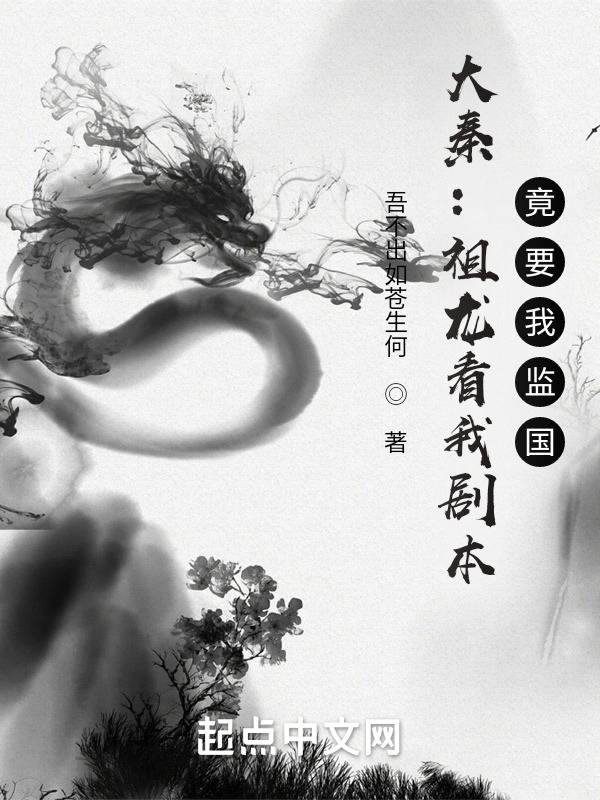
Da Qin: Zu Long Read My Script and Asked Me to Supervise the Country
大秦:祖龙看我剧本,竟要我监国
- Status
- Completed
- Length
- 430k Words
- Genre
- Historical
- Audience
- Male
- Subgenre
- Qin-Han & Three Kingdoms
- Updated
- 3y ago
- Source
- Qidian
Stats
0Monthly votes
5.6kRecommends
14.8kFans
150Chapters
Tags
Synopsis
Reader comments
Readers also read
 1914 Begins with the Rejection of the Schlieffen Plan
 In the Red Mansion: Escort Daiyu to Beijing at the Beginning
 Talker in the Song Dynasty
 Please Call Me Your Majesty the Tsar
 Never Walk Alone!
 After Signing in to the Tang Dynasty for Eighteen Years, I Suddenly Discovered That It Was Journey to the West.
 Fengshen: King Zhou, Please Be a Foolish King!
 Daming: Have I Become Wanli's Portable Grandfather?
 I Am Drawing a Hot-Blooded Episode in the Zhiyu Episode!
 Reborn as a Flat Peach, a Monkey Eavesdropped on Her Heart
 According to the Decree of Emperor Wu Shi, No One Is Allowed to Leave the Milky Way Border.
 Zombie: I Was Dug Out by Uncle Jiu Again
 Douluo: Slaying Dragons for a Thousand Years, Exposed by the Sky
How should I put it? My personal opinion is different. After all the hard work of Pig's Feet, enemies in the same world can enjoy the benefits. Damn it, I can't accept this kind of thing anyway. Personally, all the people who disagree with me will never let them have the opportunity to gain free benefits. Even if I die a hundred years ago, I will never be promoted. That's it, bye.
I was speechless after seeing the order of favor. After Qin Shihuang unified the country, he specifically adopted the county system to abolish the enfeoffment system. What else could the nobles of the Six Kingdoms do to enfeoff? Is it necessary to force the enfeoffment of money?
The First Emperor is immortal, Zhao Gao is just a dog, and Li Si is just a minister.
Dear author, can you tell me where you used to hang out?
You are too strong, really, you are too strong. The first two sections are still five miles, and the next two sections become 5km. 500 miles a day is a speed of 30km/h. Sometimes I really don't understand how you convert the units in it? Can you be more serious about writing a book? Even if you are doing a studio article, you should be more serious, okay? Can't you understand the basic data? Opening an AI code word is more rigorous than what you write.
Where did Qin's horse-drawn trains go? And it's a system. There are too many system documents.
Lu Ban (the originator of Chinese architecture, the originator of carpenters) Lu Ban (507 BC - 444 BC), surnamed Ji, Gongshu surname, named Ban, known as Gongshu Pan, Gongshu Ban, Banshu, respectfully known as Gongshu Zi, also known as Lu Pan or Lu Ban, commonly known as "Lu Ban". The name is Yizhi, a native of Lu during the Spring and Autumn Period. Luban's name has actually become a symbol of the wisdom of the ancient working people. His real name was Gongshu Ban, also known as Lu Ban, Gongshu Pan, Banshu, and his courtesy name was Yizhi. He lived in the period from the late Spring and Autumn Period to the early Warring States Period, and his ethnic group was Huaxia. His birthplace was Lu State. His birth date was 507 BC, and his death date was 444 BC. His main works include the ruler, the ink bucket, and the plane. He was the originator of civil architecture, the originator of carpenters, the founder of the theater troupe, his friend Mozi, and a professional craftsman. Luban, Ji's surname, Gongshu's surname, Ban. Also known as Gongshuzi, Gongshupan, Banshu, and Luban. A native of Lu during the Spring and Autumn Period. "Ban" and "Ban" have the same pronunciation and were commonly used in ancient times, so people often called him Lu Ban. He was born in about the 13th year of King Zhou Jing (507 BC) and died in the 25th year of King Zhending (444 BC). He lived from the late Spring and Autumn Period to the early Warring States Period. He was born in a family of generations of craftsmen. He participated in many civil construction projects with his family since he was a child. He gradually mastered the skills of production labor and accumulated rich practical experience. About 450 BC, he came to Chu from Lu and helped Chu make weapons. He once created a cloud ladder and prepared to attack the Song Dynasty. Mozi traveled thousands of miles from Lu to the capital of Chu State, Ying, for ten days and ten nights. He argued with Lu Ban and the King of Chu and persuaded the King of Chu to stop attacking the Song Dynasty. The hand tools used by carpentry masters, such as drills, planes, shovels, rulers, and ink fountains for marking, are said to have been invented by Lu Ban. The invention of every tool was inspired by Luban's production practice and came out of repeated research and testing. For more than 2,400 years, people have focused on him the collective creations and inventions of the ancient working people. Therefore, the story about his invention and creation is actually the story of the invention and creation of the working people in ancient China. 1. Inventions 1. Woodworking tools Many ancient books such as "Shi Cyan Pearl", "Wu Yuan", and "Ancient History" record that many tools and equipment used in woodworking were invented by him, such as the curved ruler (also called the square or Luban ruler), and the ink fountain, plane, drill, saw and other tools. Legend has it that Luban also invented it. The invention of these woodworking tools freed the craftsmen at that time from primitive and heavy labor, doubled their labor efficiency, and gave civil engineering a new look. Later, in order to commemorate this famous master, people respected him as the ancestor of Chinese civil craftsmen. (1) Saw It is said that the saw was also invented by Lu Ban. In fact, archaeologists have found that humans living in China have been processing and using toothed stone sickles and clam sickles as early as the Neolithic Age. These are the prototypes of saws. Hundreds of years before Lu Ban was born, in the Zhou Dynasty, people were already using copper saws, and the word "saw" had already appeared. It is said that one time when he went into the mountains to cut down trees, he accidentally slipped and his hand was cut by a leaf of a weed, which oozed blood. He took off the leaf and touched it gently. It turned out that there were sharp teeth on both sides of the leaf. He used these dense teeth to lightly scratch the back of his hand, and actually cut a gash. His hand was scratched by these small teeth, and Lu Ban was inspired by this incident. He thought that if he had such a toothed tool, wouldn't he be able to saw through trees quickly? So, after many experiments, he finally invented a sharp saw, which greatly improved work efficiency. (2) Curved ruler The earliest name of the curved ruler is "moment", also known as Luban ruler. Legend has it that it was invented by Luban. "Mozi - Tianzhi 1" said: "The wheelwright uses his rules to measure the circumference of the world." Rules are compasses and curved rulers. The curved ruler is composed of a ruler handle and a ruler wing, which are perpendicular to each other at right angles. The ruler handle is as short as one foot and is mainly used for measuring. The ruler wings are of varying length, with the longest being twice as long as the ruler handle. It is mainly used for measuring right angles and balancing lines. Carpenters use a ruler to measure right angles, planes, lengths and even balance lines. (3) Ink fountain The ink fountain is a tool used by carpenters to stretch threads. It is said that it was invented by Lu Ban. This tool uses a bucket-shaped box to store ink. One end of the string is passed through the ink hole for dyeing. The end of the dyed string is a small wooden hook, which is called "Ban Mu". It is said that it was invented by Lu Ban's mother. The class mother is usually about one inch above the ground. After fixation, the dyed wire rope is bounced toward the ground, and the construction site uses this as the horizontal line standard. You can also fix the bracket at a high place, hang the ink fountain, and use the weight of the ink fountain as a force to bounce the dyed thread toward the wall, using this as the straight line standard for the facade. Later, the master mason used a bucket line to determine the shape of the collected rocks, and then used other tools to knock off the unnecessary parts to form the required shapes of ashlar, feldspar and other stones. 2. Ancient Weapons Hooks and ladders were commonly used weapons in the late Spring and Autumn Period. "Mozi Lu Wen" records that Lu Ban transformed the hook into a "hook strong" for boat warfare. The Chu army used this weapon to engage in water battles with the Yue army. When the overship was retreating, it would hook it, and when the overship was attacking, it would be pushed back. "Mozi Gongshu" records that he transformed the ladder into a cloud ladder that could stand in the air and used it to attack cities. (1) Cloud ladder The cloud ladder is an instrument used in ancient sieges. Legend has it that it was invented by Lu Ban. The following are relevant records: "Mozi Gongshu" records: "Gongshu Pan is a tool used by Chu to build cloud ladders. If it is completed, it will attack Song Dynasty." "Warring States Policy: Gongshu Pan Sets Up the Rules for Chu" writes that when Mozi went to see Gongshu Pan, he said: "I heard that Gongshu Pan was a ladder to the clouds." "Huainanzi" says: Luban is Gongshuban, a native of Chu. He is a skillful man of the emperor, who can make a ladder. Xu Shen notes in "Huainanzi Military Training": "The cloud ladder can stand on the clouds, so it can overlook the enemy's city." (2) Gouqiang "Gouqiang" is also called "Gouji" and "Gouju". It is a fighting tool used in ancient water warfare. It can hook or hinder enemy warships. Legend has it that it was invented by Lu Ban. The following are various related records. "Mozi Lu Wen": "In the past, the Chu people and the Yue people had a boat battle on the river. The Chu people advanced with the current and retreated against it. They advanced when they saw the advantages and retreated when they saw the disadvantages. The Yue people advanced against the current and retreated with the current. They advanced when they saw the advantages and retreated quickly when they saw the disadvantages. The Yue people were therefore in trouble and defeated the Chu people. Gongshu traveled to Chu from the south of Lu, and he started to fight in boats. The weapon is used as a preparation for strong hooks. Those who retreat are hooked, and those who are advancing are strengthened. The strength of the hook is used to control the soldiers. Chu's soldiers are disciplined, but Yue's soldiers are not disciplined. Therefore, the Chu people are in a state of defeat and the Yue people are defeated." 3. Agricultural Machinery The invention and adoption of advanced agricultural machinery and tools is one of the important conditions for the development of agriculture in ancient China. "Shiben" said that Luban made stones, and "Wuyuan·Qiyuan" also said that he made rice hullers, mills, and rollers. These grain processing machinery were very advanced at the time. In addition, "Ancient History" records that Luban made a shovel. Stone Mill According to records in the "Shiben", the stone mill was also invented by Lu Ban. Legend has it that Lu Ban used two relatively hard round stones, each of which was cut into dense shallow grooves, put them together, turned them with human or animal power, and ground the rice flour into powder. This is what we call a mill. Before this, people processed grain by placing grains in a stone mortar and pounding them with a pestle. The invention of the mill changed the up and down motion of the pestle and mortar into a rotational motion, turning the intermittent work of the pestle and mortar into continuous work. This greatly reduced labor intensity and improved production efficiency. This was a major advancement in ancient grain processing tools. The actual situation of Lu Ban's invention of the grinding mill has been unknown, but judging from archaeological excavations, pestles and mortars were already in existence during the Longshan Culture period (about 4,000 years ago), so it is possible that the grinding mill was invented in Lu Ban's time. 4. Other inventions (1) Mechanical Seal "Book of Rites·Tan Gong" records that he designed a "mechanical seal" to bury Ji Kangzi's mother using a mechanical method. His skills are convincing. However, thick burials were prevalent at that time, and this method was not adopted. (2) Carving "Shu Yi Ji" records that Lu Ban once carved the "Kiuzhou Map" on stone, which is probably the earliest stone map. In addition, it is said that Luban carved an exquisite stone phoenix in ancient times. (3) Umbrella Lu Ban's wife is also said to be an outstanding craftsman. It is said that she invented the umbrella. Legend has it that Lu Ban's wife Yun felt pity for Lu Ban working in the wind, rain and scorching sun. She saw that the pavilion could provide shelter from the rain and shade, so she came up with a movable pavilion for Lu Ban to take with her and made an umbrella. (4) Well digging "The ancients dug water through the ground and used bottles to draw it, which was called a well." It is said that the first person to dig out water underground was Emperor Shun; the first person to dig a deep well in a mountainous area was Lu Ban, the "sacred ancestor of all craftsmen". Perhaps people desire "Yao Tian and Shun Day" more than anything else. So far, many people recite Shun Well, but few people pay attention to Luban Well. Water from afar cannot quench the thirst that is near. Humanity's demand for water has always relied on rivers to "drink" from rivers and lakes to "drink" from lakes. Those who do not rely on rivers or lakes have to "fetch water through the ground." The early water wells were very unsophisticated, with a large mouth and a small bottom, neither square nor round. At best, it could only be regarded as an emergency water pit for "digting a well when thirsty". It was Lu Ban who invented the technique of digging wells, which led to the emergence of stone wells with stone walls, brick wells with brick walls, pottery wells with pottery rings, ash wells beaten with sand and ash, and wooden wells with wood frames. Only then did we learn how to build well platforms to prevent the inflow of sewage and build well pavilions. Legend: The pulley for pulling water was also invented by Lu Ban. When Lu Ban saw the villagers carrying earthen pots on one end and a ball of well rope on the other and walking up to the well platform, pumping and pumping for a long time without being able to lift a jar of water, he felt that the villagers were working too hard, so he thought a lot and came up with a pulley for pulling water. (5) Lock key There was a simple lock key in the time of King Mu of Zhou Dynasty, which was shaped like a fish. The lock key improved by Lu Ban is shaped like a worm, with a mechanism inside, which can only be opened with the key, and can replace human guarding.
If there is no chapter 500 next time, I will never subscribe.
If Qin Shihuang had lived longer, it is estimated that Qin I died in the history books. The more we understand this dynasty, the more contradictory it becomes.
Can you see other people's lives being taken away from you?
The next book will be about the Tang Dynasty, about Li Shouyi (Prince Zhanghuai Li Xian) who saved Li Xian's life, revived the Tang Dynasty and prevented the Anshi Rebellion from happening.
Didn't we say that at the low martial arts stage, Eunuch Cao was the great master?
Come on, author! Waiting for it to be released. Say no to piracy!
I originally saw Taneda, the protagonist is Fusu, and there are elements of civilization. I felt that I could continue reading this novel. However, as I read it, I felt that one person was shocked and then the next person was shocked. One thing was shocking, and the next thing was shocking... I was shocked for half the book, and I really couldn't read it.