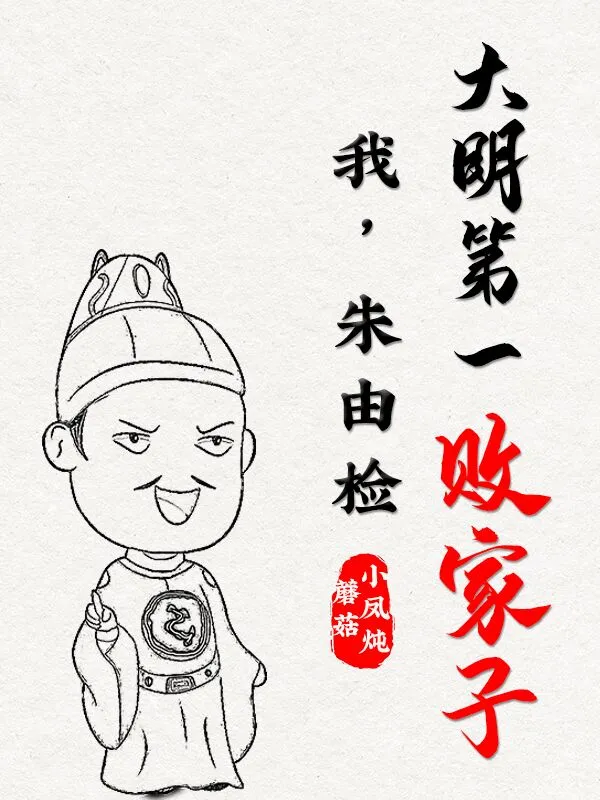
I, Zhu Youjian: the Most Prodigal Son of the Ming Dynasty
我,朱由检:大明第一败家子
- Status
- Ongoing
- Length
- 893k Words
- Genre
- Historical
- Audience
- Male
- Subgenre
- Alternate History
- Updated
- 3y ago
- Source
- Qidian
Stats
Tags
Synopsis
Reader comments
In booklists 48
Explore more →
Enjoy Your Reading Journey!
Start a reading journey!

What to Do If There Is a Shortage of Books?
Then read a book.


Internet Articles Are Also In-Depth
Mainly those articles that have had some impact on my ideas and caused me to think about life.

The Distance Between People and Books
Read more and read good books!
Classic Revisited!
A classic is a classic because you never get tired of reading it!
Collection of Grass Jelly! !
Some good novel recommendations


Happy Life Book List
Happy reading, happy life
Excellent Online Works Worth Reading on Your Bookshelf
Excellent online works worth reading on your bookshelf
Relaxing Article
The purpose of reading novels is to relax. I would like to recommend some good books that are relaxing and have good plots.
Relieve Anxiety
Relieve anxiety and calm the mind


Mushroom House of Small Mushrooms
Some books I read!
The Past! ! !
The novels I read back then.


The Wonderful Life of Xianyu
Personally I think it's wonderful

A Classic Written Down by a Cute Newbie
There are many good books that have been forgotten because of bad titles, self-disclosure, etc., So I wrote down some of my favorite good books to make a book list, hoping that more people would pay attention to these books. This list only promotes science fiction, fantasy, time travel, etc.
Deep in Memory, the Bookstore at the End of the Alley
Tell the story of the past.

My Exclusive Collection
The books recommended here are all on my bookshelf at one time or now.
A Bookworm's Book List, Recommending Your Favorite Books
May be relatively niche



All I Want Is Pleasure
I have been reading articles for so long, and although there are many very good articles, the ones that I like the most are the ones that are written with joy and joy.
On Brain Holes and New Ways to Fill Them
As the title says, this book gives priority to the new ideas contained in the book
Classics Read
I have to say that the old book is still well written.

Early Summer of That Year.
Reading started that summer.
Holding a Book and Sipping Tea.
Have a sip of old tea and read an old book!
Some Novels That I Have Read Many Times
There is a kind of novel that I still find wonderful after reading it many times. There is a kind of novel that makes you tired of reading it after reading it more than once.

It Is Better to Lack Than to Overdo
Focus on quality, not quantity!
Readers also read
 After Lying in Bed for Three Years, He Was Forced to Help the Han Dynasty
 Red Mansion: Start Escaping and Farming from the Equipment Bar
 Fu Ming 1627
 Northern Qi, Sage Khan
 Master, Adventurer and Woman
 Liu Xie: I Really Just Want to Give In!
 Travel Through the Ming Dynasty and Become a Tyrant
 Only I Can See Romance Game Announcements
 Starting from the Second Generation of Immortals
 Ming Dynasty: My Brother Zhu Yuanzhang, I Founded the United States
 Grand Military Division Alliance
 Ming Dynasty Started with Caution
When Emperor Chongzhen came to the throne, the problems he faced were actually not too serious. The Ming army's combat effectiveness was quite good. If the problems of corruption, party strife, and refugees could be solved, they could completely suppress the hundreds of thousands of slave cavalry in Liaodong and fight to death! The problem is that a large amount of money and food are concentrated in the hands of officials and wealthy households (actually the bosses behind them are officials at all levels), and the relationship between monarch and ministers is extremely chaotic. The emperor is actually dancing on an egg. If you don't pay attention, you may be beaten! Maybe he will be killed directly by the civil servant group and the eunuchs. Balancing the officialdom, producing food, making money, stimulating domestic demand and carrying out construction, if these are balanced, then we can probably go to war abroad, right? Don't use pretense and slap in the face in historical articles. It actually feels the best. A normal enjoyable novel is a story, and the characters are really enjoyable when they make people enjoy themselves as they develop. Overall, I feel that this book is my bread and butter. The protagonist's actions are logical and the villain does not forcefully suppress his intelligence (the most important thing), haha😄😄😄😄
A few days ago on the Internet, Chongzhen attached great importance to science and technology. At that time, what were Chinese scholars studying? In terms of astronomy, Galileo's counterpart is China's Xu Guangqi. Xu Guangqi (1562-1633) and Galileo (1564-1642) were figures of the same period, but their fates were quite different. With the support of Chongzhen, Xu Guangqi presided over the completion of the "Chongzhen Almanac", known as the "European Encyclopedia of Classical Astronomy", which referred to astronomical knowledge that was still very new in Europe and was not fully accepted: Kepler's "On the Harmony of the Universe" in 1619;  And uses a third of the page to introduce Tycho's solar system structure system in a theoretical way, and the calculation method uses the modern Western geometric methods of Copernicus and Kepler. The "Chongzhen Almanac" was revised and completed in 1634. A year earlier, in 1633, in the West, Galileo, known as one of the founders of modern science, was sentenced to life imprisonment by the Holy See. His later years were extremely miserable. When Xu Guangqi presided over the revision work, he served as "Dongge Bachelor" and "Wenyuange Bachelor". This is a comparison of astronomy between the West and the Chinese Ming Dynasty. It can be said that Emperor Chongzhen of the Chinese Ming Dynasty supported astronomy far more than Europe.  This "Chongzhen Almanac", which is a culmination of all the classics of European astronomy, not only represents the academic achievements of "the spread of Western learning to the east", but also represents China's acceptance of Western astronomy, and what is even more valuable is that this is not yet possible in Europe. Descartes conducted research on thinking methods and wrote "The Rules for the Guidance of the Mind" in 1628. However, due to the influence of religious forces at the time, he did not publish it during his lifetime. In 1629, Descartes moved to the Netherlands, where the bourgeoisie had taken power. He originally wanted to introduce his ideas in a book entitled "The World". However, in 1633, when the book was still being edited, he learned that the authorities of the Italian Church declared Galileo guilty because he supported Copernicus' heliocentric theory. Although Descartes was not persecuted by the Catholic authorities in the Netherlands, he decided to proceed cautiously and put the manuscript in a box, because in the book he also defended Copernicus's theory. After that, he lived in seclusion in the Netherlands for 20 years. Comparing the Ming Dynasty of China with the support of Emperor Chongzhen in compiling the "Chongzhen Almanac", which not only supported Copernicus' heliocentric theory, but also affirmed it as the core theory, it is clear at a glance which environment for scientific development was better between China and the West at that time. Boyle was born in an Irish Protestant family in 1627. He was also an admirer of Galileo. Galileo died in Achtri in 1642. Boyle was living in nearby Florence at the time. When he inquired about the news of Galileo's death, he was shocked and saddened, and began to study Galileo's work in detail. During this period, he firmly believed that a set of scientific methods must be used to understand things. From then on, he entered the field of scientific research resolutely. At this time, the Chinese Ming Dynasty government in 1634 revised and completed the "Chongzhen Almanac", which detailed Galileo's work, for 8 years.  Pascal was born in France on June 19, 1623. He began to study geometry at the age of 12 and read through Euclid's "Elements". That was in 1635, and at that time "Elements" had been introduced to China. The person who translated it was Xu Guangqi, who later served as the Grand Bachelor of Dongge and Wenyuange. At that time, intellectuals in the Ming Dynasty had generally been exposed to Western scientific textbooks. In the study of mathematics, the more intellectuals with a rich traditional culture, the more in-depth their research was. Take the famous Fang family in Tongcheng as an example. The Fang family inherited Cheng-Zhu Neo-Confucianism, which is one of the important representatives of traditional Chinese culture. "By the time Fang Yizhi's great-grandfather Fang Xuejian came, the Fang family began to accept Wang Yangming's philosophy of mind. The Fang family was an important descendant of Wang Yangming's philosophy in the southeast region." (Yu Ling's "1629, When China Faced Western Science") This is enough to show that the Fang family has a heavy mantle of Chinese culture. "Fang Yizhi's grandfather Fang Dazhen and father Fang Kongzhen both studied Western astronomy. He once studied under the Italian missionary Xiong Sanba. His book "Chongzhen Almanac" was an important astronomical work in the late Ming Dynasty. Fang Yizhi had close friendship with many missionaries such as Tang Ruowang and Bi Fangji, and his "Little Knowledge of Physics" is particularly outstanding. Fang Yizhi was particularly outstanding. The son of Zhi, Fang Zhongtong, studied under the Polish Munige, and his mathematical monograph "Several Derivatives" systematically introduced the theory and application of logarithms." (Yuling's "1629, When China Faced Western Science") All this shows that Fang, who has a rich Chinese cultural heritage, did not reject Western learning, but was a master of Western learning at that time. The scientific giant Isaac Newton, the great scientist and founder of the classical physics theoretical system, was born on January 4, 1643, in a family of yeoman farmers in Lincolnshire, England. As an adult, he became a great figure in physics and founded a magnificent physics kingdom, whose influence is still far-reaching today. But at this time, the Ming Dynasty was already in great danger, and it perished in 1644, not long after Newton was born.  After the fall of the Ming Dynasty, Leibniz, a German mathematician, natural scientist, and philosopher, was born in 1646. At this point in the introduction, you can notice a problem. From the lives of the aforementioned founders of Western science, Galileo, Descartes, Pascal, Boyle, Newton, and Leibniz, we can see that the ideas of Galileo and Descartes were suppressed in Europe at that time. The academic achievements of Pascal and Boyle were formed after the demise of the Ming Dynasty. Newton was still a newborn baby when the Ming Dynasty collapsed, and Leibniz was born after the demise of the Ming Dynasty. This means that when the Ming Dynasty fell, it was the eve of the great development of Western theory. In the Ming Dynasty, the vast class of scholar-bureaucrats had begun to study Western learning in general. The "Western learning" at that time was very different from the "Western learning" that was later introduced to China. , Because the West at the end of the Ming Dynasty was still on the eve of the great theoretical development, and China and the West had their own strengths and weaknesses in scientific development. During the Ming Dynasty in China, especially in the 67 years of the late Ming Dynasty, many systematic world-class works were produced: Li Shi Zhen's "Compendium of Materia Medica" (1578), Zhu Zaiyu's "New Theory of Legal Studies" (1584); Pan Jixun's "A View of River Defense" (1590); Cheng Dawei's "Algorithm of the Unification of the Zong" (1592); Tu Benjiu's "Fujian Haicuoshu" "(1596); Xu Guangqi's "Agricultural Policy Complete Book" (1633); Song Yingxing's "Tiangong Kaiwu" (1637); Xu Xiake's "Xu Xiake's Travel Notes" (1640); Wu Youxing's "On Plague" (1642). These works appeared one after another in the 67 years of the late Ming Dynasty. Compared with the West where "modern mathematics, modern chemistry, modern physics, and modern philosophy" have not yet developed, they are quite bright. Before 1643, the development of Western science and technology was still very unclear. Newton and Leibniz were not yet born, Boyle and Pascal were just young children, Galileo was sentenced to life imprisonment, and Descartes lived in seclusion in the Netherlands. During the same period, the Ming Dynasty had reached a peak of the spread of Western learning to the east. The academic environment was open and official support was available. The scholar-bureaucrats generally accepted and studied Western learning. Translation was also at its peak. A total of 7,000 Western books entered China. The nine systematic scientific works written by the scholar-officials of the Ming Dynasty in the 67th year of the late Ming Dynasty were just mentioned: "Compendium of Materia Medica", "New Theory of Legal Studies", "A List of River Defenses", "Algorithm Unification of Zongs", "Fujian Zhonghai Cuo Shu", "Agricultural Administration Complete Book", "Tiangong Kaiwu", "Tiangong Kaiwu" "Xu Xiake's Travels" and "On Plagues", and among the translated books are:  "Ten Books on Architecture" by the ancient Roman architect Vitruvius; "Ten Books on Architecture" by the Dutch mathematician and military engineer Simon Steffen "Mathematical Notes"; German mining and metallurgist George Bauer's epoch-making masterpiece "Mining and Metallurgy Encyclopedia" (a total of 12 "Volume)"; Italian engineering and technical expert Rameri's "Various Exquisite Mechanical Devices"; Cologne edition of "Original" (Latin text) in 1611; Jacob Roy's "Comprehensive Meaning of Measurement"; Copernicus's "On the Revolutions of Celestial Bodies"; Kepler's "Summa of Copernicus' Astronomy"; 1601 Roman edition of "Mediterranean Navigation"; "Explanation of Proportions"; "The Circumference of the Earth and Its Circumference" "The Relationship between Diameters"; "The Cosmograph" by Jacques Besson; "The Manufacture and Usage of the Geometric Astronomical Radiometer Invented by Pierre + Lecomte for Land and Sea Dual Use"; "Measurement of Magnets" by Guillaume de Notonnier; "Magic Emetics" by Sarah Angelou; "The Theory of the Causes of the Salinity of the Atlantic, Mediterranean and Other Oceans, and the Causes of Ebb and Flow Currents" by Claude Julei... More than 7,000 volumes. In the exchange of Western learning spreading eastward, the scholar-officials of the Ming Dynasty in China systematically introduced Western learning based on their understanding of Western learning. The works include "Chongzhen Lishu Yue", "Little Knowledge of Physics", "Shuduyan", "Famous Theory Exploration", "Huan Youquan", "Taixi Water Law Preface", and "Measurement Method" , "Kun Yu Ge Zhi", "Xuan Yu Dia", "On Geometry", "Usage of Geometry", "Taixi Calculation Essentials", "Western Confucian Ear and Eyes", "Distant Mirror Theory", "Far West Wonderful Instruments Illustration", "Educational Debate", "Sun, Moon and Star Dial Style", "Hungai Tongxian Diagram", "Jingtian Gai"... And so on. It can be seen that Chinese civilization is not without opportunities to synchronize with the West. At the same time as the development of Western theories, the scholar-officials of the Ming Dynasty in China have begun to comprehensively and systematically accept and study Western learning, and have their own unique insights. Although the West is the birthplace of Western learning, the church's restriction of ideas is in sharp contrast with the Ming Dynasty government's strong support for the development of science and technology.  Unfortunately, in the 10 years from the completion of the "Chongzhen Almanac" in 1634 to the demise of the Ming Dynasty in 1644, wars, natural and man-made disasters were rampant, and then the Manchus entered the pass. China's intellectuals had no intention of "scientific and technological revolution" and devoted themselves to fighting against the Qing Dynasty and restoring the Ming Dynasty, but most of them died unexpectedly. After the Qing Dynasty entered the country, in order to consolidate its rule, it launched literary inquisition and brutally persecuted the Ming Dynasty scholar-bureaucrats. When we look back at the history of the Ming Dynasty, we will see that we also had the prelude to the scientific and technological revolution and the era of great navigation. Traditional Chinese culture did not reject Western learning. The Ming Dynasty conducted valuable explorations in important fields such as navigation, foundry, geographical discovery, astronomical research, mathematics, physics, etc., And achieved amazing achievements. Unfortunately, in the more than two hundred years after the demise of the Ming Dynasty, China The Chinese civilization has suffered an unprecedented setback. The national humiliation of the past century is very sad. Some people even think that there is something wrong with the Chinese civilization itself. We must note that this misunderstanding is wrong. The Chinese civilization is broad and profound and has never rejected science and technology and progressive ideas. This misunderstanding is a lie fabricated by some people with ulterior motives to cover up historical facts. This is very shameful and hateful!
This is a good book. No writing or writing stories. Just from a new angle, describe a new idea. This shows the author's talent. I have read a lot of historical articles. Difficult angles, various literary talents. Quite a few. But I only love those authors who have some novel ideas. Hate those authors who copy stories. 1. To kill those who are on the right path and violate harmony, no one. There has never been a bloody and angry person. The city is full of corrupt officials, and the country is full of profiteering officials. Is there no one who can learn from the Manchu Qing Dynasty? We Han people have never lacked courage! 2. Those who play with means and technology. To be honest, this type of movie is very boring and can't be watched without thinking. It's not about rational logic or anything like that. You have not proven your martial prowess. You are competing against a group of old yin. Do you really think you can play it? Still in such a bad situation. 3. The difference between the author of this article lies in taking advantage of the situation. It is better to block than to open up. This is a brilliant political method. Of course, the rationality still needs to be discussed. 4. The most annoying thing is to go back and make muskets and train troops. It's not a question of whether you can win or not. I don't dare to fight! Everything you build will be sold. Can't see the essence of the problem at all. 5. The essence of the late Ming Dynasty was paralysis of the lower body. The emperor ordered not to leave the capital. 6. Finally, those who want to overcome others. The biggest problem is a crisis of confidence. This problem is not something that cannot be changed. But from the moment Chongzhen came to power, Ming Dynasty lost the opportunity to change. 7. Think about the invasion of the Eight-Power Allied Forces and the behavior of the people. You will know. Do not quickly unify the upper levels, clean the middle levels, and take over the lower levels. Then Ming will perish. 8. In other words, back to the end of the Ming Dynasty, there was only a bloodbath for the upper class, promotion of the middle class, taking over the local areas, a bloodbath for the rich and powerful, and a takeover of the lower class. Only then do you have the opportunity to change your destiny. Otherwise, no matter how you play, there will be no chance. Compromise for a few years at most. Then the people dedicated the city. Because there is no food. It's that simple.
During the seventeenth year of Chongzhen in the Ming Dynasty, there were internal and external troubles, successive years of famine, corruption in the court, corruption among officials, and a lack of military discipline. There are Jiannu slaves outside who are watching, and there are thieves inside who are causing trouble. Coupled with the general environment of Xiaobinghe, and the headstrong nature of Emperor Chongzhen Zhu Youjian, who was suspicious by nature, cruel and easy to kill... There is basically no solution! ! If we change to another emperor, maybe we can save it. But Emperor Chongzhen, forget it, he is really not good. The first thing he did when he came to power was to kill Wei Zhongxian. It was simply a stupid move among the stupidest! The result is that the Donglin Party members who are ruining the country with empty talk are allowed to take control of the government and turn a hand that is already broken into a pile of shit! (Purely personal opinion)
The reason why Wanli appointed eunuchs to go to local areas to plunder, instead of relying on the bureaucracy, the traditional governing base of the Qin state, was precisely because he was dissatisfied with the criticism of imperial power within the bureaucracy. He would rather leave a large number of central and local officials vacant for a long time, and would rather such vacancies seriously affect the daily operation of government affairs than fill the vacancies. In contrast, he preferred eunuchs, who were more loyal agents of imperial power than the bureaucracy. Although in the process of plundering mining taxes, the amount of money embezzled by the eunuchs was several times the final income of the imperial power (more than 5.6 Million taels of silver) - the degree of corruption by eunuchs in different places varied, and generally speaking, it was between 3 and 10 times. This path of the Qin system reached a further level in the Age of Apocalypse - the eunuch Wei Zhongxian took control of violent institutions such as the army, Dongchang and Jinyiwei, and became a more powerful agent of imperial power. The conflict between the Donglin Party and the imperial power has also entered a more extreme stage (the Donglin Party does not oppose the imperial power, but advocates transforming the imperial power and reshaping the political system of the Ming Dynasty). The so-called Tianqi Dynasty's "all-powerful dynasty" actually lasted only less than two years. In the second year of Tianqi, Wei Zhongxian had become powerful and began to suppress the bureaucracy. In the fifth year of Tianqi, the "Prison of the Six Gentlemen of Donglin" occurred, and the "Prison of the Seven Gentlemen of Donglin" occurred the following year... Donglin Party members were continuously exiled and killed, and all the academies in the world were destroyed. During the Chongzhen era, the Donglin Party was already dilapidated, and even more so during the Nanming era. The active ones were mainly the opposition Fushe people. The fate of these people is roughly similar to that of the Age of Apocalypse. Although Chongzhen eradicated Wei Zhongxian, the Donglin Party was just a tool he used to embellish the court. He still preferred to choose eunuchs as his agents - using eunuchs to control the bureaucracy and using a limited number of Donglin Party members to embellish the bureaucracy was what Chongzhen considered to be a "more pragmatic" approach. Until the demise of the Ming Dynasty (including Nanming), the "Donglin Party" (including Yuxu Fushe) was committed to expanding its voice, but it did not form a truly powerful political force. Facing the imperial power and the eunuch party, the institutionalized agent of imperial power, the Donglin Party was always in a vulnerable state. Attributing the responsibility for the country's demise to a man who never had the opportunity to govern - some people believe that the Donglin Party members of the Tianqi Dynasty, the Chongzhen Dynasty and even the Nanming Dynasty got the opportunity to actually govern. This is pure nonsense. The Tianqi Dynasty was "full of people" It was extremely short-lived, and the Donglin Party members in the Chongzhen Dynasty were just embellishments. In the Southern Ming Dynasty, it was the warlords who really controlled the current situation - a loose organization of comrades. This is undoubtedly not an objective attitude in reviewing history (of course, if the Donglin Party has the opportunity to govern, it may not be able to deal with civil unrest and foreign enemies). Therefore, the Japanese scholar Kazuko Ono wrote in the book "A Study of the Party and Society of the Ming Dynasty": "The Ming Dynasty died at the hands of the eunuchs rather than party strife." The imperial power used the eunuchs to govern the country. Although it was more hands-on than using the bureaucratic group to govern the country, it also caused internal divisions between the ruling group-the eunuchs and the bureaucrats. From the founding of the Northern Song Dynasty to Yuanyou, more than 130 years ago, there were only 51 prime ministers. In the 17 years of Chongzhen's reign, there were 50 chief assistants. At the same time, 7 governors and 11 governors were killed. When the imperial power ravages the bureaucracy in this way, the bureaucrats will no longer regard the imperial power as a community of interests. It is inevitable that they will be passive and slack in governance, and it is also inevitable to weaken the dominance of the Qin regime. In other words: If there really is a "party struggle that subjugates the country," then it is the imperial power itself that instigates this party struggle and turns political differences into political killings. But Emperor Chongzhen was unwilling to admit this. His famous saying was "I am not the king of the subjugated country, but all the ministers are the ministers of the subjugated country."
Looking at those things in the Ming Dynasty, we know that Wei Zhongxian is very bad. Why not kill Wei Zhongxian?
Mingmen, Jiajing, Wanli, I'm sorry we all lost to you🤪
Don't keep it, it's easy to die now, even if you keep it to the latest chapter
A new book is set sail, drinks are served and people are asked for tickets, collections and readings.
I want to say that the most prodigal son of the Ming Dynasty was not Chongzhen, but Yingzong. After three generations of accumulation, he was defeated in one battle.
Zhu Youxiao can still watch Zhu Youjian. If you move today's China to Zhu Youjian, you will be played by him. Pigs have more brains than him, they are both good and fun-loving.
It is too easy to lose one's family. If you go to the Jurchen and kneel down to offer the Ming Dynasty, the value of losing one's family will definitely be much greater.
Tiantian feels good about himself. Every chapter shows that Daming is hopeless. Why don't you just give up your position to others? Wouldn't your prodigal fortune explode in this way? What could be more wasteful than thousands of miles of wealth?
This type of novel relies entirely on the imagination of civil and military officials, who overly speculate whether what Emperor Chongzhen said was irony or the truth. Scare yourself, just like Chongzhen said before, let go and enjoy, and the civil and military officials made up their minds. Now the Ming Dynasty is like this. The emperor said something ironic, and then he didn't dare to overeat. . .
This author has understanding and can write well
It's a good angle to write official history backwards. The significance of looking back at history is not inheritance, but pursuit, avoidance and breakthrough. Hold on, don't let it go to waste 🪖
The opening is the steam engine. What is needed for a steam engine is not written. Nor was it directly invented. At the very least, sealant! How to solve it. You dare to load an unstable thing into the ship. Wooden boat equipped with steam engine. . . . You are a talent. . . Welcome to Gang.
Xu Guangqi's section makes people's noses sore! Not bad!
It's awesome, the writing is sophisticated, the plot is rich, and the characters are vividly created, especially the portrayal of Ouchi spy Ling Lingba Li Zicheng. Although it is short, it is very humane!
Are you serious about not killing Wei Zhongxian?
I haven't read the book yet, but I don't think Wei Zhongxian is killed in the introduction. We don't care about Wei Zhongxian's merits and demerits for the moment, but he is definitely a confidant of Emperor Tianqi, and he also controls the palace confinement and factory guards. The new emperor may not even be able to sleep well unless he kills him. What's more, if you don't kill Wei Zhongxian, you will break with the Donglin Party of Empress Zhang who supported you. While Wei Zhongxian is still there, you can't control the eunuch Party. If you don't please both sides, aren't you seeking death? I think the best option is to kill Wei Zhongxian but retain the power of the eunuch party to support him. In this way, Wei Zhongxian's death can increase his reputation and stabilize the people's hearts. He can also gain the first pot of gold by raiding the homes of Wei and his cronies for later use. At the same time, he will have his own political power and secure the throne so that he will not be emptied out by the Donglin Party and the Honorable Group.
At the end of the Ming Dynasty, no matter which party it was, there was basically no loyalty to the country. Some are loyal to the emperor, some are loyal to themselves,
I have a question for a newbie. I saw that the protagonist's prodigal value actually decreased. If Huo Huo and Guo Jia reduced one day's national fortune, the protagonist would get one hundred prodigal values. Subsequent events would add two more days to Guo Jia's national fortune. Should the protagonist's prodigal value be deducted by two hundred or two points |・ω・`)