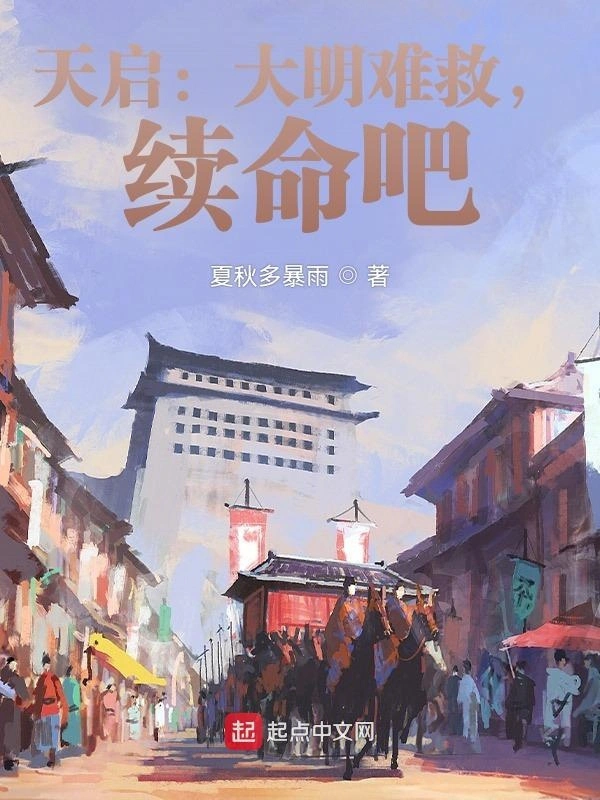
Apocalypse: It's Hard to Save the Ming Dynasty, Please Stay Alive
天启:大明难救,续命吧
- Status
- Completed
- Length
- 250k Words
- Genre
- Historical
- Audience
- Male
- Subgenre
- Song-Yuan-Ming Dynasties
- Updated
- 3y ago
- Source
- Qidian
Stats
0Monthly votes
2.8kRecommends
56Fans
136Chapters
Tags
Synopsis
Reader comments
In booklists 1
Readers also read
 Red Mansion: Start Escaping and Farming from the Equipment Bar
 After Lying in Bed for Three Years, He Was Forced to Help the Han Dynasty
 Northern Qi, Sage Khan
 Fu Ming 1627
 Siheyuan: Start by Picking up Attributes
 Ten Kingdoms Week
 Long Wanshengshi
 Beastmaster: I Can See the Evolutionary Path
 Immortal Who Seizes the Body
 Da Liu Bandits
 I Am the Carpenter Emperor
 The Age of Huangtian
Preface to Gu Cheng's "History of the Southern Ming Dynasty": To be precise, during the Ming and Qing dynasties, a small but fierce Manchu upper class within the Chinese nation colluded with the most reactionary officials, gentry and landlords among the Han people to take advantage of the contradictions and steal the fruits of victory of the peasant uprising. After the Manchu aristocrats took over the Central Plains, under the influence of the more advanced Han culture, their own development made a staged leap. The Qing Dynasty was vigorous and powerful for a period of time, and it played an important and positive role in the establishment of China, a multi-ethnic country. However, on the other hand, the ethnic discrimination policies implemented by the Manchu aristocrats caused great turmoil in the domestic political situation and interrupted the normal process of Chinese social development, which cannot be ignored. The facts of historical progress provide the strongest evidence. China was a leader in the world before the middle period of the Ming Dynasty. After the middle period, China gradually fell behind in science and technology. However, until the end of the Ming Dynasty, the gap between China and Western European countries was not large. During the reign of Zhu Youjian, the last emperor of the Ming Dynasty who was overthrown by the Dashun Army, he still diligently introduced Western science and technology, especially firearms and calendars. Many scholar-bureaucrats also put aside their territorial opinions and paid attention to absorbing new knowledge from the West, although their purpose was to save the dying Ming Empire. The establishment of Qing Dynasty rule was at the expense of the great destruction of the country's productivity. The stable rule was greatly touted by some people as the prosperous age of Kangxi, Yongzong and Qianlong. It was during the more than 100 years that China was in this "prosperous age" that the distance between China and the development level of Western society became wider and wider. Less than fifty years after the "prosperous age" (if we go by the way some scholars praise the three emperors Kang, Yong, and Qian, Jiaqing, who reigned for twenty-five years after Qianlong, should be considered a good emperor who worked hard to govern, at least not an unscrupulous emperor), the Sino-British Opium War broke out, followed by tragedies of losing power and humiliating the country, which exposed the corruption and backwardness of the Qing Empire. In his book "History of Peasant War in the Late Ming Dynasty", the author proves with conclusive facts that the Dashun Army overthrew the Ming Dynasty and took over the entire Yellow River Basin, which caused almost no damage to social production, and swept away or severely attacked the aristocratic, official and gentry forces that seriously hindered the development of productivity. If this momentum was not interrupted by the Manchu aristocrats and the renegade Han warlords and officials such as Wu Sangui, Chinese society would have achieved rapid development based on what had been achieved in the Ming Dynasty, and the history of the past three hundred years might have been different.
The introduction says you can't mix foreign and foreign words, and after talking about backhand, one is in English and the other is in English. Haha, why can't our Chinese characters express the meaning you want to convey? ? ?
A shrewd and capable emperor. . . . Are you really not afraid of death? Historically, Tianqi used Wei Zhongxian and civilian officials to fight against Taiwan and was killed. You are smart and capable when you are an emperor. Not afraid of being killed? The most important thing for Tianqi is not to be shrewd, but to rectify the harem. Don't be like the history of food poisoning and death after falling into the water.
The author did not grasp the key point at all. In the late Ming Dynasty, you had a good policy, but you could not carry it out under the sabotage of the powerful bureaucrats and gentry. Do you think you can get money by opening up the sea? If it weren't for the author's cheating, believe it or not, he would give you one hundred taels of silver a year. You can't play with these people within the original rules. You will never win if you don't cheat. This is why many people say that it is better to rebel before becoming an emperor. I still suggest that the author has some guns, cleans up the palace, and then continues to commit major crimes and kill more people, robbing the rich and giving to the poor.
The contradictions in the Ming Dynasty, the protagonist did not reflect when doing things, didn't any of the courtiers object to the decree issued by the protagonist? The political struggle in the court is not reflected. This is probably the reason why the author wrote a book with weak character dialogue and a dull book. The political power in the court is more like a fog.
Without the Qing Dynasty, the Ming Dynasty was born and died due to a peasant uprising. The dragon-slaying warriors eventually became evil dragons, a typical example of China's feudal era. But with the Qing Dynasty, the Ming Dynasty expelled the Tartars, restored China, founded the country and overthrew the Mongolian Yuan Dynasty, and finally resisted the Manchu Qing Dynasty and died heroically. After that, the rebellion against the Qing Dynasty and the restoration of the Ming Dynasty lasted from the early Qing Dynasty to the fall of the Qing Dynasty. They lived great and died heroically. In a sense, it was the Qing Dynasty that made the Ming Dynasty possible. The Ming Dynasty itself was indeed just an ordinary dynasty. When compared horizontally, it was above average (perhaps even below) in history. But the Manchu Qing Dynasty turned the Ming Dynasty into a symbol, a spiritual symbol. From 1644, 1662 to 1912, it was the spiritual sustenance and spiritual motherland of countless Chinese people who did not want to be slaves.
When you see this kind of Chinese characters with foreign characters, you don't even need to read them. What kind of historical article can be written with this consciousness? Can you write the essence of Ming Dynasty history? I don't even recognize my own writing heritage, so you can imagine what kind of rubbish you write.
Alas, the corruption in the previous dynasties did not first rectify the administration of officials. No matter how good the policies were, they changed in local places. Zhang Juzheng's reform also first rectified the administration of officials.
Those who talked about tax reform in the late Ming Dynasty were all nonsense, but the truth is that they died because of tax increases. The Manchu and Qing Dynasties also used the slogan "Never Increase Taxes" as a memorial to mock the previous dynasty. In the state of the late Ming Dynasty, no matter how much tax burden was levied, it would become a matter of officials and gentry paying back the taxes in full, and the common people dividing the accounts between them. The final result was to force the people to rebel just like Chongzhen's increase in Liao's salary. To put it bluntly, the emperor ascending the throne is like an airborne leader. When your interests are inconsistent, you will definitely be ignored by them. Just like Chongzhen in history.
The ancient system of kings and ministers was like a tiger and its breeder. Every time a dynasty changes, it is equivalent to a wild tiger going down the mountain. In front of the ferocious tiger, the breeders can only cut and feed the meat cautiously. With the birth of a new generation of tiger cubs, the meat in the hands of breeders becomes a bargaining chip. Whichever tiger cub is better behaved will get more food. The tiger cub will eventually eat well, inherit his father's status, and monopolize the keeper's food. However, the experiences of tiger cubs in their early childhood have unknowingly put a yoke on their ferocious nature. Generation after generation of tiger cubs gave up their ancestral advantages in order to become the most carnivorous tiger, and were coerced and lured into cages by breeders. After a certain generation of tigers enters the cage, the breeder becomes the owner, the master-servant relationship is reversed, and the tiger is no longer able to resist. The breeding funds are squandered by the owners, and the tigers are getting thinner in the cages. Eventually, the descendants of ferocious tigers became sick tigers, and new wild tigers began to descend from the mountains. The owners turned into butchers, taking the flesh and blood of sick tigers to raise the new king of beasts.
In the course of Chinese history, the power at the top is becoming more and more concentrated, but the control at the grassroots level is getting worse and worse. The Ming Dynasty basically lost control of the grassroots level. A big reason is the separation of officials. The Han Dynasty was the only one that still had strong control at the end of Chinese history. Those who like to watch the Three Kingdoms can find that many people were engaged in basic jobs before they were developed. The petty officials in the Han Dynasty also had the opportunity to be promoted if they did well. Cao Wei's nine-rank Zhongzheng system allowed officials to separate their families. Officials did not have to go to the grassroots level. Front-line officials could not be promoted no matter how good they were. The emergence of the imperial examination system completely eliminated the possibility of promotion for front-line officials. Officials basically leave after working for a few years, while local petty officials basically stay in one place for their entire lives. For them, they have no chance of promotion in their lifetime. If officials are the main artery of the imperial court, these petty officials are the capillaries. The emperor will be ostracized by officials, and local officials will also be ostracized by these petty officials. Many times, if officials do not give benefits to these petty officials, work will not develop. Where the benefits come from, of course, are the people. Why is it said that all the people behind the imperial court were kidnapped by the gentry? Because many of the petty officials were from the gentry's family, or were related by relatives. If you really want to change things, in addition to reforming officials, you must also mobilize local officials. At the very least, local officials cannot be alone when they take office. They don't even have a single person when they arrive.
This introduction is also in English. Is it to show off your foreign language skills?
Nine sides
I feel that at the end of the Ming Dynasty, if you want to save the Ming Dynasty, you can only reshape it, rebuild it, and establish a new Ming Dynasty in the war of iron blood and gunpowder smoke. At that time, the emperor's temple name was Zu instead of Zong, which was equivalent to the appearance of a ruthless person in the Zhu Ming royal family and the founding of the country again. (Personal opinion, don't comment if you don't like it.)
I have been thinking about it, can the Ming Dynasty really come back if the emperor changes to an emperor who knows history? In fact, many people in history had a premonition of destruction, but a small number of lofty ideals could not resist the decay of the entire country.
The so-called gentry's dominance was the reason for the weakness of the Ming Dynasty, but it was definitely not the reason for the demise of the Ming Dynasty The Mughal Dynasty in India next door only had gentry, and the emperor was just a coordinator. After coordinating the interests of various places, he could rely on local armies to fight wars. If the local administration in the Ming Dynasty deteriorated further, it couldn't possibly be worse than the Mughals, right? Why were the Mughals able to defeat Uzbekistan, but the Ming Dynasty could not defeat the Manchus? Chongzhen should definitely take the blame
We can learn from the Qing Dynasty's secret policy system
We can't save it, but we are already corrupt from top to bottom. We must change the dynasty. The foundation of Ming Dynasty is already rotten.
The end of the Ming Dynasty is really hopeless. If it doesn't work, we can create a Ming Dynasty version of the Jiedushi separatist regime or let the landlords organize their own regiments to train and cultivate a few big warlords. They can't benefit others, nor can they benefit the Manchus. By the way, kill the Kong family in Shandong to show the arrogant civil servants that words are useless in front of swords and guns. We should change the problem of emphasizing literature over military force since the Song Dynasty. Swords and guns can also make those bureaucrats and merchants pay their taxes.
Why no one speaks. The sadness is so great.