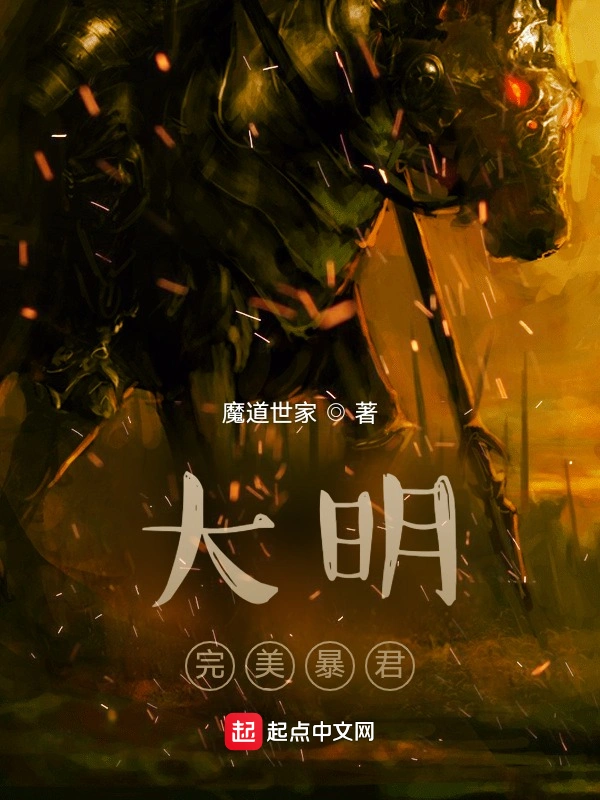
The Perfect Tyrant of Ming Dynasty
大明完美暴君
- Status
- Completed
- Length
- 1.4M Words
- Genre
- Historical
- Audience
- Male
- Subgenre
- Song-Yuan-Ming Dynasties
- Updated
- 3mo ago
- Source
- Qidian
Stats
0Monthly votes
16kRecommends
49.2kFans
641Chapters
Tags
Synopsis
Reader comments
In booklists 2
I Have Been Exposed to Online Writing Since 2003 and Have Been Here Ever Since! Personal Taste. Added from Time to Time!
I am completely disappointed with the current various lists of Qidian. I would like to post the books I am reading for everyone to see. It is better than reading randomly without any purpose!
10Books27Follows5yUpdated
Worth a Look
A bookworm who has been stationed at Qidian for 20 years!
7Books0Follows5yUpdated
Readers also read
 Talker in the Song Dynasty
 Please Call Me Your Majesty the Tsar
 In the Red Mansion: Escort Daiyu to Beijing at the Beginning
 1914 Begins with the Rejection of the Schlieffen Plan
 The Reborn Fashion King
 Travel Through the Ming Dynasty and Become a Tyrant
 I Am the Carpenter Emperor
 Fusion of Wolf Spider Genes, Killing Like Crazy on the Russian-Ukrainian Battlefield
 Live Forever as a Cat
 Emperor Zhengde
 The Sun and the Moon Are Always There
 Ni Ming 1644
 Create a Wealthy Family in Hong Kong, I Am Really Not an Actress Sniper
I read a lot of novels about the Ming Dynasty, and they were all done slowly, for fear of this or that. It only took two or three hundred chapters to straighten out the government affairs. I was tired and really tired of reading it. Now I am happy with it. Don't worry about whether it is reasonable or not. No matter how you write, some people criticize it for being unrigorous. Even history books have people criticize it. What's more, you are a contemporary novel.
Let me share my personal opinions, please don't comment. As the protagonist in the book is an emperor, he always likes to use modal particles when speaking, such as asking Wei Zhongxian, "What's your name?" Or asking the eunuch, "How does my armor look like?" Don't underestimate a modal particle. Multiple "ah"s will make subordinates think that the emperor is not very confident and has a weak character. They hope to get his approval and flattery, giving subordinates the feeling that the emperor's inner thoughts are easy to guess. And if it is "How do I feel about this armor?", The "What's your name" aura comes out immediately, which can give the subordinates an unquestionable and unpredictable feeling. Even if the subordinates flatter, they will be cautious. This can be regarded as a small method used by the superior to control the subordinates. You can use more modal particles when expressing condolences and getting close to the people. This will make the emperor appear cordial and easy-going, but when dealing with people who have been around the emperor for a long time, you need to create a sense of distance and elusiveness for him, so that subordinates can do things cautiously.
To put it bluntly, the Ming Dynasty would only be missed by so many people if the alien race hadn't conquered the world in the end and massacred it. If it were a Han court, the number of Mingfen would be reduced by half. Because the foundation of the Ming Dynasty was too bad, the issue of vassal kings was worth destroying the Ming Dynasty.
There is one point in this novel that the author takes too much for granted. Or the author thinks that he is right. When you train musketeers, the infantry will not kill anything. You actually said that musketeers don't need to learn martial arts and fighting skills. Isn't the author really obscene? Even during the Republic of China, there were bayonets and cavalry and sabers. Why, author, are you better at muskets than bullet rifles? No matter how you play with muskets, if you don't have close combat capabilities, except for being strong and getting close, what's the difference between you and ordinary people? Musketry cavalry should be equipped with sabers. Otherwise, if someone gets close to you, how can you fire a musket? Finally, either equip a bayonet if the technology allows. You said that the musketeers don't learn melee combat. It's really funny. Normally, there are too many opportunities when the opponent wants to melee. There are walls, so you can fight hand-to-hand. You can also wait for you to get closer and fight. You can't have cavalry to cooperate every time. If you don't learn melee combat, your body will be useless. I really don't like this point of the author.
Looking at the author's post about his understanding of personal expeditions, you can see that the author still does not have a deep understanding of the fundamental causes of the Ming Dynasty's fall and the lessons of history. The author's so-called coping methods have prototypes in history. His name is Yang Guang. Some people say that he is far-sighted and far-sighted, and some say that he is strategic. There are many talented people, and some people say that he is brave and courageous and is not afraid of difficulties. Some people say that he is the first of his generation to benefit all generations. Yang Tong is posthumously named Emperor Ming of the Sui Dynasty, Dou Jiande is posthumously named Emperor Sui Min, and Li Yuan, who had the last laugh, deliberately disgusted him and is posthumously named Emperor Sui Yang. No matter who the emperor is, he destroyed the foundation of the Sui Dynasty, laugh! ! The troubles of the Ming Dynasty have never been external but internal, not natural disasters but man-made disasters, not the lack of firepower, backward equipment, and timid barbaric warriors, but the regression of civilization that is complacent, unwilling to make progress, and arrogant! To sum up in one sentence, the giant Ming Dynasty is sick. From top to bottom, from the inside out, the mechanism system that has been running for more than two hundred years has accumulated and exploded, from finance, official administration, power structure, local governance, official selection and appointment, military construction to wealth and then With the "structural collapse" of distribution, a single spark of hope for a new era can ignite a prairie fire that overthrows the decadent old rule. What you are doing now is not treating patients and saving people, but pulling the patient to give him a last chance and sprinting towards the end of death. First think about how to overturn the ancestral precepts of the Ming Dynasty and resolve the irreconcilable contradiction between the privileges of the powerful scholar-bureaucrats who cling to the sick body of the Ming Dynasty and suck out the marrow, and the impoverished refugees who have nothing and would rather have a seed. The foundation of the rule is about to fall apart. Even the First Emperor dare not be so violent when he is still thinking of fighting a national war.
It's really frustrating to read. Author, why did you write the novel and make the protagonist so frustrated? The emperor, who had fought several times and won several battles, wanted to go on a southern tour. Only one-third of the officials disagreed, so the protagonist gave up. Why didn't he dare to kill? The scholar-bureaucrats in the late Ming Dynasty were terrible. Except for a few whose names were recorded in history, there were still a few who were trustworthy. It would be okay to kill them all. In the late Ming Dynasty, there were many people who had fame but could not become officials! This is what forced the protagonist to leave the capital at night. How many soldiers did Qin Shihuang lead on his southern tour? Oh! I don't know how the protagonist survived with such intelligence. Is an emperor without soldiers still an emperor?
About personal recruitment
Everyone should be very clear about the situation at the end of the Ming Dynasty, so I won't go into details. I'll just talk about why the protagonist wants to go on a personal expedition. First of all, the Ming Dynasty in the first year of Tianqi was not peaceful, but very chaotic. The first one: Sichuan chieftain She Chongming rebelled near Chongqing in September. The extent was no less than that of Yang Yinglong during the Wanli period. Moreover, because the Ming army was too rubbish, it could not be put down in a short time. Another great chieftain in Guizhou, An Bangyan, also joined the rebellion in March of the following year. This rebellion was called the Southwest Rebellion, which lasted for twenty years. It lasted from the first year of Tianqi until almost the fourteenth year of Chongzhen, when it was basically put down. The Ming Dynasty invested a lot of money, food and troops. Because of this war, the disaster spread to the entire five southwestern provinces, and refugees broke out everywhere. This was also the main reason for the peasant rebellion during the Chongzhen period and one of the reasons for the demise of the Ming Dynasty. Second: Nurhaci attacked Liaoshen on a large scale. Historically, because Xiong Tingbi was deposed, Nurhaci took down the two important towns in Liaodong with almost no effort. Although the protagonist of this book fully supported Xiong Tingbi, the Ming army in Liaodong could not defeat the Eight Banners Army. This is a fact, and this is what Emperor Wanli did for him. The reason why he has not sent troops since the Battle of Saarhu is because he has clearly realized this. He even mobilized Zhejiang soldiers and Baigan soldiers to defend Liaodong, and ordered Xu Guangqi to train the new army in Tongzhou. It is obvious that Emperor Wanli no longer believes in the Ming army, and he pinned all his hopes on Xu Guangqi. Third: A nationwide drought. The record in Ming history is a nationwide drought in the Ming Dynasty in the first year of Tianqi. Whether the Ming history can be believed or not, first of all, there was indeed a severe drought in the Ming Dynasty that year. No matter which history book it is recorded, there was even no harvest in the north, and even the south of the Yangtze River was greatly affected. So you know how serious this drought is, right? The above are all the reasons that led to the demise of the Ming Dynasty. The war in the southwest lasted second only to the Liaodong War. It is obvious that the Ming Dynasty at that time did not have the ability and no such talented people to pacify it in a short time. If the protagonist does not take action at this time, who will take action? Tell me, who are the cool people at this time? Sun Chuanting? Lu Xiangsheng? Yang Sichang? Stop being funny, okay? In addition, an expedition to Mongolia is inevitable. Historically, due to the inaction of the Ming Dynasty and the threat of the Manchu Qing Dynasty, various Mongolian tribes rushed to join the Manchu Qing Dynasty. This is also the reason why Huang Taiji was able to directly bypass Liaodong and reach the capital. Is history going to happen again? I just want to say one thing, others will not wait for you to be ready before fighting you. Those who say that the protagonist will develop for five or ten years can go away. I don't need you to read my book. Also, in the Ming Dynasty during the Apocalypse, no talented person could lead and pacify the world alone. Someone as powerful as Xiong Tingbi could only barely hold on to Liaoshen. Is there anyone better than Xiong Tingbi? Could you please let me know someone? There are also people like Sun Chuanting and Lu Xiangsheng. They are still young and may not even understand how to behave in the world. Should they be entrusted with important responsibilities? Then I might as well just write about Huo Qubing from the Ming Dynasty. Wouldn't that be more awesome? As the saying goes, if you like it, watch it, if you don't, don't watch it! I am not writing a history book!
Open a post and see how many friends are reading it
Friends who are watching support a small wave and will deduct 1
It's a bit too taken for granted. It's not like you can just do something as soon as you say it. People will wait for you to behead and things will be done. It feels like everyone is a fool and only the protagonist has the brains.
I just watched it and couldn't help but post to point out some common sense errors.
I have just read a few chapters. The author's ideas and writing are still good, but there are some common sense mistakes that I hope the author can correct. The first one: How could Guangzong call the emperor's eldest son in the first chapter? At this point in time, I have been the crown prince for almost 20 years. Is it a joke that the dispute between the country and the country during the Wanli period was so big? Second: Zhu Youxiao is not the emperor's grandson. The edict to establish the emperor's grandson was not issued before Wanli died, so he just ordered the emperor's grandson. Third: In the third chapter, Deng Ji wrote three requests and three concessions. This is the need of the founding emperor, not the successor emperor. Emperor Wen of Han Dynasty was a minister and not his legitimate son, so he asked three requests and made three concessions. Zhu Youxiao was legal and orthodox, so he did not need it. Fourth, Chapter 4 writes about Wang Huazhen, the governor of Guangning. This is just the counselor of Guangning. There is only one governor of Liaodong in Liaodong. I have only read four chapters. Although these errors do not affect reading, they should not appear. I hope the author can be more rigorous and correct them!
There was no sharing of land, the government and the gentry enjoyed the same benefits, the progressive land taxation system, the reform of commercial taxes, the reform of the salt and iron monopoly, and the reform of the privileged class of princes, all these could not be saved by the Ming Dynasty.
By the way, isn't the author afraid of a counterattack from the civil servants when the protagonist goes on a personal expedition? I feel like it would be too risky to go on a personal expedition, and the army has only been training for a few months, so the time is a bit rushed.
After the internal stability in the later period, the princes can go overseas to expand territories, colonize the world, and let the whole world speak Chinese!
I just don't understand. Your views on guns are too retarded, right? The increase in the power of guns should have started with the breech-loading gun, and the breech-loading gun was a thing later. Since your three-layer armor is so bad, why did the Qing Dynasty lose?
This is the novel of the late Ming Dynasty. 99% Of the novels of the late Ming Dynasty do not dare to kill this person or that person. And then these Donglin Party members obey the author's arrangements and poison them to death. . . That's it, kill him until he has no descendants, and see how the Donglin Party kneels down
Only twenty chapters later, I was successfully persuaded to quit.
Where did the rule come from that the emperor had to address himself as "Sun Chen" when visiting Concubine Liu? Where did the author see such a title?
A personal expedition? I'm afraid you don't want to imitate Zhu Qizhen, the God of War.
The military power of the Ming Dynasty was not in the hands of the emperor but in whose hands. Who did the emperor take the military power from?