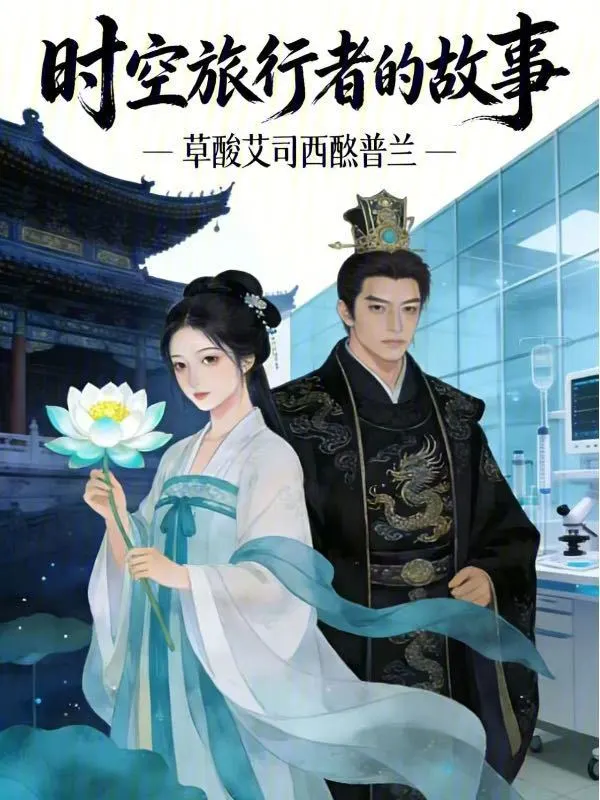
The Story of a Time Traveler
时空旅行者的故事
- Status
- Ongoing
- Length
- 562k Words
- Genre
- Fantasy Romance
- Audience
- Female
- Subgenre
- Eastern Xuanhuan
- Updated
- 8mo ago
- Source
- Qidian
Stats
0Monthly votes
78Recommends
0Fans
137Chapters
Synopsis
Reader comments
Readers also read
 There Is a God Like This
 Dumb House
 Beast Control Starts from Zero Points
 My Ancestor Is a Max Level Boss
 Terror Invasion: My Villains All Came True
 Rebirth of a Concubine
 Traveling Through Ancient Times with Supernatural Powers, Zaizai Grew a Warehouse Full of Grain
 After My Beautiful Father Barged in on the Door, I Became the Favorite of My Stepmother's Family.
 Start Cultivating Immortality by Extracting the Entries of All Things
 Splendid Pastoral Wife
 Pretending to Be an NPC, I Lead the Players to Revive the Sect.
 In Famine Years, the Whole Family Doesn't Have Enough to Eat, and the Vicious Stepmother Eats Alone
Every book is the child of the author. He works hard to write every word. I hope that the readers will feel happy and smile after reading it. This is the biggest motivation! Every character is a protagonist in our lives. Come on! Middle-aged girl!
There is always love in thousands of mountains and rivers, can you update it quickly?
The whole story of the "Great Etiquette" event in the Ming Dynasty.  Dimengtianxia 1 year ago Follow The Great Etiquette Incident was a major political event between the 16th year of Zhengde and the third year of Jiajing, led by Yang Tinghe, Mao Cheng and others, who were the chief ministers of the cabinet at the time, and Zhu Houcong, Emperor Shizong of Ming Dynasty and Jiajing Emperor. Wuzong of the Ming Dynasty once again fell into the water while playing and suffered from lung disease. He died early at the age of 31, leaving no heirs or brothers. Who should inherit the throne of the Ming Dynasty became the first priority. After discussions between the then empress dowager and the chief minister of the cabinet Yang Tinghe, Zhu Houcong, the son of King Xingxian, was elected to succeed the throne.  Emperor Jiajing Zhu Houcong was the cousin of Wuzong of the Ming Dynasty. He belonged to the vassal king. According to the patriarchal etiquette of the Ming Dynasty, the vassal king belonged to the small clan and the royal family belonged to the big clan. When a Xiaozong succeeds the Great Unification, according to the special cases of the Han and Song dynasties, the father of the previous emperor should be recognized as Huangkao (the title during sacrifices refers to father), and his biological father can only be called Huangshu. (Mother feels the same way) Regarding Yang Tinghe's statement, Jiajing Emperor Zhu Houcong naturally refused to do it. What does it mean to change my parents for no reason? This started the great ceremonial event. The main two parties in the fight were Yang Tinghe, the chief minister of the cabinet, the former ministers and Emperor Jiajing of Ming Shizong. The fight between the two sides began before Emperor Jiajing entered Beijing.  Yang Tinghe Yang Tinghe asked Zhu Houcong to enter the city through Donghua Gate according to the plan of the Ministry of Rites, and then temporarily live in Wenhua Hall and choose a day to ascend the throne. Zhu Houcong naturally refused to do it, because this was the process for the crown prince to succeed to the throne. Then you are not saying that I, Zhu Houcong, is the son of his Ming Wuzong. Yang Tinghe, a great scholar, once helped Emperor Wuzong of the Ming Dynasty draft a posthumous edict. The content of the imperial edict was expressed in the tone of Wuzong Wuzong of the Ming Dynasty: "I am dying, and I have not established an heir. The eldest son of King Xingxian, King Kao, has grown up. He is wise, benevolent and filial, and his moral order must be established. I have obeyed the ancestral precepts of my brother and my brother, and reported it to the ancestral temple. Please ask the Empress Dowager Cishou to send officials to welcome him to Beijing today. Heir to the throne of emperor, enshrined in the ancestral temple Zhu Houcong used the imperial edict to argue that the imperial edict was to make me the emperor, not to be a prince. But Yang Tinghe still disagreed. Then I, Zhu Houcong, will not be the emperor today. I can be whoever you like. Anyway, I will not enter the city according to this etiquette. In the end, the Empress Dowager came forward to ask the officials to go out of the city to meet Zhu Houcong. They entered through Daming Gate and then ascended the throne in Fengtian Hall.  Then there was the matter of Jiajing's father-changing as mentioned above. The ministers of the court, headed by Yang Ting and Mao Cheng, believed that since Jiajing succeeded the small sect to the big sect, it should respect the orthodoxy and let Xiaozong of the Ming Dynasty be the emperor, and his biological father, Wang Xingxian, be the emperor's uncle. Zhu Houcong refused, and the two sides fell into a stalemate. During this period, Zhu Houcong even bribed Yang Ting and Mao Cheng, but unfortunately neither of them were moved. The two sides were in a stalemate. In the end, because Jiajing only ascended the throne, he was weak and had no choice but to compromise first. Although Jiajing also had the support of Zhang Cong and others, Zhang Cong's insignificance was not enough to affect the overall situation. However, Jiajing was extremely tough on the matter of welcoming his biological mother to Beijing with the courtesy of the Empress Dowager. Yang Tinghe objected to this matter. Jiajing said that if you don't agree, I will resign as emperor and return to the feudal country with my mother. In the end Yang Tinghe had no choice but to give in. In the third year of Jiajing's reign, Zhang Cong and others once again expressed their support for Jiajing and honored his biological father as the emperor's imperial examination, which just catered to Jiajing. Jiajing invited ministers to discuss, but Yang Tinghe strongly opposed it and threatened to resign as prime minister. At this time, the Jiajing throne was already stable. He had already seen that Yang Tinghe was not happy with him. Since you want to resign, then get out!  Zhang Cong Then Jiajing issued an edict to register his parents and honor his biological father as the emperor and his biological mother as the queen mother. The officials were in an uproar, thinking that it was not in line with the patriarchal etiquette. More than 200 officials, including Yang Tinghe's son Yang Shen, knelt down at Zuoshun Gate and cried, asking Emperor Jiajing to withdraw his decree. Jiajing heard the crying in the Wenhua Palace and ordered the eunuchs to disperse the ministers, but the cries of the ministers were still deafening until noon. Jiajing was furious and ordered the Jinyi Guards to arrest the gang leader and send them to prison, but this aroused the ministers even more. Zhu Houcong further ordered that 134 officials below the fifth rank be imprisoned, and 86 officials above the fourth rank be suspended pending punishment. After Zhu Houcong was afraid that his parents would be given the honorary title, Jinyiwei asked him how to deal with the over one hundred officials who had taken the title too much. Jiajing ordered officials above the fourth rank to have their salaries suspended, and officials below the fifth rank to serve as imperial staff. A total of sixteen people died due to the imperial staff. After Zuo Shunmen's imperial cudgel was released, the officials who objected changed their tune one after another.  Jinyiwei The Great Ceremony incident seemed to be a dispute over patriarchal etiquette, but it was actually a battle over imperial power. The sudden death of Emperor Wuzong of the Ming Dynasty led to a fall in imperial power, and this lost imperial power was controlled by Yang Ting. After Jiajing ascended the throne, he naturally had to take back the lost imperial power. Naturally, Yang Tinghe was unwilling to hand it over. The great ceremonial incident was actually a political game between Emperor Jiajing and Yang Tinghe. It ended with Emperor Jiajing successfully taking over the imperial power and Yang Tinghe being defeated. Reference materials: Baidu Encyclopedia "Records of Emperor Shizong of the Ming Dynasty" and "Complete Biography of the Emperor of China".