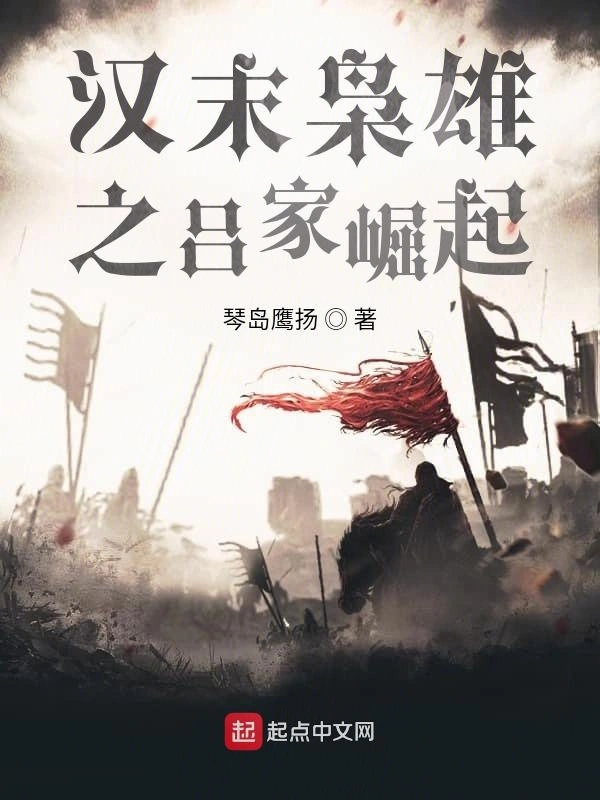
The Rise of the Lu Family of Heroes in the Late Han Dynasty
汉末枭雄之吕家崛起
- Status
- Completed
- Length
- 87k Words
- Genre
- Historical
- Audience
- Male
- Subgenre
- Qin-Han & Three Kingdoms
- Updated
- 5y ago
- Source
- Qidian
Stats
0Monthly votes
61Recommends
0Fans
30Chapters
Synopsis
Reader comments
Readers also read
 1914 Begins with the Rejection of the Schlieffen Plan
 Please Call Me Your Majesty the Tsar
 Talker in the Song Dynasty
 In the Red Mansion: Escort Daiyu to Beijing at the Beginning
 The Reborn Fashion King
 Liu Xie: I Really Just Want to Give In!
 Mixed in the Three Kingdoms Fighting for the World
 Tokyo: Starting from Pretending to Be a Boyfriend
 Fusion of Wolf Spider Genes, Killing Like Crazy on the Russian-Ukrainian Battlefield
 1899 If You Don't Want to Be a Eunuch, You'll Go to America.
 Cultivation of Immortality Begins with a Rickshaw Driver
 Tokyo Starts with Accidentally Breaking into Tianjia
 Legend of the Heroes of China
 The New Biography of Liao Hua in the Three Kingdoms
The difficulty of the protagonist's start is still too high, and the best time is to travel before the battle of Cao Lu Dingtao. Many historical authors like difficult starts, thinking that the higher the difficulty, the more readers will be attracted to them. In fact, this is not the case. High-difficulty comebacks will inevitably require frequent use of the protagonist's aura and golden fingers, or even violate common sense and collapse the plot, which is not worth the gain. Before the Battle of Dingtao, Cao Cao was short of food in the army, so he ordered Xiahou Dun and others to take food from Ying and Rujian and took the opportunity to seize Northern Yuzhou. Lu Bu, who was also short of food, ordered Zhang Liao and others to go to Qingzhou to collect food from the sea, resulting in Zhang Liao's troops being unable to support the battle of Dingtao. It was acceptable for Cao Cao to retake Yanzhou, but it would be fatal to welcome Emperor Xian. From then on, Cao Cao became famous for his conquests and appointed and dismissed officials with evidence. It is said that Cao Cao did a lot of massacres in the early days, but those massacres in the past after welcoming Emperor Xian were nothing. In addition, although Lu Bu captured Xuzhou, it was further away from the horse-producing areas of You, Bing, and Liang. The cost of purchasing war horses would increase significantly, not to mention that transporting war horses would be unsafe. Lu Bu's army had many experienced officers and soldiers in cavalry, but due to the lack of horses, it would be difficult to expand the cavalry force, and it would even become weaker.
There are currently four forces under Lu Bu's command. One is the Bingzhou Wolf Cavalry headed by Lu Bu, Wei Xu, Zhang Liao, and Cheng Lian. The other is the Hanoi Army headed by Hao Meng and Cao Xing. The other is the Yanzhou Army headed by Chen Gong, and the other is the Danyang Army headed by Xu Dan. The Taishan soldiers headed by Zang Ba, Sun Guan, and Yin Li are allies of Lu Bu's army. So the question becomes: Which force do Gao Shun and the trapped camp led by him belong to? To solve this mystery, we must first analyze the mystery of Gao Shun's birthplace. At the end of the Eastern Han Dynasty, there were three gathering places with the Gao surname in the Three Kingdoms: the first is the Youyan area, where famous figures include Gao Jianli from the pre-Qin period; the second is the Yin and Chenliu counties of Henan, where the famous figures include Gao Gan and Gao Rou; the third is the Huainan area, where the famous figure is Gao Pei. Based on the trajectory of Lu Bu's activities, Gao Shun may be of the Gao family lineage of Chenliu, the former subordinate of Zhang Miao, the prefect of Chenliu. Zhang Miao was famous for his chivalry and may have been kind to Gao Shun. The reason why Gao Shun and Chen Gong were at odds was that he indirectly killed Zhang Miao. The predecessor of the elite trapped camp may be some of Zhang Miao's personal guards. Because he had no seniority in Lu Bu's army, Lu Bu knew his loyalty but could not reuse him. Gao Shun deeply hated Cao Cao for massacring Yongqiu, so it made sense to refuse to surrender. Zhang Miao was killed by his subordinates, so we still need to think of a situation where Gao Shun and the tribe loyal to Zhang Miao, led by Gao Shun, defected to Lu Bu. Of course, the above information about Gao Shun's place of origin is just speculation.
I bumped into the book cover while passing by and caught up on the traffic~
Updated to Chapter 8, it also ushered in the first small climax of the book, "The Battle of Lu and Liu Xiapi". The content is mainly based on official history and supplemented by romance. So far, there have been no major flaws or serious violations of common sense. The description of the character's words and deeds also fits the character image to be created, and the character's personality is well portrayed. The content is concise, not sloppy, and detailed. Generally, the narration used extensively in historical time travel stories is greatly reduced in this article, and information is obtained through conversations between passers-by and exchanges between acquaintances, giving a stronger sense of immersion. As for the shortcomings, I will leave a message later when I think of it. Finally: good writing will be popular, leave your name before it becomes popular, and be in the front row!
There is a trend in this book: the author is creating a Lu Bu that is completely different from the historical records. The trapped camp performed well in the Battle of Xiapi, and Lu Bu ordered Gao Shun to expand the trapped camp. The author's Lu Bu has taken the first step to get rid of the shackles of historical data. Readers may not be aware of this, but just think it is the butterfly effect of the protagonist participating in the battle of being trapped in the camp. The plot develops to the chapter "Knowing his loyalty but not being able to use it" and a "new Lu Bu" is finally born. Originally, Lu Bu seized Gao Shun's military power and handed it over to Wei Xu, which reflected Lu Bu's own suspicious character and nepotism. However, this book is set up as Lu Bu relieved Gao Shun from the command of the camp in order to let him take the new soldiers to the West Sea to quell the chaos and train the new soldiers. Lu Bu changed from a brave and foolhardy man to a man of foresight and long-term vision. Is it possible that Lu Bu is also a time traveler? Lu Bu became more suspicious after Hao Meng's rebellion, and may have adopted a system similar to the separation of soldiers and generals during the Song Dynasty. In non-war times, the military power of Hanoi soldiers, Yanzhou soldiers and the trapped camp was concentrated among himself and Wei Xushou, and in wartime, it was handed over to military commanders who were not from the Bingzhou faction to lead the operations. As the protagonist of the time traveler, he should have more influence on the direction of the plot. For example, asking Gao Shun to go to the West Sea to quell the chaos and train new recruits should be the protagonist's suggestion to Lu Bu, not Lu Bu's own decision. The author wants to create a "new Lu Bu" to break the situation. I don't know if this book will be a bright road or a thorny path.
Emperor Xian is the posthumous title given to him by later generations. You say he is dead when he is only in his teens or 20s? It should be His Majesty or the Emperor
The protagonist leads a hundred men to defeat two groups of five hundred rebels, and the troops are divided twice, which is not very reasonable. The protagonist needs at least two hundred people. Regarding casualties, in the era of cold weapons, it is difficult to achieve victory with fewer casualties and zero casualties. It is best not to write whatever is beneficial to the protagonist, but also to take into account the rationality.