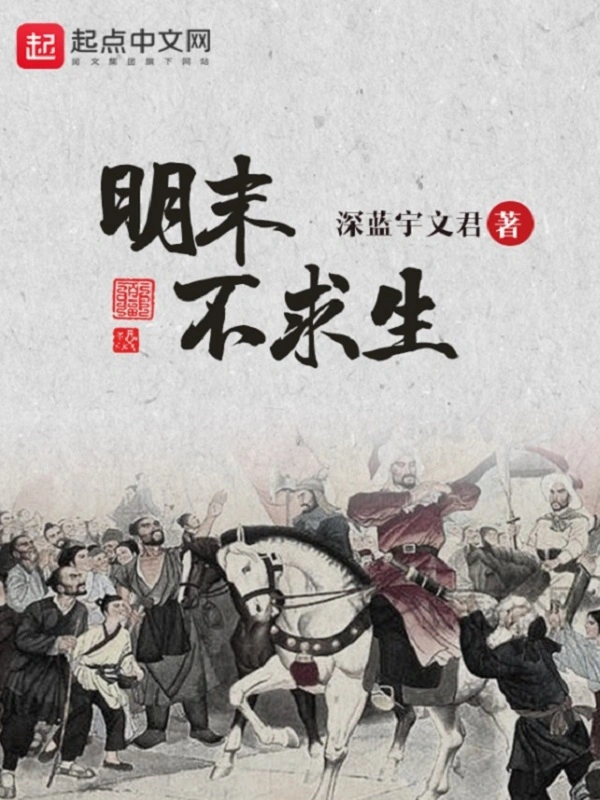
Do Not Seek Survival at the End of Ming Dynasty
明末不求生
- Status
- Completed
- Length
- 2.4M Words
- Genre
- Historical
- Audience
- Male
- Subgenre
- Song-Yuan-Ming Dynasties
- Updated
- 6y ago
- Source
- Qidian
Stats
Tags
Synopsis
Reader comments
In booklists 19
[Xiancao and Seedlings] the Top Book in the Eyes of Lao Fengzhu
◆ As a bookworm for ten years, I only choose top-notch books that I have read. ◆ The standards are strict, please choose according to your own taste, and the three are ordinary grass jelly. ◆ I will join only if the writing, plot, and concept are all good, and it must be positive and keep me chasing. ◆ I add or delete from time to time according to my preference, and the seedlings are not ★. Note: High-quality works can be scrolled down ———— You can follow the book list and recommend yourself.
Focusing on Lesser-Known Historical Periods
This book list mainly recommends stories from lesser-known historical periods such as the Spring and Autumn Period and the Warring States Period, the Qin and Han Dynasties, the Jin and Southern and Northern Dynasties, the Five Dynasties and Ten Kingdoms, the turn of the Yuan and Ming dynasties, and foreign history. The single author will select the books with good writing skills and exciting stories to recommend to everyone. Books with novel stories and well-written stories will be highly recomm


History/fantasy/games/2d Books Some Recommended Books
Just put some of the books I'm reading I'll try my best to choose some that appear less frequently on other lists. Five-star full score system. Scores are purely personal and are for reference only. If you have any good books, please leave a message and recommend them ('▿') Friends are also welcome to leave their own opinions or suggestions ฅ( ̳• ◡ • ̳)ฅ Also, friends who like this book list Please give me some attention-(¬∀¬)σ We regularly clean up books that have too few likes and see if we c
Classic Book a Classic in My Heart!
After reading it for several years, I think it is a book that is truly meaningful and conscientious.
Urban History, Recommended by a Ten-Year-Old Bookworm
Only collect good books
Premium Books, Time Travel, Fantasy, System, Martial Arts
I have read many book lists, and I want to write one of my own, so that I can give some recommendations to people who are short of books.
Sensational Historical Novels
I have been a bookworm for many years and I sincerely collect historical novels with good writing and not blunt stories. If you don't like them, don't criticize them!
The Bookworm's Fodder
For picky readers who read everything, the books in this list have been tested by myself. Please feel free to eat them and reject the clichés and noobs! Find great books in the entire library! Share it with your peers. (No one is watching anyway_(:з∠)_
My Little Book List
Just like it
Books I Like to Read
Very nice

Enduring, a Great Collection
Recommended classic novels, basically all of them have been read. Welcome to recommend good novels. I also hope everyone will like and follow 👍
Recommended Sincerely by Old Bookworms
Selected Book List Regularly cleans up eunuch books, leaving only those that are serialized
Nice Historical Article
It mainly contains historical articles, and I have read every one of them!



Let's Read a Book Together
Solve the book shortage.
Bookworm's Bookshelf
I like
Books You Like to Read
Kindness
You'll Know After Seeing It
Mine

. . . . . .
Like
If You Are Hungry for Books, Come Quickly! Focus on Relaxing and Refreshing Articles
I am quite picky and have been a bookworm for more than ten years.
Readers also read
 Please Call Me Your Majesty the Tsar
 Talker in the Song Dynasty
 In the Red Mansion: Escort Daiyu to Beijing at the Beginning
 1914 Begins with the Rejection of the Schlieffen Plan
 The Reborn Fashion King
 Da Liu Bandits
 Strategies for Revitalizing the Northern Song Dynasty
 Fusion of Wolf Spider Genes, Killing Like Crazy on the Russian-Ukrainian Battlefield
 Live Forever as a Cat
 Daming Under Facebook
 Picked up a Copy of Chronicles of the Three Kingdoms
 Ten Kingdoms Week
Some people commented very well. This is a pure ass-selling book. The fan of the peasant army is probably grass jelly. For ordinary readers who are not big fans of Li Zicheng, in addition to being really unattractive, the Ming Dynasty's decision-making and the beautification of the army go too far. Moreover, he endlessly praises Chuangjun, pulls Daming out and blackmails him when there is nothing wrong, and performs various magical operations. After the first plot was released and I joined the army, it was amazingly embarrassing. The blunt lyricism regardless of the occasion really greatly reduced the readability of the book.
Hate the Ming Dynasty, Chongzhen is like a fool, and the death of a loyal and hard-working general like Mao Wenlong is like a dead dog. The arrogant and domineering general did not dare to accuse him. Civil servants who dared to do their jobs were demoted or killed whenever they made mistakes, which made all the civil and military officials in the dynasty live in a dawdle. When he is about to die, he still blames his ministers and pretends to love the people like a son, but he has no responsibility at all when he is the boss. There is no one who has massacred hungry people and still pretends to be a benevolent king.
The writing style of this book is acceptable and it is a good historical time travel novel. Most people feel that although the protagonist's character is realistic, it is too thin. In addition, the protagonist's aura is a bit heavy and the opponent is too weak. There are many less exciting rival scenes, or it is biased against history. Many people don't like it because of this. Although I have been reading it for so long, I still hope that the author will continue writing. I personally feel that the scenery seen from different angles is different.
The author lets himself go and wastes the subject matter, which is not as good as the eunuch
Regardless of the controversy between Li Chuang and the late Ming Dynasty, this writing is about letting oneself go, right? Are the chapter titles all memes? I couldn't stand it after watching it at first. Really let yourself go. He also used the banner of rehabilitating the bandits and the revolution three hundred years later with little knowledge, but did not input it. Nan Ming was indeed supported by the remnants of the Chuang Army, mixed with the national surnames, but these vassal kings were basically evil. But the writing of this book is really good. The characters that Kangqing can portray are not outstanding, the rationality of the plot is hesitant, and there is no useful information from the early to the middle stage. Hey. The characters are written to death, and the value lies in the memories and the continuation of the plot at that time. Then the later plot continues to rely on the death of one or two characters. The only protagonist in the Chuang Army has an overall strategic vision for the war. Forcibly kill a rebel leader. Please, what are you doing? Then you forcefully play tricks. What are you doing? Is this portraying the protagonist who saves the camp and makes up for his regrets, or travels back and forth to pretend to be sexy?
Come on, great author, keep at it, everything is difficult at the beginning, keep calm, and someone will dig out the gold!
The writing is indeed good, and there is a spirit of resistance to the injustice of the world in the text.
The writing style is fluent and readable, but adding unnecessary extravagance may lead to mistakes.
The writing is good, but please correct the problem of spoilers at the end of the article. If it's free, readers will tolerate it, but if you pay to subscribe, what do you mean by this spoiler? If you feel the urge to create, just update two more chapters, or post them in the WeChat group
I don't know how the protagonist will rise to power next. With the butterfly effect of the protagonist, the Chuang Army can truly control their own territory. At least now they can stably manage Henan and Huguang. If this momentum continues, the Qing army will really be in trouble. Unless Li Zicheng has no heirs or dies in battle, it is impossible for the protagonist to become emperor under normal circumstances.
There must be too much spirit from the Zhu family in this comment. A group of people are crazy about Li Zicheng. Li Zicheng rebelled because he had nothing to do. The only thing that could save the Han people at the end of the Ming Dynasty was the peasant army. And some people said that the Ming Dynasty was better than the invading army? The late Ming Dynasty was the peak of internal strife between TM and the TM was better than the Chuang army. Is it really a joke that when King Chuang came and refused to pay for food? The entire Southern Ming Dynasty, except for the King of Tang and King of Lu, was a rotten fish. Shi Kefa and the Donglin Party could not govern the country with internal fighting. King Fu and King Lu were rubbish among the rubbish. No matter how rubbish the peasant army was, they still insisted on resisting the Manchus until death. Without Sun Kewang and Li Dingguo, Nan Ming would have died early. After the death of Li Zicheng, he broke into the army and formed the Kuidong Thirteen Family to insist on resisting the Qing Dynasty. Can this group of Zhu family members with spirit go read a book? Chongzhen is half of the blame for the chaos in the Southern Ming Dynasty. I just couldn't stand reading "History of the Southern Ming Dynasty" so I looked for some historical novels to read.
Countless people tried their best to save the life of a dynasty that was so bad that it couldn't get any worse. In spirit, would the Zhu family say good things to the rebellious peasants? No, they said that in "History of the Ming Dynasty" the Manchus maliciously distorted the facts to smear the Ming Dynasty, and at the same time they firmly believed in the historical data of the Qing Dynasty against the peasant army. Did the Qing Dynasty have too little distorted history? Go and read the manuscripts of Qing history written by Manchu and see how evil they are. All the peasant uprisings recorded are all called bandits, rebels, bandits, and thieves. There is not a single good word. This fully exposes the reactionary thinking of the scholar-officials who wrote the history of the dynasty. It is wrong to rebel, and you are not allowed to rebel even if you are forced to death.
Finally, I no longer praise Mo Ming's bad feet, and there are some innovations on top of this. Already invested, good luck with the signing and good luck with the completion
Li Zicheng was exaggerated by the author, so high that he became a white lotus, which aroused the disgust of some people. It was just a relatively bad era.
Readers, how did you discover this book?
The data in this book is a bit bleak. I wonder where you found this book? I wonder if there is any way. Can you help promote this book?
What kind of hidden dragon is Li Zicheng? He is just a first-class bandit with the same virtues as Huang Chao. He has been fighting for more than ten years and has no experience. He can never change.
Some celebrities gnashed their teeth when they saw the so-called "rogue bandits". Who allowed you to break into Beijing and force Chongzhen to death? This is what the scholar-bureaucrats in the late Ming Dynasty thought. They did not reflect on themselves and blamed the Ming Dynasty's demise on the bandits. "If you don't starve in peace, you will imitate the mantis." - Why don't you just starve to death at home? If you don't rebel against me, won't the Ming Dynasty survive forever? ——How shameless and cold-blooded this is! The demise of the Ming Dynasty was its own fault, the result of the rulers' unscrupulous oppression of the people. If you don't even have this awareness, how can you be called an objective star?
The Qing Dynasty and the Ming Dynasty vigorously discredited the rebels from the standpoint of imperial power. The opening of water jars from the Yellow River breach was all done by officials of the Ming Dynasty. In order to beautify the Ming Dynasty emperors, the Qing Dynasty's revision of Ming Dynasty history went to great lengths and compiled many words to praise the Ming Dynasty and the Ming Dynasty emperors. The words Mingfen said in praise of the Ming emperor and the Ming Dynasty were all compiled by the Qing Dynasty's revision of the Ming History.
Come on, there were very few peasant armies in Wenzhan in the late Ming Dynasty, and it was even rarer to have detailed textual research.
Those who overthrew the Ming Dynasty were peasants who had no food to eat, and those who resisted the Manchus and shed the last drop of blood for the Ming Dynasty were also peasants (Li Dingguo, Li Laiheng). For just one thing, these unknown heroes should always be remembered - Reposted from a netizen at Station B
At the end of the Ming Dynasty, only Li Zicheng was relatively good. At least they called for equal land tax exemption. They just wanted to have enough to eat, and they also wanted everyone to have enough to eat together. However, the political methods were not good. What could a bunch of people have to argue with? They had to starve to death in order to take care of the overall situation and let the gentlemen continue to drink human blood. Leave the Virgin alone.
Super low-end version of "Water Margin", rated two stars
1. The serious collapse of the time-travel setting 1. The complete waste of modern knowledge As a time-traveler, the protagonist carries the historical experience and revolutionary ideas of later generations, but abandons core tools such as class analysis, agrarian revolution, and ideological mobilization. The so-called "nine-year compulsory education" only promotes the brainwashing slogan of the military song "Chinese Boys" among the refugees with an illiterate rate of 90%. It neither runs schools nor conducts rectification and reform, and it has become an extremely anti-intellectual setting loophole. 2. The emptiness of institutional reform The protagonist's "field system" and "decentralization of military and political power" are claimed to be innovative, but in fact they are completely dependent on the feudal system: Monopolize military power but retain the title of "general" (such as Zhang Xianzhong's "four righteous sons" model); Land distribution is limited to ownerless wasteland, tacitly allowing powerful landlords to retain core land; Marriage alliance to recruit warlords (Luo Yujiao and Hao Yaoqi) is no different from Zuo Liangyu's recruitment of bandits. This so-called reform of "old bottles with new paper" was proven to be ineffective by Zhang Juzheng in the late Ming Dynasty, but the protagonist insisted on repeating the same mistakes. 2. The complete collapse of strategic logic 1. The suicidal decision of the three-front battle The protagonist simultaneously fights against the remnants of Li Zicheng, the Nanming warlords, and the Eight Banners of the Manchu and Qing Dynasties. The core reason is zero points for diplomacy and negative points for united front: blindly suppressed the remnants of Li Guo instead of integrating and dividing them (Li Guo was once his political ally); Adhered to the slogan of "Replacing Ming with Shun" against the Southern Ming Dynasty, and did not seek support from the Zhu Ming clan at all (please refer to Li Dingguo's alliance with the Ming Dynasty to resist the Qing Dynasty); Let the Qing army unite in Monan Mongolia and sit back and watch it complete the strategic encirclement. This reckless strategy is far less pragmatic than Zhang Xianzhong's "westward march to Sichuan". 2. The total collapse of the base area construction The protagonist inherited Li Zicheng's Henan-Hubei foundation, but: There is no census and land acre statistics (copied from the Ming Dynasty yellow book); There is no reconstruction of the tax system, still relying on the gentry to collect taxes; There is no military industrial layout (firearms are all confiscated). Comparing Li Dingguo's self-produced ordnance capabilities in real history when he was "two famous kings", it can be called historical nihilism. 3. The confusion of class narrative 1. Appeasement and appeasement of the gentry and landlords The protagonist continued to make concessions in Kaifeng, Xiangyang and other places: Tacitly allowed the gentry to evade taxes (webpage 3 proves that more than 50% of the land is in the hands of the owner); Retain the imperial examination system; When the Kaifeng mutiny was being purged, only officers were killed and not against the system. This kind of "revolution that does not touch core interests" is completely consistent with the failure of the Kuomintang's "25 rent reduction". 2. A complete betrayal of the poor peasants and refugees It talks about "equalizing the land", but in practice it is: The camp system is actually a copy of the military camp (peasants pay 50% of the output); In times of famine, priority is given to ensuring food and grass for the army; The strong men of the refugees are forcibly recruited into the army, and their families have no social security. It is more deceptive than Li Zicheng's "Ying Chuang Wang but not accepting food". 4. Extreme fragmentation of character creation 1. The protagonist's divided personality On the one hand, he flaunts "the orthodoxy of all peoples in the world", on the other hand, he acquiesces to Hao Yaoqi's private soldiers to plunder; on the one hand, he cleanses Li Guo's old ministry, and on the other hand, he marries Luo Rucai's old party. This kind of juxtaposition between good and evil is illogical, similar to how Yuan Shikai suppressed revolution and claimed to be a republic. 2. The collective wisdom of the villains The Southern Ming bureaucracy can only fight among themselves, the Qing army relies only on cavalry charges, and the remnants of Li Guo are brainless in revenge - completely divorced from the complexity of the multi-party power game in the late Ming Dynasty, and reduced to a stage of infantile power struggle. 5. Complete subversion of historical logic 1. Absurd distortion of the military setting The protagonist only relies on a small number of elite troops (the website states that the main force of the former battalion is no more than 10,000 people) to carry 100,000 Qing troops head-on, ignoring that the core of the war in the late Ming Dynasty is the logistics and mobilization system (Yuan Chonghuan needs 200,000 soldiers and civilians to cooperate year-round to defend Liaodong). It can be called the logic of an anti-Japanese drama. 2. The extreme magic of technological leap It was possible to produce flintlock guns in 1645 (in reality, it was not popularized until 1690), but it did not establish a gunpowder industry (sulfur and saltpeter all depended on smuggling). It is better to go directly to Mecha Warrior with this kind of setting. Summary: Ultra-low-end version of "Water Margin" The essence of this book is a feudal restoration script packaged in modern vocabulary. The protagonist is like Song Jiang wearing Napoleon's military uniform, shouting revolutionary slogans but kowtowing everywhere to persuade him. The retrogression in his "reform" practice was even worse than that of Zhang Xianzhong in real history - at least the Daxi Army really dared to kill the vassal king to divide the land. Regarding the subject of historical time travel, this kind of work that has neither institutional innovation, strategic rationality, nor humanistic care can be called a shame for time travel literature.
The emperor guarded the country, the king died in the country, and he looked down on the peasant uprising. This is the favorite name of unlearned and stupid fans. Since ancient times, many kings have died guarding the country. Chang'an, the capital of the Han and Tang Dynasties, has always been threatened by nomads in the northwest. Isn't this the emperor guarding the country? In the Song Dynasty, Kaifeng was so close to the Liao Kingdom that the emperor guarded the country. King Zhou of Shang and King You of Zhou are not dead in Sheji, a bunch of ignorant and brainless.
After reading dozens of chapters, to be honest, the historical background in the book is very clear, and the historical characters are well portrayed. However, the portrayal of the male protagonist is really failed. He is obviously a keyboard warrior who has experienced higher education and the baptism of the information explosion era, but in the book, the limitations of the peasant class's thinking are revealed everywhere, and the small farmer's ideology is vividly expressed... The book describes the male protagonist as more like An ancient boy who accidentally learned some knowledge about later generations, rather than a time traveler. The male protagonist's performance does not match the actual background, and is incompatible with the rigorous description of the historical part in the book... It makes people feel uncomfortable (If you feel that it is difficult to write a character who grew up in the era of information explosion into a rigorous ancient story, you can also write that the protagonist's mother is a time traveler like other books).
When Germany occupied Shandong, the Kong family welcomed the portrait of William II into their home. The author can write about the ugly behavior of this family.
Let's proceed step by step, how can you be independent when you are still young, not to mention that the protagonist is still one of the heirs to the power.
I feel that most people think from the perspective of the royal family, and don't even think about whether they are more likely to travel through time and become a relative of the royal family or a commoner. What is the difference between this and those who speak for capitalists now?
Li Zicheng was laid off from the post station that year. He borrowed usury to pay taxes, was beaten by Ai Ju, escaped to join the frontier army, and was owed wages. In terms of misery, he was even worse than Coach Lin, so he rebelled. The Ming Dynasty forced Li Zicheng out and complained about why he didn't starve to death? What else is engaged in production? Shaanxi experienced severe drought for six consecutive years in those years, followed by drought, locust plague, and snow disaster. Produce, produce your mother!
Li Chonger's Advanced History
Everyone admits that the late Ming Dynasty was bad, this is indisputable, but is Li Zicheng a good thing? Is Chuangjun a good thing? Wherever the rogues go, there is no vegetation and they still hold the people hostage? Is this the rebels? The villages that could still barely survive were robbed of food by others, and their young women and children were held hostage. After the country was over, the fruits were given to foreigners, and a political power was established that could not rule and entered the capital but still behaved like bandits.
Damn, I can't stand it anymore. Did the author write a bastard protagonist just to disgust people? Spending money really feeds the dog
How can he be called poisonous? The main character has a very bad character and moral character, but he also loves to act. His acting skills are still poor, and his acting is noticed by others. He is worthy of being compared to Liu Bang, not even Zhang Shicheng and Chen Youliang. He thinks that he has the knowledge of future generations and an unparalleled understanding of history. Do you really think that it is your own ability? If you take a cut, you will gain wisdom, but you cannot transfer it to the protagonist. If you keep taking a cut, you will not make any progress. Are you writing such a protagonist to disgust readers?