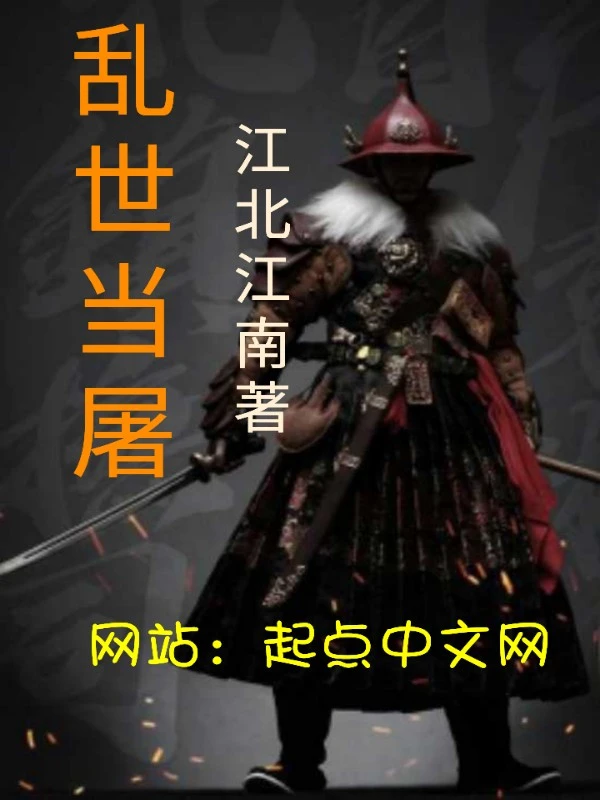
A Massacre in Troubled Times
乱世当屠
- Status
- Completed
- Length
- 77k Words
- Genre
- Historical
- Audience
- Male
- Subgenre
- Song-Yuan-Ming Dynasties
- Updated
- 7y ago
- Source
- Qidian
Stats
0Monthly votes
12Recommends
0Fans
39Chapters
Synopsis
Reader comments
Readers also read
 1914 Begins with the Rejection of the Schlieffen Plan
 Please Call Me Your Majesty the Tsar
 Talker in the Song Dynasty
 In the Red Mansion: Escort Daiyu to Beijing at the Beginning
 The Reborn Fashion King
 China Entertainment, as a Patriotic Person, I Am Fully Open to Capital.
 Exchange Souls with the Villainous Lady
 Tokyo: Starting from Pretending to Be a Boyfriend
 Fusion of Wolf Spider Genes, Killing Like Crazy on the Russian-Ukrainian Battlefield
 Starting from the Strange Ming Dynasty
 Chang Sheng: If God Can't Reward Those Who Work Hard, I'll Just Do It
 The Immortal Sect Has Been Imprisoned for Eternity, I Will Deal with the Gods and Demons
Read history, look at history, practice brings true knowledge, knowledge of civilization First of all, as a senior reader, I have been reading books for more than ten years. I also wrote a few books intermittently, and of course I read more. The history of the Ming Dynasty, as one of the four major disaster areas in ancient times, I often pay attention to and participate in this issue. Before discussing the history of the Ming Dynasty, we have several questions that must not be avoided. ① Primitive society Slave society Semi-slave semi-feudal society Feudal society The relationship between modern society, which one is closer to modern society, of course you can look at the history of the East and the West. It was the West that first entered modern society and then led the world. Comparing all aspects one by one, you will find that the primitive society is closer to modern society. Are you surprised by this result ② Analyzing Eastern history, if all ancient farming dynasties belonged to feudal society, then the minority regimes (such as Dayuezhi, Xiongnu, Goryeo, Dali, Liang, Jin, Yuan, Mongolia) Ancient, Manchu and Qing dynasties), were they a slave society (or a semi-slave and semi-feudal society)? Why could feudal society basically not be able to defeat slave society? What was the reason? Why could a large population fail to defeat a small population? The obvious answer is that feudal society was not as capable of mobilizing as slave society, so it could not defeat it. ③All the farming dynasties in the East, starting from the Qin Dynasty, were almost all feudal societies. The rulers have always governed the country solely from the Confucian school, and the mobilization ability is only the right of the royal family. In the West, various sects and kingdoms have been combined. Both the sects and the kings have the mobilization ability. Sometimes the king is not as good as the pope. It is interesting to compare and find that the emperor has no one to check and balance, but the king has the pope to check and balance. Isn't it interesting? Then we have a question, why does the emperor have no checks and balances? It's because the church cannot develop. Why? Because the church has been suppressed by the rulers in the East (Buddhism in Thailand became the Shaolin Temple in the East, Christians became red-haired ghosts, and local Taoism and Red Lotus were rebels), haha! Have you discovered that the West is more ignorant than ours? ④ Why can the West take the lead in developing modern society (and also have the throne), but the East cannot, but must look to the West for guidance? It is not because Easterners are not as smart as Westerners. The only answer is that we have taken a detour, and we are going further and further on the detour and are unwilling to come down. ④After reading the above articles, you will find that our feudal society is not as good as the Western slave society (the West was a slave society in the Middle Ages). Of course, we do not look at the problem from the perspective of the rulers, but from the perspective of the masses. Did this result subvert your knowledge? Did you feel shocked? Then let's discuss when did we in the East start to take a detour. Looking back on our history, it was not until Qin Shihuang that we began to only respect Confucianism and abolished hundreds of schools of thought. Well, we started from the Warring States Period. What are the deeds of Qin Shihuang? Building the Great Wall and the Terracotta Warriors unites the six kingdoms, only respecting Confucianism and abolishing hundreds of schools of thought. The Terracotta Warriors and Horses of the Great Wall are scenic spots, uniting the six kingdoms is a merit, and respecting Confucianism is a fault. Is it different from what we have learned? With the above overall view, we are looking back at the history of the Chongzhen period of the Ming Dynasty. We can look at the essence through the surface and analyze the personal psychology of this era. For example, during the Chongzhen period, which one of Chongzhen and Apocalypse was more suitable to be the emperor in the late Ming Dynasty, it was obviously Apocalypse (of course we don't want to see whether Apocalypse's death was normal or not). History will not change. We need to look at a group of people in that era and classify them into stages. This way the social relationships will be clearer. After all, they belong to a feudal society. Chongzhen, eunuchs and eunuchs, farmers are the foundation of the Ming Dynasty, and eunuchs belong to the loyal royalist party (why eunuchs are placed in front of eunuchs is because without eunuchs, there would be no eunuchs). The Donglin Party (including other local parties, etc.), Businessmen, landlord clans, and the military belong to the bourgeoisie of feudal society. For this class, they can live without an emperor, but they cannot live without status. Note that farmers had no status in feudal society. Although there were divisions between scholars, farmers, industry and commerce, the farmers mentioned here were not farmers, they were clansmen. In feudal society, no one cared about farmers. Eunuchs were all farmers (eunuchs who were not farmers had no self-esteem and could not survive). If you think about it carefully, eunuchs are born royalists and fight against the bourgeoisie. Now that I understand the social class, let's look at the events of the Ming Dynasty. It is very clear that those things are beneficial to the Ming Dynasty and those things are detrimental. Let's take a look at what Chongzhen did (we don't deal with people, and we don't say what this person is like), kill the eunuchs (we haven't established a force to balance the Donglin Party, and don't understand the way of balance), raise taxes (there is no eunuchs anymore, it is the bourgeoisie that collects taxes, and they will all be added to the untouchables. The untouchables can't live anymore and will definitely rebel under the leadership of careerists). Chongzhen didn't have the eunuchs, how can the money of the bourgeoisie be handed over? If you don't have money, you can only continue to raise taxes, forming a vicious circle; abolition of the inns will only make you blind, and then the situation will get out of control. In this case, it is unreasonable for the Ming Dynasty to survive. Finally, we look at Li Zicheng and Zhang Xianzhong. The uprising of the untouchables is a matter of course. What is good or not is whether they can truly stand on the standpoint of the untouchables. It is obvious that it is possible at first, but gradually it becomes impossible. Therefore, this is a tragic history of struggle that can be praised and lamented. Finally, as the times progress, our horizons will become wider and wider, and our knowledge will become more profound. Let's work hard together! Everyone
Very good, relatively realistic. This is the most rewarding historical novel I have ever read!