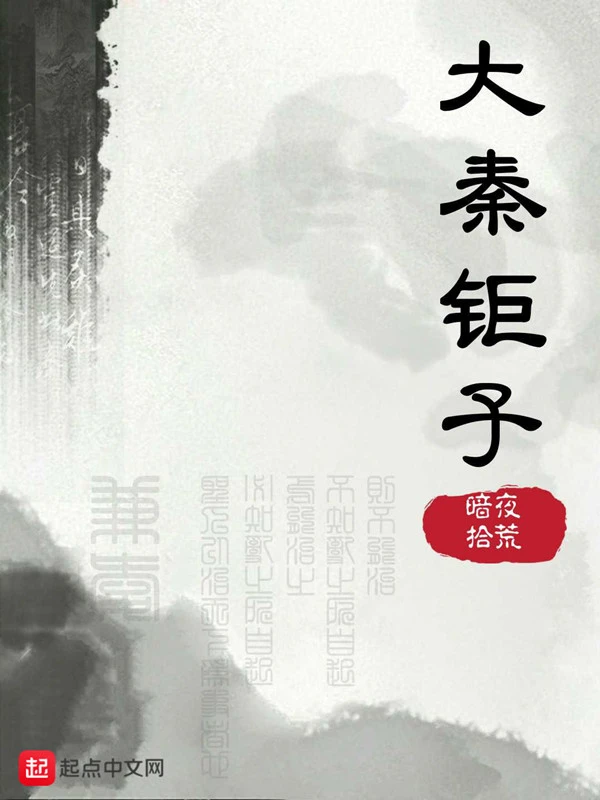
Da Qin Juzi
大秦钜子
- Status
- Completed
- Length
- 2.0M Words
- Genre
- Historical
- Audience
- Male
- Subgenre
- Qin-Han & Three Kingdoms
- Updated
- 6y ago
- Source
- Qidian
Stats
Tags
Synopsis
Reader comments
In booklists 16


Travel Through the Sea of Books
📖📖📖There is a road to the mountain of books, and diligence is the path, and there is no limit to the sea of learning, and hard work is the boat! 🔊➕ "The edge of a sword comes from sharpening, and the fragrance of plum blossoms comes from the bitter cold!" 📝📝📝Knowledge is power - Bacon 🌟1. Books are the ladder of human progress - Gorky 🌟2. Books are inseparable life partners, friends and mentors for young people - Gorky 🌟3. The influence of people is short and weak, but the influence of book

My Favorite
The busy and fulfilling year of 2018 has come to an end before I know it. It's actually quite hard for me, the baby panda, to look cute while chewing bamboo every day. But while I was busy, I also read many good books. Looking back, I read too many books in 2018. It feels like I chewed more bamboo than I usually do. To be honest, as I chewed bamboo and read hard every day, I really found a lot of books that I couldn't put down. Now I will carefully select a few books that I feel are the best. Go
A Collection of History Books
Now I like history books, which are very interesting, so I want to create such a book list.

Moderator Recommendation
Friends who like it, please remember to pay attention ❤ Oh, if the new book is not popular, it will be removed and replaced with another book. The most popular books are not included, most of them are half-popular but really good-looking, and some are just seedlings. It contains both the work of enlightenment and the beginning of cultivation. The attractive thing about seedlings is their imagination. Often many seedlings can make your eyes shine. Unfortunately, many of them become blind after th
Whole Grains
💦💦💦💦💦💦💦💦💦💦💦💦💦💦💦💦💦 The sea is open to all rivers, I am an omnivore, I'm happy! Although there is picky eating behavior, he does not only eat one kind. Not bad, That's who I am! I have a story, do you have tea? As for books, as long as they are good-looking books, I will try them. Ah, sometimes I like it so much, At this time, I will recommend it to everyone seriously, Share my joy of reading with everyone! However, There are so many good books about Qidian. Every time I look for a good book, I am
Happy Every Day
The theme of this book is happiness and happiness! This book is just a joy! Happy! Casual! To make friends The books I've included are all my favorites! If appropriate, some interesting articles will also be added, including history, military, fantasy, science fiction, martial arts, urban, fantasy, fairy, supernatural, etc. Because I am happy, I am happy O(∩_∩)O I hope to bring my joy and happiness to everyone! Friends, if you have any good books, please tell me in the comment area. Good bo
The Immortal Spirit Breaks Through the Nine Heavens
Those who must install it must bring their own lightning rod Those who must install it must bring their own lightning rod Those who must install it must bring their own lightning rod
Sea of Books Taobao
——First of all, let me introduce this book list. This book list was dug half a year ago. I have been very busy, so I just left it there without paying attention to it. Today I saw that many book friends have their own book lists. The various fancy ways to play on the front page of the book list made me itchy, so I decided to stay up late and add a few of the fairy grass and fairy flowers that I usually read and like🌹! 🐥—🐥—This book is still about golden crispy chicken, and it requires everyone'
There Is Beauty in the Book
Share the "Zi Feiyu" Kong Jing version with everyone (I made a slight modification, the Kong Jing replaced Keiko's name as Gang Zi!) Zhuangzi said: "The fish swims calmly, which is the joy of the fish." Gangzi said: "You are not a fish, how can you know the joy of fish?" Zhuangzi said: "You are not me, how do you know that I don't know the joy of fish?" Gangzi said: "You are not me, how do you know that I don't know you and don't know the joy of fish?" Zhuangzi said: "You are not me, how do you
Personal Book List, Added from Time to Time. Gu Gu Gu Gu
Comprehensive comics, rebirth, unlimited, mostly systems
Historical Military
A veteran of historical novels, able to see through all kinds of tricks
Female Readers Who Love Watching Male Videos
Just what I like so far. If you don't ask for it in vain, I would like to write an article with online IQ! I like to read history, hegemony, farming, and the end of the world. Because of the lack of books, I even watched male videos...


Bookworm's Personal House of Wonders and Wonders
Good books I've been reading and reading recently


I Like to Watch
I like it

Observation Book List
Observe

Task List
Task
Readers also read
 Talker in the Song Dynasty
 1914 Begins with the Rejection of the Schlieffen Plan
 Please Call Me Your Majesty the Tsar
 In the Red Mansion: Escort Daiyu to Beijing at the Beginning
 The Reborn Fashion King
 Strategies for Revitalizing the Northern Song Dynasty
 Struggle in the Last Years of Hongwu
 Tokyo: Starting from Pretending to Be a Boyfriend
 Fusion of Wolf Spider Genes, Killing Like Crazy on the Russian-Ukrainian Battlefield
 Ming Dynasty Started with Caution
 My Neighbor Is the Emperor
 Emperor Zhengde
 Reborn as a Pirate
 Super Amateur Feng Shui Exploration
 I Became a Sacrifice to the Evil God
Thought 5 - Differences in perspectives between the author and the reader: Xin Ling's character creation
Compared with the previous articles, this article is more based on my personal subjective feelings as a starting point to write some of my own feelings. In this novel, I particularly like the character Xin Ling, but this character's role ended abruptly after chapter 400. This kind of discomfort has made me think about the author's creation of this character these days. After thinking about it, maybe on the one hand, the author values the plot much more than the characters, and on the other hand, it is also the difference between the author and the reader's perspective on a character. From the author's point of view, especially for a character like Xin Ling who will affect the entire plot structure, he should have thought about the arrangement of this character in the entire book from the time he started writing. For Xin Ling, he was the one who led the protagonist to understand and approach the Mo family in the early stage. After the protagonist replaced Xin Ling and became Zhao Mo's fake prince, and won the position of Chu Mo's fake prince, the significance of this role in the Mohist family had ended. The protagonist will enter the officialdom of Da Qin next, so how to connect the protagonist with Da Qin? The personal friendship between the hero and Fusu is not enough. For this reason, Xin Ling once again plays the role of a tool. From this perspective, Xin Ling's fate was calculated by the author. However, for readers, these plots in "Juzi" are not so adaptable. For the female character who first appears in front of the protagonist, and stays with the protagonist for a long time, accompanying the protagonist from birth to death, even if she is not the heroine, at least she is the soul character throughout the entire novel. However, after four hundred chapters, Xin Ling disappeared from the protagonist and reappeared as Fusu's wife, and her appearance frequency became less and less. For this situation, there must be a strong sense of discomfort. In fact, if you think about it, the author has laid the groundwork for Xin Ling to leave the protagonist from the beginning. From repeatedly mentioning Xin Ling's identity as a princess, to Li Ke having no feelings for Xin Ling between men and women; from Xin Ling always portraying an image of ideals above all else, to Xin Ling taking the initiative to walk side by side with Fusu. Even before Xin Ling got married, there was a plot where Qin Shihuang specifically mentioned his "daughter-in-law", telling readers not to have Xin Ling's ideas, as this character would inevitably leave the protagonist. Just from the reader's point of view, it is difficult to imagine that this character who has been fighting for Mo Yi to death will suddenly get married. Especially in the chapter when Xin Ling leaves, there is no interaction between the protagonist and Xin Ling, which makes us (we) mistakenly believe that things have turned around, or even Xin Ling will not leave at all, so that such an important character will not end his mission hastily. But the result is that Xin Ling really changed his mind like this. For readers (me personally), after nearly a week of continuous thinking and sorting out, they can probably figure out that although this character is more sad than happy, her fate is somewhat lucky for her. In that era, as a woman, she had ideals and abilities, and she met a good match like Fusu who couldn't even be described as being blessed by a god. But from the perspective of the overall plot arrangement and readers, such a character is tragic. The tragedy is that Chapter 400 is the dividing line, and the contrast between this character before and after is too obvious. The first half is amazing, but the second half is really helpless, and the ending doesn't even get a single line. This before-and-after comparison and the sloppiness at the end make people wonder what Xin Ling became in the end? Have her ideals changed? Is she still cold to Fusu? Is her relationship with the protagonist still as good as before? Unfortunately, there are no answers to these questions. The novel "Juzi" has been completed for more than a year. It is unfortunate that it is difficult to have the opportunity to ask the author to give an explanation for the character Xin Ling. Personally speaking, after writing these thoughts, I have more or less the outline of this image in my mind. If I were to temporarily override my identity as a reader and speculate on the author's original intention of creating this character, supplemented by the author's reply, the character Xin Ling did not change his ideals until his death. However, since the Mohist family and Li Ke no longer need Xin Ling's help, and the subtle relationship between the Mohist family and Da Qin later in the plot, Xin Ling is probably just Being able to insist on one's own beliefs in the heart, but rarely having the opportunity to take action, this is undoubtedly in conflict with the image of "taciturn but quick to act" in his character introduction. In my personal opinion, for such an idealist who pays attention to practical work, depriving him of the opportunity to realize his dreams is worse than taking his life. As for the relationship between Xin Ling and Fu Su, it can actually be seen from the later stage that Xin Ling's character is wise, and her attitude towards Fu Su has been softening. So in the end, the relationship between Xin Ling and Fu Su should be more like that of a modern old married couple (but Xin Ling may be a little more forceful in daily life and not express opinions on the overall situation). As for her relationship with Li Ke, it is probably the most difficult to guess. Because the two hadn't seen each other for too many years, and thinking about it, there was really no special reason to meet later. Especially for Li Ke's return to the Qin Dynasty in a strong position, apart from pure "old friends reminiscing about the past", the meeting between the powerful officials and the queen was awkward. Of course, for Xin Ling, whether it is reminiscing about old friends or concerns about identity, they are probably not issues she considers. This also makes it more difficult for us to guess the relationship between the two. It is indeed rare for the author to forcefully portray the second male lead's wife as the female lead like this. On the one hand, this is indeed a good thing. It shows that when the author writes, he wants to tell a complete story with a spiritual core, rather than just a means of making money to please readers. But from the reader's point of view, I hope the author can take the reader's mood into consideration, even if it is not a good death, at least give such an important female character a complete and decent exit. Counting the one I posted in "Pirates", I have written a total of five reflections on the book "Juzi". Each article brings new understanding as I write it. Maybe I like this character too much. After reading it on Monday, I was obsessed with the plot details of "Juzi" for the whole week, and my work efficiency at work was reduced hahh. Overall, I thank the author for his creation. Thank you. I may still write my thanks for this book later, such as Li Ke or Fu Su, but I am afraid that I will no longer have such a strong enthusiasm for writing.
Emmmm The author's character design is really not pleasing to the eye. He needs to put more effort into the characterization of the characters. It's not because our aesthetics are different, but it feels stiff and jerky, and sometimes even embarrassing. Creating characters is not just about having characteristics. The vividness of the characters lies in the deep and solid description. For now, my interest can only focus on the plot.
Feelings 3 Xin Ling's feelings for Mo
Xin Ling's feelings for Mo became complicated after Mo got married. On the one hand, it is the place where I grew up and where my beliefs and ideas are, but on the other hand, it is the place where I was deprived of my identity as a Mohist. Fortunately, the author clarified my doubts and figured out some details, which I would like to share with you. Xin Ling's feelings towards Mo and towards the Mo family are different. For the Mohist family, the former emperor drove him out of the house. Xin Ling acted cautiously, and also had feelings of "cannot bear to think" and even hatred towards the Mo family. However, Xin Ling's ink painting was not only a careful arrangement, but also Xin Ling's own rational decision. In addition, Mo's spirit is an ideal that he always firmly believes in even if he is not a disciple of the Mo family. Therefore, from our perspective, it is difficult to figure out what Xin Ling's feelings for Mo are. The author mentioned in his explanation that whether in the Mohist family or in the Qin Palace, Mohist thought has always been Xin Ling's belief, and the use of Mohism was only a political consideration. In order for the Mohist family to take root better in Da Qin, Xin Ling originally wanted to cut off all apparent ties with the Mohist family, as if he had never had a Mohist family background. But secretly, he tried his best to help the Mohist family. But this idea was broken by Li Ke. Li Ke is worthy of being a born saint in the book. He does not need Xin Ling's sacrifice. Even if Qin Shihuang does not trust the Mohist family who is closely related to the crown princess, and even if the Qin State's opposition is huge, Li Ke can break through all obstacles and create a world. Therefore, under Li Ke's insistence, Xin Ling did not cut off the contact with the Mo family, at least with the Mo family's Juzi. After Li Ke's disruption, the situation seems to be more complicated. According to the author's current understanding, after Li Ke expressed his feelings to Xin Ling, Xin Ling no longer cared about letting others know about his close relationship with the Mohist family, at least he did not want to completely disconnect it from the outside like before. So when Li Ke attacked Juzi, Xin Ling, who was married and married, took the initiative to ask Li Ke a question on behalf of Zhao Mo in front of the Mo family and Fusu. During the following years of Qin Shihuang's reign, he did not shy away from communicating with Li Ke. Even if Xin Ling resists the Mo family psychologically, since she and the Mo family's Juzi share the same sibling relationship, there is no point in showing her neutrality to outsiders. Xin Ling himself also knew that his connection with the Mo family could not be severed. However, what is Xin Ling's position for herself at this time? Is it for the Mo Yi believer who marries Fusu for the Mo family, or for the Qin prince concubine who believes in Mo Yi? There is a fundamental difference between these two situations in terms of primary and secondary. Fortunately, Fusu Zhiren and Li Ke Zhiqiang, the combination of the two created a living environment that did not require Xin Ling to make a choice (not surprisingly, this content will be elaborated in the next reflection). Therefore, during the reign of Qin Shihuang and the following ten years when Fusu was King Yong, Xin Ling was both the prince's concubine and a Mohist outside the Mohist family. However, in the year when Fusu ascended the throne, the Mohist family left Qin for the third time. This incident had a considerable impact on Xin Ling's identity and attitude towards the Mohist family. This impact is not sudden, but long-lasting. Before leaving the Qin Dynasty for the third time, the reason why Xin Ling could maintain close contact with the Mo family was due to Li Ke's personal relationship, as well as Mo and Yong's relationship. Xin Ling saw and heard ink every day, so he naturally maintained his identification and inclination towards ink. But the third time he left the Qin Dynasty lasted ten years, and Li Ke and Xin Ling did not see each other for 11 years. During these 11 years, it can be seen from the author's description that Xin Ling did two things in total. He ordered Mo Wei to assassinate Meng Xie and sent Zhao Er to study with Li Ke. In addition, Xin Ling seemed to be just Empress Mo Li of the Qin Dynasty, assisting Fu Su and raising her husband and children. After being separated from the Mo family for 11 years, even Xin Ling may gradually fade away from his feelings for Mo. Not forgotten, but simply faded away. Of course, by this time, Li Ke's image as a saint had already reached its peak, and the Mohists were rampaging across the land of Qin like monsters of capital. The Mohist family no longer needs Da Qin, and the Mohist family will even develop better without Da Qin. To say that Xin Ling no longer shows his glory as a Mohist, it would be better to say that the mission entrusted to Xin Ling by the Mohist family and by Xin Ling to himself has ended. Xin Ling retired after his success. The Mohist family, which had grown up under the joint cultivation of Li Ke, Fusu, and Xin Ling, no longer needed Li Ke's guidance, Fusu's compromise, or Xin Ling's secret protection. Xin Ling is like a retired old man who puts down the burden of persisting in his life and returns to a simple person. Deep down in his heart, he firmly believes in the truth that he has believed in since he was ten years old. A wife and mother, she ended her life at the age of fifty-two (three). It can be considered a happy ending. As a reader, it is a pity that the author did not pay much attention to this strange woman in the later period. After Xin Ling succeeded and retired, no extra attention or writing was given to her. After seven hundred chapters, she only made a few necessary appearances, and Xin Ling was not left with anything to think about the world, the protagonist, or the readers. Perhaps this is more in line with Xin Ling's character. He comes and goes freely, without saying meaningless words. Since he wants to think about it, there is no need to rely on words. Confusion is the dizziness of freedom. After Xin Ling became a Mohist, he may have experienced such confusion, but with the emotional help of Fusu and Li Ke, Xin Ling finally found his own position: not a Mohist disciple, but the Mohist in his own heart. He is not bound by the rules of ink, but plays his role according to the ink spirit in his heart.
Why! I am deeply impressed. One is Zhao Bai and the other is Canghai, two living treasures in this article. I didn't expect it to end like this. Why.
Thoughts 2——Xin Ling and Gui Moli were two people
In "The King of Qin", there are three people who have lived in two lives. It goes without saying that the protagonist Li Ke has lived in two lives. He was born a saint and knew the secret from birth. Fusu is not complicated either. Fusu and He Hua form the basis for Li Ke's understanding of Fusu's monarchs and ministers. He Hua's experience is also an important reason why he can still coexist peacefully with the Mohists and Li Ke after he ascends the throne. However, neither Li Ke nor Fusu encountered much difficulty when facing the change of identity. Li Ke believed that he was Li Ke since he was born in this world. Although Fusu encountered identity difficulties after returning to Qin Gongzi, he was still not separated. Only Xin Ling, Xin Ling and Mo Li were two people, and the change of identity brought her great pain. Identity is very important to a person. Identity forms the foundation of our lives without even realizing it. "I" have a name, I am the child of my parents, the friend of the people around me, the best friend of the people I grew up with, and the husband of my wife. Losing identity means not only losing one's name, but also severing our social relationships and tearing apart one's self-personality. Even without mentioning these, we can understand how it feels when a person loses his past. This girl was brought up by her master Shen Xing since she was a child and named Xin Ling. Wearing straw sandals and brown clothes, practicing Moyi, he is a fake man. In Xin Ling's life, he believed in universal love, non-aggression, economical use, frugal burial, heaven's will, Minggui, respecting the virtuous, advocating unity, non-happiness, and non-fate; practicing swordsmanship and studying mechanisms were his life; beans, rice, soup and lotus root were his diet. Brothers who are traveling with us should be careful to be teachers. The Mo family constitutes everything about Xin Ling, and Xin Ling constitutes everything about this girl. At this time, Xin Ling was a Mohist from heart to body. When Li Ke showed amazing machine skills, Xin Ling sighed that Li Ke was not a Mohist; Li Ke saw that Shen Xing was not high and walked away, Xin Ling was so angry that he wanted to kill Li Ke; in order for Zhao Mo to return to Qin, it was difficult to break the teacher's order. All this is for the Mo family. Although Xin Ling does not hate Fusu, she does not necessarily like Fusu. The sentence "Teacher's orders cannot be violated" in Chapter 433 is proof. However, after Shouchun, Xin Ling entered the Qin Dynasty, and his position and identity underwent major changes. Before entering the Qin Dynasty, Xin Ling met Qin Shihuang, and Ying Zheng called him Mo Li. Xin Ling showed strong resistance and helplessness. However, after entering the Qin Dynasty, Xin Ling no longer existed, and this girl was just Gui Moli. Fu Su and Ying Zheng both called themselves Mo Li, but Xin Ling couldn't find any trace of him. You can imagine how this girl spent the days after her wedding. The master ordered him to produce ink, and the girl was no longer an ink artist. From that day on, he wore cloth shoes instead of straw sandals every morning; he wore black clothes instead of brown clothes; he was no longer surrounded by Mohist disciples but people from the palace of Qin. Slowly, Xi Jian's life turned into a hobby, and his diet was not all beans, rice and soup. All the changes reminded this girl that she was no longer Xin Ling, and Xin Ling's pride made this girl understand that since she had become a Mohist, she could no longer restrain herself by the requirements of a Mohist, let alone consider herself a Mohist, and the ten righteousnesses of the Mohist family that she had pursued even to death had to be abandoned. So who is this girl? Fusu and Emperor Qin both called her Mo Li, so this girl will be Mo Li from now on. Mo Li is the princess of Fusu and the future queen of Qin. The princess of Da Qin, Mo Li, wore mysterious clothes and ate delicacies. But how easy is this transformation? Once, Xin Ling was everything to this girl, and Gui Moli was just an empty shell with nothing. But after that day, Xin Ling seemed to have died, and this girl was living in the world with an empty shell. It is precisely because of this that in Chapter 438, Mo Li stayed in the Mo family for a short time. Fusu said, "Although I smile a lot more, my heart is very painful." The teachers around him are still the same, the brothers are still the same, Mo Yi is still the same, and the brown clothes and straw sandals are still the same, but he is no longer Xin Ling. If you live in the Qin Palace, you can still hide yourself from others, but you are surrounded by Mo people, but you are Mo Li. Fortunately, there is Li Ke. Mo Li originally planned to give up everything and painfully maintain the personality of the princess Mo Li. In Chapter 432, Li Ke said, "The teacher wants you to marry Mo Li... But it has nothing to do with you and me at this time. We are from the same school and are sisters for the rest of our lives." Only for Li Ke, this girl may not be Xin Ling or Mo Li, but just a senior sister; this person is both Xin Ling's junior brother and Fusu's best friend. To him, this girl is both Xin Ling and Mo Li. Li Ke's existence connects the girl's past and future, and connects Xin Ling, who is close to disappearing but only left with pain, and Li Ke, who is reality or has no sense of reality and the past. After Shen Xing died, Xin Ling became Mo Li, but with Li Ke, Mo Li could briefly resurrect Xin Ling. We don't know when this girl completely accepted the fact that she was already Mo Li. What is certain is that the girl who felt "very bitter" when she saw the disciples of the Mo family has not yet let go of Xin Ling's past. When Fusu established himself as King Yong, the Yong Kingdom and the Mohist family were one and the same, which may have given this girl an opportunity to get to know herself and sort herself out. A few years later, when Li Ke was plotted by Qin's domestic and foreign forces, Canghai died, and the Mohist family came out of Qin for the third time. At that time, Mo Li was able to use the Mohist power to assassinate the Meng family orphan without any burden; after sending his son to his junior brother At that time, the message was not about revenge for the three thousand beasts, but about venting his anger on his junior brother. We knew that Xin Ling was no more, and there was only Mo Li in the world. Only Li Ke's heart left a trace of life for Xin Ling, who had borrowed his corpse to resurrect his soul. But ten years had passed by then. When Fusu invited Li Ke to enter Qin again, there was an interesting episode. Fusu asked Mo Li if he wanted to go to see Li Ke together, but Mo Li refused. At this time, 11 years had passed since the Mo family left Qin, and Li Ke and Xin Ling had not seen each other for at least 11 years. But at this time, Queen Gui Moli of Da Qin did not go to see Li Ke. The girl's reason was that "men don't talk about state affairs, but women can't get in the middle". But when an incident involved both Li Ke and Fusu, the girl's words to Fusu were often perfunctory. For example, when Xin Ling asked Li Ke to accept a disciple, both of them knew that the reason why Li Ke agreed was because they were siblings, but Fusu said that he was forcing Li Ke with a sword. Here we can also guess the reason why Xin Ling did not go to see Li Ke. There are three possibilities. The first one is that Fusu represents the imperial power and is an aristocratic force; Li Ke represents the Mohist family and is a reformist. There is a natural class conflict between the two. Even when Fusu asked Zhao Gao about Mengtian's whereabouts and was afraid to learn that Li Ke had killed Mengtian, Mo Li was by Fusu's side, and it was Fusu who bowed his head to Li Ke. Mo Li, who was already the Queen of Da Qin, had no way to face such a situation. No matter Xin Ling as Mo Li or living with Li Ke, there was no way to face such a contradiction. Second, at that time, Mo Li was completely Mo Li, and the Mohist family was no longer "particularly important" to him. She was just the queen of Qin. Therefore, killing Meng Xie was not for revenge, but only to vent anger for Li Ke. Although this possibility is a pretty good ending for Li Qiye, it is the greatest cruelty to this characterization, to Xin Ling, and to that girl. This means that this character has completely lost its original charm. I don't know how the author chose it, but I personally don't want to believe it. Of course, we can imagine the third, more complete possibility. For this girl, Xin Ling or Mo Li is meaningless. This 43-year-old girl finally stopped being confused. She is both Xin Ling and Mo Li, the Queen of Qin, and the former Mohist, a fake king. Therefore, Mo Li can command the Mohist assassins, but does not avenge Biuan; Da Qin's bowing to the Mohist family is not only the preservation of Qin but also the prosperity of Mohism; her husband's compromise with his junior brother no longer requires her help. In the author's writing, in addition to the title Fusu, "Xin Ling" is also often used to refer to this girl. From a personal perspective, this is the free and easy, selfless and caring Xin Ling that he was when we first met him. In the book "The King of Qin", the world is a melting pot, and the people are turbulent with the actions of a "Long Aotian" character. Among the many characters, the three people who are second-generation people share hardships and hardships. And this girl - Xin Ling and Gui Moli, between the two male characters, is even more dazzling and unforgettable.
This book is quite interesting. The harem was very normal. It was very much due to the patriarchal era at that time. Women would not be admitted randomly.
It's wonderfully written, but it makes me tired to read it half in vain.
Feudal past and present life
Today, when I was talking about Peeping Chapter, I saw a post like this. The general idea is that "feudalism" as a social system originated in Europe, and it is a misuse in China. The early teaching materials were wrong, and experts also admitted it. Regardless of whether this statement is a rumor or confirmed, in short, this post reminds me of the very hot debate on the term "national hero" a few days ago, so the fire of controversy was raging, and the 150-word reply space was simply not enough. Let's talk about the word "feudal". It's still the old rule. The following only represents the opinions of one family. If you like it, you will like it, if you dislike it, everyone will discuss the matter. The word "feudal" comes from the "Poetry. Shang Ode. Yin Wu": "The fate is in the lower country, and feudalism is blessed." The original meaning is to build a feudal state, and the extension is full of "special rights and wealth are owned by special individuals." This is what Baidu said. It is a rare definition that is accurate and unambiguous. The feudal period was based on land, so special wealth must refer to land. The private ownership and control of land is "special rights wealth". To put it bluntly, feudal society is a political form that realizes and guarantees the land privatization model in the social stage where land is the foundation of the country. Similarly, the English translation of feudalism is "feudalism". Youdao quotes the example sentence from Collins English-Chinese Dictionary as "As feudalism decayed in the West it gave rise to a mercantile class." With the disintegration of the Western feudal system, the commercial class came into being. This sentence also focuses on the fundamental wealth of society, rather than illusory institutional regulations. It can be seen that the word feudal, whether in its original or extended meaning, whether it is positioned in the East or the West, has never had anything to do with the political system. The Western lords' dictatorship can be called feudal, and the Eastern monarchy and dictatorship can also be called feudal. What's more, even in the short history of Western feudalism, lords had varying degrees of control over land, and dictatorial monarchs also appeared. Not to mention, Napoleon was still lying on the grass of the French Invalides. If an expert really thinks that feudalism is a misuse of China, how should he define the feudal period in the West? Is it necessary to specifically set aside those autocratic kings and create an intermittent feudal era? In summary, feudal originally meant to establish a state, and its extended meaning was land private ownership. The Qin Dynasty named the land boundary "feng", which is obviously the development and characterization of the meaning of the word. Kaifeng Jianqi was feudal. Although the social system that regarded slaves as core wealth began to disintegrate since the Warring States Period, the clear private ownership of land began in the Qin Dynasty. Therefore, the statement that Chinese feudalism began in the Qin Dynasty can withstand scrutiny. At least on this point, the textbook does not mislead students.
The rulers of the Qin Dynasty very much welcomed advanced production tools and technologies. If their laws did not adapt to the development of productivity, they would basically improve the law, instead of following the old ways and suppressing the development of productivity like other dynasties. This is because Qin has always been a pioneer in reform. As I said before, if new technologies and tools make rapid progress in agriculture, the government will reward the parties involved very greatly, so I think the author has handled this point well. , I feel baffled, the Qin Dynasty's idea of governing the country is not Confucian, why should the protagonist hide it?
I would like to ask what is the point of this book? Why do I feel that the struggle for power outweighs the development of technology. For more than a hundred years I have been fighting with this person and that person in a small place. I wrote a few about the development of new technologies, but I immediately wrote about them again because the new technologies conflicted with other people's interests. If we keep writing like this, we might as well change the title to "The Fighting King of Daqin Village"
I don't know the author's setting of the protagonist as a legitimate son of a prince in trouble. If he is, he can be called a son, but if not, he cannot be called a son. The protagonist's concubines are called the protagonist. If the protagonist is the head of the family, they are called master, husband, or master. If the protagonist is not the head of the family but is the legitimate son, he is called the young master, young master, or young master. The concubines call themselves servants. The protagonist's staff calls the protagonist Lang Jun, Dong Zhu, Shao Lang Jun, and Shao Dong Zhu, and the staff calls them XX. The subordinates who are personally attached to the protagonist call the protagonist Lang Jun, Shao Lang Jun, Lang Zhu, and Shao Lang lord. The subordinates call themselves disciples and subordinates. The protagonist's subordinates who have no personal attachments call the protagonist Lang Jun or Shao LangJun. If the protagonist has an official position, they will use the official title. The subordinates call themselves XX.
I don't know if the cultural level is low or for some reason it seems difficult! Neither ancient nor modern, neither foreign nor native! Junk article
The writing is okay, but the plot is old-fashioned. Do you think it's appropriate to use the novel technique to write a web novel? The villains are everywhere being led around, and a small invention is used to add various conspiracies. How is this different from the previous Stallion novels?
Chapter 20: Being a cheap person, plus intrigues, daily fun? Consider him funny! It's not until Chapter 70 that you come out to meet people, and then what? Will I be able to make a machine tool after writing 10,000 chapters? Or is it too fast? I'm looking forward to it! (I'm sure we want to see the protagonist show off his "IQ" with several village chiefs and party secretaries in a three-thirds of an acre of land)
You have to fight to death after not doing a few things... There are too many plots about Machiavellian plots, especially the protagonist who is not good at plotting and is beaten to death by a township cadre. How can anyone like to watch it?
This young master is not that young master. This young master is a young master + a son. Gong is a noun. Zi is a modifier (adjective, adverb, quantifier, verb, and other similar words). That young master is a young master. Gong is a noun, and son is also a noun. The artistic conception, environment, identity, status, and influence of the two are different, and they cannot be used indiscriminately. The same is true for the word "adult".
Someone in the Qin Dynasty made inventions and created so many tools that were beneficial to farming. They were reported directly to the government and received huge rewards. They could also be promoted and make a fortune. How come the protagonist is so low-key? It's really uncomfortable for an engineering dog to have to write so many twists and turns.
Why do I feel like the author is deliberately creating conflict? Even if you don't create these conflicts. Just the various problems you encounter when making various inventions are enough to irritate you. Why bother deliberately creating conflict? Moreover, the conflict you create is a bit insignificant, and it seems a bit boring to people. Your writing is not good at creating conflict. When I read the conflict in your book, I will think of those other books. I hope the author can change it, otherwise it will be too embarrassing not to be able to read many places.
Hahahahahaha
Is this why Qin Shi Huang conquered the Six Kingdoms?
I always feel that the protagonist is a bit over-the-top, always looking at his own one-third of an acre of land, always worrying about the suspicion of the First Emperor, and what to do if Confucianism and Legalism flourish. I don't think there is anything to worry about, just go ahead and do it. Is Confucianism comparable to the thoughts of the time traveler who are two thousand years ahead of the times? What about the First Emperor's suspicion? Can you still put aside the benefits of the Mo family and not suppress the Mo family? Who can complete the industrial revolution in place of the Mohists? It is not a good thing for the Mohist family to be the dominant one. Everyone knows how Confucianism has degenerated after becoming dominant. Confucianism is corrupt at best, and Mohist degeneration does not know what will happen. Crazy scientists are much more destructive than corrupt officials. Leave other schools of thought to act as catfish to supervise the Mohist family. If the Mohist family can lose, it means that the Mohist family is a waste. You can still lose with such a huge advantage, but the mud cannot support the wall. It cannot adapt to the world at all, and there is no need to exist.
I can make steam engines, but I can't make paper. Are you kidding me?
The book is a good book, but I was too tired to read the machinations and schemes. I beat the younger ones and the older ones, one after another. And Xiao Suizi, he was just a little kid in the early stage. After his mother died, he became very resourceful. He was only eight years old.
It's simply hard to bear. We have to understand that in fact, most taxes in ancient times were not harsh. It was just the officials and gentry who imposed what they should have to bear on the people at the bottom. In particular, the founding emperor was nobody. He knew that he had to rely on the nobility, but he also knew that the people at the bottom were the cornerstone. He was more or less helpless because he could not find a good way to balance the two groups.
Speechless, don't look at the latecomers. Send daughter
It's neither fish nor fowl. To write a novel, you have to incorporate ancient nonsense sentences! And the time traveler is pretty bad, I don't know what he does all day long! A time traveler is not like a time traveler! Written by Bai Bubai, it is ancient! Looks strenuous
It feels like Jack Ma fantasizes about the life of a diaosi. I always feel like I am using newspapers to deduce the lives of civilians...
Thoughts 4 - Inevitability and contingency in the plot structure: Li Ke, Fusu and Xin Ling
Because there are too many ifs in this article, the quality may be low. Please forgive me The development of history is coupled by inevitability and contingency, and the same is true for historical stories. On the one hand, the development of the plot is affected by the historical environment, and on the other hand, different developments will occur with the intervention of important figures such as the protagonist. The story of "The King of Qin" is generally about the protagonist's industrial and commercial development in Da Qin. This overall plot structure is influenced by the impression of the Qin Dynasty and is also driven by a series of characters. Among them, the influence of Li Ke, Fusu and Xin Ling is the core. Whether the author deliberately arranged it or not, the story of "The King of Qin" itself is driven by three or four characters who have two lives. The first is Mozi. The mechanical knowledge he acquired through studying abroad transformed the original Mohist school in history. This laid the foundation for the Mohist school's special status in the Qin Dynasty and created conditions for the subsequent protagonists to enter Mozi. According to the timeline, the second one should be Fusu. Fusu came into the world as Yin Hehua and experienced various aspects of people's livelihood, which shaped his benevolent character. The third one is Li Ke, a born saint who knows everything from birth to death. The fourth one is Xin Ling. The dual identities of Xin Ling and Gui Moli connect Li Ke and Fusu, connecting the past and the future. Excluding Mozi, among the remaining three, each has a "just right" personality and ability that drives the development of the main line of the story: Li Ke is the strongest, Fusu is the best, and Xin Ling is the wisdom. Li Ke and Fusu can be said to be the core of the whole story. Although Fusu did not appear many times (in the early stage), if Fusu was left in "The King of Qin", the story would not be able to continue. In terms of identity, Li Ke is the great son, and Fusu represents Da Qin; in terms of plot, Fusu's arrival gives the young Li Ke a chance to break the situation and speeds up Li Ke's escape from the bitter wine; in terms of story structure, only Fusu's perfection can carry the development of the Mohist family, thus allowing the protagonist to complete the budding and development of industry and commerce in Da Qin. In these senses, Fusu is even another protagonist of "The King of Qin". Without Fusu, the entire story will undergo huge changes. Just as Li Ke said in Chapter 456, "If you don't want to beat the world to death, the only thing you can rely on is Fusu's kindness." Only Fusu succeeds to the throne, and only Fusu maintains perfection, can the Mohist family cultivate and grow the industry and commerce in its infancy. If this condition does not exist, Li Ke must stand on the opposite side of the empire and find a way out for the Mohist family. This historically rare, accidental act of goodness lays the foundation for the story. Li Ke is the protagonist of the story, but Li Ke does not live like the protagonist. Some readers think "The King of Qin" is a "Long Aotian" novel, but the biggest difference between the protagonist in this novel and the Long Aotian-style protagonist is that Li Ke's personal relationship is too inconspicuous. For his mother, wife, children, brothers and sisters, he has no desire or emotion that goes beyond the line. Of course, it is also related to the author's detailed description. Of course, we can speculate on the relationship between Li Ke and his children as a daughter slave. However, judging from the important plots in the article, Li Ke rarely lost his mind several times, including accepting Zhao Er as a disciple and avenging Cang Haijun. In this sense, Li Ke's title of saint is well deserved. But Li Ke's real and obvious character is his strength: after getting out of the bitter wine, Li Ke's strength is rampant across the land of China. He is a military god, a powerful son, and a politician. As long as Li Ke has the desire to become emperor, no one can substantially stand in front of him. Such a powerful protagonist created the Mohist school that transcended the times for nearly two thousand years. Only when Li Ke is strong can the story achieve the set goal. Otherwise, no matter how kind Fusu is, the buds of industry and commerce will be destroyed by the imperial forces. Li Ke and Fusu are like the two elements of Tai Chi, one yin and one yang. Li Ke is a gentleman who is strong in the sky and constantly strives for self-improvement. Fusu is a gentleman who is Kun in the terrain and carries great virtues. Li Ke constantly strived to build an extremely powerful Mohist school, and supported Su Houde to carry forward the thoughts and production relations that transcended the times for two thousand years. There is another interesting comparison: Li Ke can do many things because of Xiqiang. Li Ke can find a way out by himself without Xin Ling's sacrifice. While Emperor Qin was still praying for immortality and Fu Su was still asking about his future, Li Ke's eyes had already reached the point of deciding which prince should be chosen in order not to bring ruin to all living beings. In contrast, Fusu is unwilling to do it and cannot do it because of the supreme good. Fusu did not want to be suspicious of Li Ke, would not force Xin Ling, and would not refuse to compromise with the Mohist family for selfish reasons. Only when yin and yang are in harmony and the monarch and his ministers know each other can "Da Qin" and "Ju Zi" be united. Of course, Xin Ling's role is more secretive, but without Xin Ling, the story would also collapse. Without Xin Ling, Li Ke would not be able to get out of the bitter wine (or it would take longer); without Xin Ling, Li Ke would have been dead for a long time; without Xin Ling, Li Ke might not be able to connect with Fusu; without Xin Ling, the emperor and the emperor may not be at odds; without Xin Ling, the forces opposing industry and commerce in the empire would be stronger. The most important thing is that the person who connects the past and the future and makes Mohism and industry and commerce still full of vitality after Li Ke and Fusu withdraw from the stage of history is Xin Ling. Li Ke originally wanted to accept only one disciple, his eldest son Li Zhao. It was at Xin Ling's request that Li Ke accepted Zhao Yuyan and Zhao Er, and the latter two were the real factors that allowed the story to continue after Li Ke quit. Without Xin Ling, the ending of the story would be that Li Ke helped Su create the powerful Qin Empire. After the death of the two, the conservative forces of the empire quickly counterattacked, and Li Zhao was unable to recover. Just like Mozi's sudden appearance, history gradually returned to its original track. But with the existence of Xin Ling, history has truly changed, and the story of Da Qin Juzi is not limited to the more than 40 years that Li Ke was active on the historical stage. Therefore, Xin Ling not only communicated with Li Ke and Fusu, but its most important significance was to connect the past and the future. Coupled with a series of actions such as Xin Ling's ink, staying in Xianyang, and assassinating Meng Xie, it is fair to say that she is extremely wise. The three people each made a huge impact on the book within the scope of their own roles, and under the coupling of two, the story produced wonderful changes at the same time. The relationship between Li Ke and Fu Su has been mentioned above, and the relationship between Xin Ling and Li Ke has also been detailed in the previous articles. The following mainly focuses on Xin Ling and Fusu. This pair can be said to be the most peculiar pair in "The King of Qin". There is no reason to explain the combination of this pair except chance. Xin Ling had a very cold personality. Among the six princes selected by Qin Shihuang, only Fusu did not flinch, which made this marriage possible. When Xin Ling went out to marry someone, she might have been devastated. It can be seen from her plan to abandon the identity of the Mo family and cut off all ties with the Mo family. Another person might not be able to tolerate Xin Ling. After Xin Ling and Li Ke reached a tacit understanding, another prince might be suspicious of Xin Ling and wary of Xin Ling's possible influence from the Mohist family, not to mention Qin Shihuang's attitude. However, Fusu endured all of this. Accepting Xin Ling, who was from the Mo family, meant that he would be jealous of his father, be influenced by Li Ke in the future, and even be betrayed by his wife, but Fusu accepted Xin Ling just like that. With Xin Ling, Fusu would have a little more initiative when facing Li Ke in the future. For Xin Ling, meeting Fusu was her greatest luck. If the person who made the engagement with Xin Ling was not Fusu, Xin Ling might be jealous, suspicious, and wary. No matter which attitude it is, it will be another injury to Xin Ling, who was just sacrificed by the Mo family. Xin Ling, who was out of Mo, lost her second place to live. Only Fusu could give Xin Ling a real home. It can be seen from Chapter 234 that Emperor Qin chose six princes for Xin Ling. If Hu Hai chose Xin Ling, I am afraid that Xin Ling would only die in the future; even if it were others, if Xin Ling could not be fully accepted, and with the tacit understanding between Li Ke and Xin Ling, I am afraid that the best outcome would be that Xin Ling and her husband have been estranged for many years, and the husband and wife have separated. Xin Ling may fall more towards the Mo family, and Li Ke will be more concerned about Xin Ling's situation. Combined with their identities, it might be even more difficult for the Moh family to get along with Da Qin. Of course, Li Ke had imagined a possibility. If Fusu was no longer the best, Li Ke would turn into an evil dragon and become the enemy of the world. If this happens, Xin Ling, who is caught in the middle, will find it difficult to cope with it. If Li Ke wins, Xin Ling will ask Li Ke to spare Fusu's life; if Fusu wins, Xin Ling will probably die as revenge after failing to stop him, or die as the same person after his ideals are completely shattered. By then, there will be a complete conflict between the positions of the princess and the Mo Zhe in Xin Ling. Fortunately, Li Ke and Fusu have not changed, and Xin Ling has always been the original Xin Ling. It was the fateful cooperation of Fusu, Li Ke and Xin Ling that made this story possible and formed the unity of chance and necessity.
Many of the above ideas have been rejected by the author, I will write again when I am in the mood 💀
I want to see what I can do, but I don't have a clue to abandon it.
This is a pig's foot with a feeling tendency, and it is still weak in feeling, not attack-oriented.