Library
Browse and search books
3 novels found

失忆与记忆:张晓刚书信集(1981-1996)
Zhang Xiaogang
"Amnesia and Memory: Zhang Xiaogang's Letters (1981-1996)" selects the letters exchanged between Zhang Xiaogang and representatives of the contemporary art world from 1981 to 1996. The book provides a clear case of the personal growth of an iconic contemporary Chinese artist in the context of social change, as well as the mutual support and mutual support of a group of southwestern artists in times of confusion and confusion. Their unique artistic spirit and artistic pursuits reflect the gradual change of China's contemporary art creation environment. In addition to a large number of texts published for the first time, the book also contains a certain number of correspondence manuscripts, works, and some precious historical photos and other picture materials. It has important documentary value and collection value for the study of contemporary artists such as Zhang Xiaogang and the history of contemporary Chinese art.
"Amnesia and Memory: Zhang Xiaogang's Letters (1981-1996)" selects the letters exchanged between Zhang Xiaogang and representatives of the contemporary art world from 1981 to 1996. The book provides a clear case of the personal growth of an iconic contemporary Chinese artist in the context of social change, as well as the mutual support and mutual support of a group of southwestern artists in times of confusion and confusion. Their unique artistic spirit and artistic pursuits reflect the gradual change of China's contemporary art creation environment. In addition to a large number of texts published for the first time, the book also contains a certain number of correspondence manuscripts, works, and some precious historical photos and other picture materials. It has important documentary value and collection value for the study of contemporary artists such as Zhang Xiaogang and the history of contemporary Chinese art.

传媒与“新写实小说”的兴起
Zhang Xiaogang
As an important literary phenomenon at the turn of the 1980s and 1990s, "new realistic novels" have long been understood as a collection of works by writers with similar essential characteristics. This research perspective and method has narrowed the understanding of this literary phenomenon: on the one hand, it ignores the role of editors, literary magazines, literary institutions, readers and other subjects in the occurrence of this phenomenon, and cannot explain the complexity and contradiction among the above subjects. On the other hand, it will inevitably lead to blindness to the political, economic, cultural and other social and historical factors in the occurrence of this phenomenon. This affects the historical depth of understanding this phenomenon and the determination of its historical coordinates.
As an important literary phenomenon at the turn of the 1980s and 1990s, "new realistic novels" have long been understood as a collection of works by writers with similar essential characteristics. This research perspective and method has narrowed the understanding of this literary phenomenon: on the one hand, it ignores the role of editors, literary magazines, literary institutions, readers and other subjects in the occurrence of this phenomenon, and cannot explain the complexity and contradiction among the above subjects. On the other hand, it will inevitably lead to blindness to the political, economic, cultural and other social and historical factors in the occurrence of this phenomenon. This affects the historical depth of understanding this phenomenon and the determination of its historical coordinates.
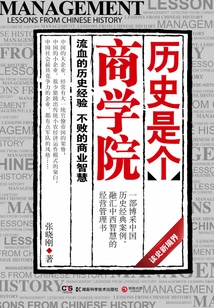
History is a Business School
History历史是个商学院
Zhang Xiaogang
Select key stages, events, and important figures from Chinese history as cases for analysis, and cite the essence of Western management, economics, marketing and other works. Most of them are translated by the author from the original works, striving to be honest and elegant, and integrating a large number of classic content from ancient Chinese poems. It not only embodies the exquisite insights of the ancients "cultivate oneself, manage one's family, govern the country and bring peace to the world", but is also connected with modern business management ideas, and can also enhance the humanistic accomplishments of entrepreneurs and managers. On this basis, the author expressed his own voice, proposed three major organizational archetypes in Chinese society, and discussed their impact and inspiration on modern organizations. He elaborated on many viewpoints such as paying attention to the value of "benevolence" in management, being good at running undefeated strategically, transcending personal limitations in leadership building, cultivating loyalty in human resource management, guarding against "horseman politics" in employing people, and finding "sustenance" from tradition in brand building. The focus of "History is a Business School" is not to tell historical stories. The author believes that telling stories in an almost catchy way is more suitable for entertainment after dinner. For entrepreneurs and managers, reading history is to learn valuable wisdom and lessons from the common experience of the Chinese nation, so as to gain inspiration that can help solve practical problems.
Select key stages, events, and important figures from Chinese history as cases for analysis, and cite the essence of Western management, economics, marketing and other works. Most of them are translated by the author from the original works, striving to be honest and elegant, and integrating a large number of classic content from ancient Chinese poems. It not only embodies the exquisite insights of the ancients "cultivate oneself, manage one's family, govern the country and bring peace to the world", but is also connected with modern business management ideas, and can also enhance the humanistic accomplishments of entrepreneurs and managers. On this basis, the author expressed his own voice, proposed three major organizational archetypes in Chinese society, and discussed their impact and inspiration on modern organizations. He elaborated on many viewpoints such as paying attention to the value of "benevolence" in management, being good at running undefeated strategically, transcending personal limitations in leadership building, cultivating loyalty in human resource management, guarding against "horseman politics" in employing people, and finding "sustenance" from tradition in brand building. The focus of "History is a Business School" is not to tell historical stories. The author believes that telling stories in an almost catchy way is more suitable for entertainment after dinner. For entrepreneurs and managers, reading history is to learn valuable wisdom and lessons from the common experience of the Chinese nation, so as to gain inspiration that can help solve practical problems.