Library
Browse and search books
3 novels found
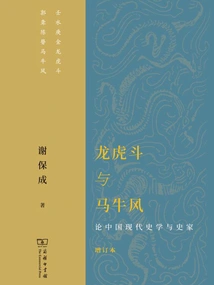
龙虎斗与马牛风:论中国现代史学与史家(增订本)
Xie Baocheng
This book discusses new history in a broad sense, which includes both the "new history" of Wang Guowei and the Marxist new history of Guo Moruo. It often publishes new and old materials that were previously unknown or unnoticed, and examines some issues that it has not dealt with in depth or has avoided for a long time. It is of a probing nature and is different from other works on "new history." The most exciting part is that "the mind wanders and meditates, and is in the same realm as the ancients who established the theory." Throughout the discussion of various historians. Describe in detail the academic achievements and scholarship of Wang Guowei, Chen Yuan, Chen Yinke, Guo Moruo, etc. Moreover, it pays attention to historical details, describing the meeting between Chen Yuan and Guo Moruo, the vivid scenes of Guo Moruo's visit to the Institute of History and Language, and the grudges between Guo Moruo and Chen Yinke, penetrating into the hearts of the characters and giving new explanations to historical unsolved cases. The book "Dragon-Tiger Fight and Horse-Niu Feng" was published in 2012 by Life, Reading, and New Knowledge Sanlian Bookstore. This is an expanded edition, which adds the author's research results in recent years and is of great benefit to a better understanding of modern Chinese historians and historiography.
This book discusses new history in a broad sense, which includes both the "new history" of Wang Guowei and the Marxist new history of Guo Moruo. It often publishes new and old materials that were previously unknown or unnoticed, and examines some issues that it has not dealt with in depth or has avoided for a long time. It is of a probing nature and is different from other works on "new history." The most exciting part is that "the mind wanders and meditates, and is in the same realm as the ancients who established the theory." Throughout the discussion of various historians. Describe in detail the academic achievements and scholarship of Wang Guowei, Chen Yuan, Chen Yinke, Guo Moruo, etc. Moreover, it pays attention to historical details, describing the meeting between Chen Yuan and Guo Moruo, the vivid scenes of Guo Moruo's visit to the Institute of History and Language, and the grudges between Guo Moruo and Chen Yinke, penetrating into the hearts of the characters and giving new explanations to historical unsolved cases. The book "Dragon-Tiger Fight and Horse-Niu Feng" was published in 2012 by Life, Reading, and New Knowledge Sanlian Bookstore. This is an expanded edition, which adds the author's research results in recent years and is of great benefit to a better understanding of modern Chinese historians and historiography.
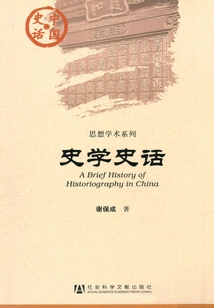
Historiography
History史学史话
Xie Baocheng
Historiography is a discipline that uses historical materials to study and describe human history to show the future. The development of Chinese historiography can be roughly divided into six stages: The pre-Qin period was the formation stage of historiography. During this period, a number of historical monographs that had many influences on later generations appeared, such as "Spring and Autumn", "Zuo Zhuan", "Guoyu", and "Warring States Policy". The period from the early Han Dynasty to the early Tang Dynasty was the stage when the status of history was established. During this period, historical works such as "Historical Records", "Han Shu", and "Hou Han Shu" appeared one after another, and biographical history books gradually gained the "supreme" status. The period from the mid-Tang Dynasty to the end of the Ming Dynasty was the development stage of historiography. During this stage, the formation of the "Tongdian" and "Three Tong" series, the "Zizhi Tongjian" and the evolution of its genre, and the continuous revision of the chronicle-biographical "official history" constituted the three main pillars of the development of Chinese historiography. The early Qing Dynasty was a period when traditional historiography was returning to glory. During this period, official history books were much more than any previous dynasty, covering almost all major categories of history, showing the glory of historiography during the Qiang-Jia period. The late Qing Dynasty and the early Republic of China were a period of fission in historiography, and the development of historiography ushered in a new trend of thought called "historical revolution." The middle and late period of the Republic of China was a period of collision between old and new historiography. As a world historical trend, "democracy and science" collided with China's cultural traditions with an unstoppable force, which also caused some new changes in Chinese historiography itself.
Historiography is a discipline that uses historical materials to study and describe human history to show the future. The development of Chinese historiography can be roughly divided into six stages: The pre-Qin period was the formation stage of historiography. During this period, a number of historical monographs that had many influences on later generations appeared, such as "Spring and Autumn", "Zuo Zhuan", "Guoyu", and "Warring States Policy". The period from the early Han Dynasty to the early Tang Dynasty was the stage when the status of history was established. During this period, historical works such as "Historical Records", "Han Shu", and "Hou Han Shu" appeared one after another, and biographical history books gradually gained the "supreme" status. The period from the mid-Tang Dynasty to the end of the Ming Dynasty was the development stage of historiography. During this stage, the formation of the "Tongdian" and "Three Tong" series, the "Zizhi Tongjian" and the evolution of its genre, and the continuous revision of the chronicle-biographical "official history" constituted the three main pillars of the development of Chinese historiography. The early Qing Dynasty was a period when traditional historiography was returning to glory. During this period, official history books were much more than any previous dynasty, covering almost all major categories of history, showing the glory of historiography during the Qiang-Jia period. The late Qing Dynasty and the early Republic of China were a period of fission in historiography, and the development of historiography ushered in a new trend of thought called "historical revolution." The middle and late period of the Republic of China was a period of collision between old and new historiography. As a world historical trend, "democracy and science" collided with China's cultural traditions with an unstoppable force, which also caused some new changes in Chinese historiography itself.
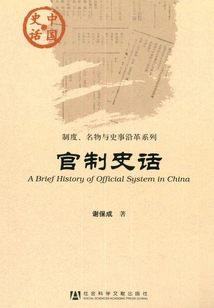
官制史话
Xie Baocheng
As the monarch's power gradually strengthened, the scope of government administration over the people became wider and wider, the ranks of bureaucracy continued to expand, officials were divided into more detailed divisions, and the monarch's management of officials became more and more strict, forming an increasingly complex official system. This book mainly introduces the official system of unified dynasties in the past dynasties. It is written in a systematic way and is divided into five aspects: the central decision-making system, the central government system, the local administrative system, the supervisory system and the military system. It aims to reflect the overall evolution of the ancient official system through the changes in each official system, and at the same time examine the relationship between the monarchy and the official system as well as the gains and losses of the official management system.
As the monarch's power gradually strengthened, the scope of government administration over the people became wider and wider, the ranks of bureaucracy continued to expand, officials were divided into more detailed divisions, and the monarch's management of officials became more and more strict, forming an increasingly complex official system. This book mainly introduces the official system of unified dynasties in the past dynasties. It is written in a systematic way and is divided into five aspects: the central decision-making system, the central government system, the local administrative system, the supervisory system and the military system. It aims to reflect the overall evolution of the ancient official system through the changes in each official system, and at the same time examine the relationship between the monarchy and the official system as well as the gains and losses of the official management system.