Library
Browse and search books
11 novels found
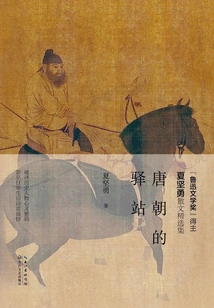
Tang Dynasty Station
Literature唐朝的驿站
Xia Jianyong
This book is a self-selected collection of Xia Jianyong's prose, divided into three series: the first series includes Xia Jianyong's historical and cultural prose works, such as "The Station of the Tang Dynasty" and "Several Simulation Questions Done by Bai Juyi", etc. The second series mainly includes a series of rural nostalgia and other daily works. Prose works that are realistic to daily life, such as "Children's Chorus", "Three Kinds of Grass", "Remembering the Cabin", etc. The third volume includes two huge cultural essays, "Heroes' Ode" and "War Ode", striving to fully present the artistic characteristics of Xia Jianyong's prose. Xia Jianyong is an important representative writer of cultural prose and the winner of the Lu Xun Literature Prize. His works are both generous and generous, concise and warm, and have high cultural and artistic qualities. He is undoubtedly one of the important representatives of contemporary prose.
This book is a self-selected collection of Xia Jianyong's prose, divided into three series: the first series includes Xia Jianyong's historical and cultural prose works, such as "The Station of the Tang Dynasty" and "Several Simulation Questions Done by Bai Juyi", etc. The second series mainly includes a series of rural nostalgia and other daily works. Prose works that are realistic to daily life, such as "Children's Chorus", "Three Kinds of Grass", "Remembering the Cabin", etc. The third volume includes two huge cultural essays, "Heroes' Ode" and "War Ode", striving to fully present the artistic characteristics of Xia Jianyong's prose. Xia Jianyong is an important representative writer of cultural prose and the winner of the Lu Xun Literature Prize. His works are both generous and generous, concise and warm, and have high cultural and artistic qualities. He is undoubtedly one of the important representatives of contemporary prose.
Encounter on the Road
Realistic Fiction路遇
Xia Jianyong
Come to China Literature's website to read more of my works!
Come to China Literature's website to read more of my works!
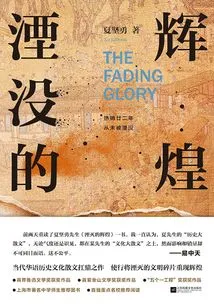
Oblivion of Glory
Literature湮没的辉煌
Xia Jianyong
"The Oblivion of Glory" conducts an in-depth investigation and understanding of Chinese history and culture through the narration, recollection, examination and reflection of the remaining ruins and ruins, interprets the rich meanings contained in these glorious relics, and resurrects the historical legends that were once full of glory. The author carefully identifies the flickering clues scattered in people's lives today, leading them to vivid and rich characters in the vast history, making people understand the contingency and inevitability of individuals creating history, and deeply appreciate the helplessness of history and the indescribable destiny of life.
"The Oblivion of Glory" conducts an in-depth investigation and understanding of Chinese history and culture through the narration, recollection, examination and reflection of the remaining ruins and ruins, interprets the rich meanings contained in these glorious relics, and resurrects the historical legends that were once full of glory. The author carefully identifies the flickering clues scattered in people's lives today, leading them to vivid and rich characters in the vast history, making people understand the contingency and inevitability of individuals creating history, and deeply appreciate the helplessness of history and the indescribable destiny of life.
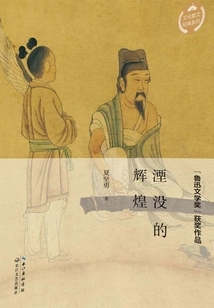
Oblivion of Glory
Literature湮没的辉煌
Xia Jianyong
"The Oblivion of Glory" is a masterpiece of prose by the famous essayist Xia Jianyong. It won the first Lu Xun Literature Award and has been a best-seller in the market for many years. It contains cultural prose works such as "Lonely Little Stone Bay", "Inn", "The Oblivion of the Palace", "Sad Wind in the East Forest", "Small Town Story" and other classic works, which have high aesthetic value. The author uses sharp writing, free words, and profound thoughts to integrate history and politics, culture and emotions. He shuttles through the mountains of geographical space, overlooks the smoke and dust of history, and discusses the past and present. It is an important historical and cultural prose work.
"The Oblivion of Glory" is a masterpiece of prose by the famous essayist Xia Jianyong. It won the first Lu Xun Literature Award and has been a best-seller in the market for many years. It contains cultural prose works such as "Lonely Little Stone Bay", "Inn", "The Oblivion of the Palace", "Sad Wind in the East Forest", "Small Town Story" and other classic works, which have high aesthetic value. The author uses sharp writing, free words, and profound thoughts to integrate history and politics, culture and emotions. He shuttles through the mountains of geographical space, overlooks the smoke and dust of history, and discusses the past and present. It is an important historical and cultural prose work.
The Oblivion of Miyagi
General Fiction湮没的宫城
Xia Jianyong
When modern intellectuals look at Nanjing, they often unconsciously look at it with the eyes of scholar-bureaucrats from the Tang and Song Dynasties. All they can see is the golden powder of the Six Dynasties, just like the declining scene in the poems of Liu Yuxi and Wei Zhuang. It seems that there has never been a prosperous Ming Dynasty here. They wandered in the streets and alleys of the Ming Dynasty looking for the splendor of Wang Xie's descendants, and they pushed aside the remaining bricks and tiles of the Hongwu Dynasty to search for the soft and graceful aftertaste of "Flowers in the Backyard of the Yushu". In fact, as soon as they look back, they will see the city wall of the Ming Dynasty lying under the shadow of the mountain not far away. It is a huge antique that attracts world attention, and it is not false at all. As a city, Nanjing is most worthy of boasting during the Ming Dynasty, and its urban layout is also the result of large-scale construction during the Hongwu Dynasty of the Ming Dynasty. Therefore, the Nanjing seen by modern people is actually a Ming city. When visiting ancient times and exploring the sights here, it is difficult to escape the deep and vast back of the Zhu Ming Dynasty. Of course you have to visit the Ming Forbidden City.
When modern intellectuals look at Nanjing, they often unconsciously look at it with the eyes of scholar-bureaucrats from the Tang and Song Dynasties. All they can see is the golden powder of the Six Dynasties, just like the declining scene in the poems of Liu Yuxi and Wei Zhuang. It seems that there has never been a prosperous Ming Dynasty here. They wandered in the streets and alleys of the Ming Dynasty looking for the splendor of Wang Xie's descendants, and they pushed aside the remaining bricks and tiles of the Hongwu Dynasty to search for the soft and graceful aftertaste of "Flowers in the Backyard of the Yushu". In fact, as soon as they look back, they will see the city wall of the Ming Dynasty lying under the shadow of the mountain not far away. It is a huge antique that attracts world attention, and it is not false at all. As a city, Nanjing is most worthy of boasting during the Ming Dynasty, and its urban layout is also the result of large-scale construction during the Hongwu Dynasty of the Ming Dynasty. Therefore, the Nanjing seen by modern people is actually a Ming city. When visiting ancient times and exploring the sights here, it is difficult to escape the deep and vast back of the Zhu Ming Dynasty. Of course you have to visit the Ming Forbidden City.
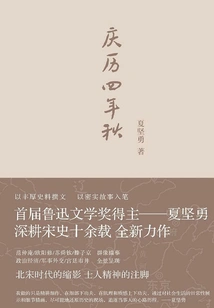
Autumn of the Fourth Year of Qingli
Literature庆历四年秋
Xia Jianyong
Xia Jianyong, the winner of the first Lu Xun Literature Prize, has been deeply engaged in the history of the Song Dynasty for more than ten years. This new masterpiece reproduces the ups and downs of the officialdom and penetrates into the subtleties of the world. The brushwork is delicate and the texture is clear, comparable to the text version of "Along the River During the Qingming Festival"; The epitome of the Northern Song Dynasty, the footnote of the scholar's spirit, the panoramic presentation - politics, economy, military diplomacy, court and market, group portraits, it is a brand new masterpiece of the "Song History Trilogy" after "The Twelve Years of Shaoxing". A small dinner party to honor the gods caused an uproar in the court. The background was the Qingli New Deal in the mid-Northern Song Dynasty. The work shows the broad aspects of life from the palace to the market, including politics, society, military, and diplomacy, which are intricate and thrilling; changes, power struggles, conspiracies, and man-made disasters are all thrilling. The twists and turns of the imperial court's new policies are placed in the description of daily life. It has both a detailed and subtle insight into human affairs and a macroscopic grasp of the general trend of the world. It is full of interest and thought-provoking reading.
Xia Jianyong, the winner of the first Lu Xun Literature Prize, has been deeply engaged in the history of the Song Dynasty for more than ten years. This new masterpiece reproduces the ups and downs of the officialdom and penetrates into the subtleties of the world. The brushwork is delicate and the texture is clear, comparable to the text version of "Along the River During the Qingming Festival"; The epitome of the Northern Song Dynasty, the footnote of the scholar's spirit, the panoramic presentation - politics, economy, military diplomacy, court and market, group portraits, it is a brand new masterpiece of the "Song History Trilogy" after "The Twelve Years of Shaoxing". A small dinner party to honor the gods caused an uproar in the court. The background was the Qingli New Deal in the mid-Northern Song Dynasty. The work shows the broad aspects of life from the palace to the market, including politics, society, military, and diplomacy, which are intricate and thrilling; changes, power struggles, conspiracies, and man-made disasters are all thrilling. The twists and turns of the imperial court's new policies are placed in the description of daily life. It has both a detailed and subtle insight into human affairs and a macroscopic grasp of the general trend of the world. It is full of interest and thought-provoking reading.
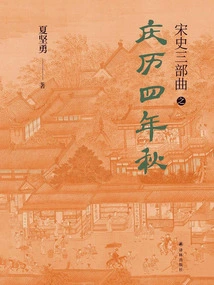
庆历四年秋(宋史三部曲)
Xia Jianyong
"Spring of the fourth year of Qingli" is the immortal time fixed in the first sentence of Fan Zhongyan's eternal classic "The Story of Yueyang Tower". During the fourth year of the reign of Emperor Renzong of the Song Dynasty, in this seemingly short time axis, Fan Zhongyan, Ouyang Xiu, Su Shunqin, Teng Zijing... How many stories and literary talents have been recorded in history? Xia Jianyong goes from spring to autumn, discusses the past from the present, and looks at the present from the past. He uses novel writing style, small talk and great meaning, and opens and closes in the folds of history to unearth rich humanistic significance. "Autumn of the Fourth Year of Qingli" is the second part of Xia Jianyong's "Song History Trilogy". A small dinner party to honor the gods caused an uproar in the court. The background was the Qingli New Deal in the mid-Northern Song Dynasty. The work shows the broad aspects of life from the court of the Northern Song Dynasty to the common people in the city, including politics, society, military diplomacy, and the intricacies of government affairs; power struggles for reform, conspiracies and man-made disasters, and the undercurrents are turbulent and thrilling. The twists and turns of the new policies of the imperial court are placed in the depiction of daily life. It not only contains detailed insights into human affairs, the publicity of the spirit of the broad-minded Qingyuan scholars, but also has a macroscopic grasp of the general trend of the world. It is thought-provoking to read.
"Spring of the fourth year of Qingli" is the immortal time fixed in the first sentence of Fan Zhongyan's eternal classic "The Story of Yueyang Tower". During the fourth year of the reign of Emperor Renzong of the Song Dynasty, in this seemingly short time axis, Fan Zhongyan, Ouyang Xiu, Su Shunqin, Teng Zijing... How many stories and literary talents have been recorded in history? Xia Jianyong goes from spring to autumn, discusses the past from the present, and looks at the present from the past. He uses novel writing style, small talk and great meaning, and opens and closes in the folds of history to unearth rich humanistic significance. "Autumn of the Fourth Year of Qingli" is the second part of Xia Jianyong's "Song History Trilogy". A small dinner party to honor the gods caused an uproar in the court. The background was the Qingli New Deal in the mid-Northern Song Dynasty. The work shows the broad aspects of life from the court of the Northern Song Dynasty to the common people in the city, including politics, society, military diplomacy, and the intricacies of government affairs; power struggles for reform, conspiracies and man-made disasters, and the undercurrents are turbulent and thrilling. The twists and turns of the new policies of the imperial court are placed in the depiction of daily life. It not only contains detailed insights into human affairs, the publicity of the spirit of the broad-minded Qingyuan scholars, but also has a macroscopic grasp of the general trend of the world. It is thought-provoking to read.
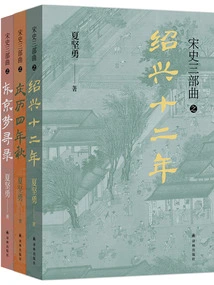
宋史三部曲(套装共3册)
Xia Jianyong
The "Song History Trilogy" includes "The Twelve Years of Shaoxing", "Autumn of the Fourth Year of Qingli" and "Tokyo Dream Search". Taking three representative historical periods as the twelfth year of Shaoxing under Gaozong of the Southern Song Dynasty, the fourth year of Qingli under Emperor Renzong of the Northern Song Dynasty, and the first year of Xiangfu under Emperor Zhenzong of the Northern Song Dynasty as narrative nodes, it starts with the meaningful historical events of Yue Fei's murder, Qingli's New Deal, and Song Zhenzong's eastward enfeoffment, and enters into a cross-section of history, elucidating the subtle details and peeling off cocoons. The narrative time of the work spans the two Song Dynasties, covering customs, prices, imperial examinations, arts and literature, officialdom, reform, tea administration, horse administration, ultimatums, edicts, geography, climate, celestial phenomena, industry, foreign trade, clan, relatives, officials, It covers every detail, from the turbulent political struggles and checks and balances between monarchs and ministers, to the various world conditions of people selling pulp in shacks and carts, vividly reflecting the political situation and social life of the two Song Dynasties. It can be called the literal version of "Along the River During the Qingming Festival". Xia Jianyong has been deeply involved in the history of the Song Dynasty for more than ten years. He "searched for new aesthetic objects on the big coordinates of nature, history and life, and also looked for a new territory to promote individual souls and reflect on the national spirit." Song Gaozong, Song Renzong, Song Zhenzong, emperors, monarchs and ministers were all human beings. Understanding human nature naturally means understanding the emperor. He profoundly revealed the inner world and behavioral logic of the parties involved, deeply explored the subtleties and commonalities of human nature behind the events, and understood the eternal nature of human nature.
The "Song History Trilogy" includes "The Twelve Years of Shaoxing", "Autumn of the Fourth Year of Qingli" and "Tokyo Dream Search". Taking three representative historical periods as the twelfth year of Shaoxing under Gaozong of the Southern Song Dynasty, the fourth year of Qingli under Emperor Renzong of the Northern Song Dynasty, and the first year of Xiangfu under Emperor Zhenzong of the Northern Song Dynasty as narrative nodes, it starts with the meaningful historical events of Yue Fei's murder, Qingli's New Deal, and Song Zhenzong's eastward enfeoffment, and enters into a cross-section of history, elucidating the subtle details and peeling off cocoons. The narrative time of the work spans the two Song Dynasties, covering customs, prices, imperial examinations, arts and literature, officialdom, reform, tea administration, horse administration, ultimatums, edicts, geography, climate, celestial phenomena, industry, foreign trade, clan, relatives, officials, It covers every detail, from the turbulent political struggles and checks and balances between monarchs and ministers, to the various world conditions of people selling pulp in shacks and carts, vividly reflecting the political situation and social life of the two Song Dynasties. It can be called the literal version of "Along the River During the Qingming Festival". Xia Jianyong has been deeply involved in the history of the Song Dynasty for more than ten years. He "searched for new aesthetic objects on the big coordinates of nature, history and life, and also looked for a new territory to promote individual souls and reflect on the national spirit." Song Gaozong, Song Renzong, Song Zhenzong, emperors, monarchs and ministers were all human beings. Understanding human nature naturally means understanding the emperor. He profoundly revealed the inner world and behavioral logic of the parties involved, deeply explored the subtleties and commonalities of human nature behind the events, and understood the eternal nature of human nature.
Donglin Beifeng
Literature东林悲风
Xia Jianyong
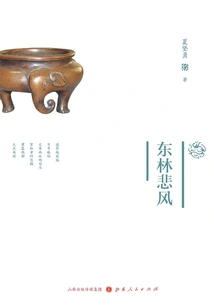
"Donglin Sad Wind" is a collection of historical and cultural essays, including 21 articles by the famous writer Xia Jianyong. This book uses prose writing and sharp language to discuss the past and the present. It analyzes Chinese and foreign historical figures such as Yang Guang and Stalin, Chinese and foreign literary giants such as Bai Juyi and Gorky, and historical cultures such as Dunhuang Feitian. It re-examines the historical merits and demerits of political figures, describes the career of literati, traces their historical phenomena, analyzes the rise and fall of civilizations, and laments the fate of culture. The author uses a sharp writing style to explore the relationship between culture and politics, culture and social change, and culture and the times.
"Donglin Sad Wind" is a collection of historical and cultural essays, including 21 articles by the famous writer Xia Jianyong. This book uses prose writing and sharp language to discuss the past and the present. It analyzes Chinese and foreign historical figures such as Yang Guang and Stalin, Chinese and foreign literary giants such as Bai Juyi and Gorky, and historical cultures such as Dunhuang Feitian. It re-examines the historical merits and demerits of political figures, describes the career of literati, traces their historical phenomena, analyzes the rise and fall of civilizations, and laments the fate of culture. The author uses a sharp writing style to explore the relationship between culture and politics, culture and social change, and culture and the times.
绍兴十二年(文化散文经典系列)
Xia Jianyong
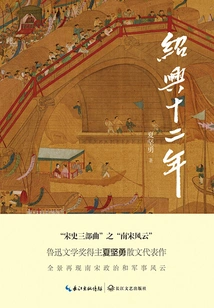
Shaoxing "Twelve Years in Shaoxing" is a long historical prose masterpiece by Xia Jianyong, winner of the Lu Xun Literature Award. This book has won the Jiangsu Province "Five One Project" Award, the "Zhongshan" Literary Award and other awards. "Shaoxing Twelve Years" attempts to comprehensively reflect the political situation and social life of that era through a cross-section of Shaoxing's twelve years of history, using the twelve months of the year as the longitude and a series of major events that occurred in that year as the latitude, and deeply revealing the inner world and behavioral logic of the parties involved. There are not only grand narratives about the political and military affairs of that era, but also subtle descriptions involving all aspects of social life, including customs, prices, imperial examinations, academic trends, arts and literature, officialdom, tea politics, horse politics, ultimatums, postal transmissions, geography, climate, industry, foreign trade, clans, and relatives. The details are meticulously embedded in the framework of a big and ups and downs plot. The author is not interested in popular explanations or jokes about history, nor is he satisfied with standing at the highest point of morality and repeating the characterization of characters and events by existing evaluation systems. Instead, he strives to present a kind of historical poetry and philosophy in his writing, restore the atmosphere and social texture of the time, and pursue the characters' mental journeys, thereby moving towards a deeper and broader historical time, space and spiritual world.
Shaoxing "Twelve Years in Shaoxing" is a long historical prose masterpiece by Xia Jianyong, winner of the Lu Xun Literature Award. This book has won the Jiangsu Province "Five One Project" Award, the "Zhongshan" Literary Award and other awards. "Shaoxing Twelve Years" attempts to comprehensively reflect the political situation and social life of that era through a cross-section of Shaoxing's twelve years of history, using the twelve months of the year as the longitude and a series of major events that occurred in that year as the latitude, and deeply revealing the inner world and behavioral logic of the parties involved. There are not only grand narratives about the political and military affairs of that era, but also subtle descriptions involving all aspects of social life, including customs, prices, imperial examinations, academic trends, arts and literature, officialdom, tea politics, horse politics, ultimatums, postal transmissions, geography, climate, industry, foreign trade, clans, and relatives. The details are meticulously embedded in the framework of a big and ups and downs plot. The author is not interested in popular explanations or jokes about history, nor is he satisfied with standing at the highest point of morality and repeating the characterization of characters and events by existing evaluation systems. Instead, he strives to present a kind of historical poetry and philosophy in his writing, restore the atmosphere and social texture of the time, and pursue the characters' mental journeys, thereby moving towards a deeper and broader historical time, space and spiritual world.
东京梦寻录(宋史三部曲)
Xia Jianyong
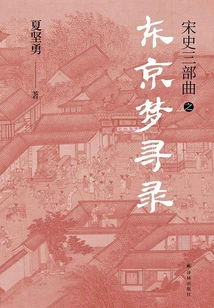
"Tokyo Dream Search" is the final work of Xia Jianyong's "Song History Trilogy" after "The Twelve Years of Shaoxing" and "The Autumn of the Fourth Year of Qingli". "Tokyo Meng Xun Lu" is derived from a perfunctory sentence in "History of the Song Dynasty: The Annals of Zhenzong", "The alliance with Chanzhou was established, the Zen ceremony was completed, the auspiciousness was great, the heavenly book was repeatedly dropped, and the guide was paid to pay tribute. The king and ministers of the country were as sick as crazy. It's strange." The whole country has been dreaming of Tokyo for ten years. Zhenzong of the Song Dynasty was the end of the two thousand years of feudal emperors who sealed Mount Tai in the east. As a benevolent but inferior king of Taiping who loved his people but was superstitious, Zhenzong's psychology of sealing Mount Tai in the east was not uncomplicated. He was the third emperor of the Northern Song Dynasty, the third prince of Taizong Zhao Guangyi, and he used to be named Zhao Dechang, Zhao Yuanxiu and Zhao Yuankan. In 985, the eldest son of the emperor Yuan Zuo was deposed in Fengong; in 986, the second prince Yuan Xi died unexpectedly. Three years later, Taizong, who had always been at odds over the issue of establishing a crown prince, officially issued an edict to establish Yuan Kan as the crown prince and change his name to Zhao Heng. At this time, the drama belonging to the third prince had just begun. In the fourth year of Jingde (1007 AD), Song Zhenzong Zhao Heng, who had concluded the "Chanyuan Alliance", ascended the throne and had been in power for ten years. On the last day of the year, Zhenzong gave a banquet and summoned Wang Dan, the prime minister of the dynasty, to "drink in it" and rewarded an altar of jewels during the banquet. On the third day of the first lunar month of the year, Zhao Heng summoned all the officials in Chongzheng Hall. A minister reported that a bunch of yellow silk hung on the owl kiss in the south corner of the left palace gate, known as the Book of Heaven. As a result, a seven-eight-year-old historical drama in which heavenly books frequently descended and auspiciousness arose... Slowly began...
"Tokyo Dream Search" is the final work of Xia Jianyong's "Song History Trilogy" after "The Twelve Years of Shaoxing" and "The Autumn of the Fourth Year of Qingli". "Tokyo Meng Xun Lu" is derived from a perfunctory sentence in "History of the Song Dynasty: The Annals of Zhenzong", "The alliance with Chanzhou was established, the Zen ceremony was completed, the auspiciousness was great, the heavenly book was repeatedly dropped, and the guide was paid to pay tribute. The king and ministers of the country were as sick as crazy. It's strange." The whole country has been dreaming of Tokyo for ten years. Zhenzong of the Song Dynasty was the end of the two thousand years of feudal emperors who sealed Mount Tai in the east. As a benevolent but inferior king of Taiping who loved his people but was superstitious, Zhenzong's psychology of sealing Mount Tai in the east was not uncomplicated. He was the third emperor of the Northern Song Dynasty, the third prince of Taizong Zhao Guangyi, and he used to be named Zhao Dechang, Zhao Yuanxiu and Zhao Yuankan. In 985, the eldest son of the emperor Yuan Zuo was deposed in Fengong; in 986, the second prince Yuan Xi died unexpectedly. Three years later, Taizong, who had always been at odds over the issue of establishing a crown prince, officially issued an edict to establish Yuan Kan as the crown prince and change his name to Zhao Heng. At this time, the drama belonging to the third prince had just begun. In the fourth year of Jingde (1007 AD), Song Zhenzong Zhao Heng, who had concluded the "Chanyuan Alliance", ascended the throne and had been in power for ten years. On the last day of the year, Zhenzong gave a banquet and summoned Wang Dan, the prime minister of the dynasty, to "drink in it" and rewarded an altar of jewels during the banquet. On the third day of the first lunar month of the year, Zhao Heng summoned all the officials in Chongzheng Hall. A minister reported that a bunch of yellow silk hung on the owl kiss in the south corner of the left palace gate, known as the Book of Heaven. As a result, a seven-eight-year-old historical drama in which heavenly books frequently descended and auspiciousness arose... Slowly began...