Library
Browse and search books
5 novels found
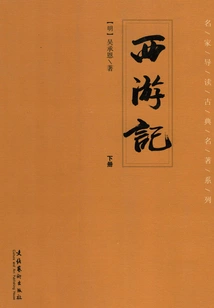
Journey to the West (part 1, Part 2)
General Fiction西游记(上、下)
Wu Chengen
"Journey to the West (Part 1 and 2)" is based on the historical fact that the eminent monk Xuanzang of the Tang Dynasty went to the West to worship Buddha and obtain Buddhist scriptures. Through the author's extremely imaginative conception and description, it creates the images of the brave and loyal Sun Wukong, the pedantic Sanzang of Tang Dynasty, the delicious and lazy Zhu Bajie and the diligent Monk Sha. Through the hardships and hardships of going to the West to obtain Buddhist scriptures, it reflects the author's dissatisfaction with reality, and profoundly exposes and criticizes the darkness, decadence of feudal society and the mediocrity of the ruling class.
"Journey to the West (Part 1 and 2)" is based on the historical fact that the eminent monk Xuanzang of the Tang Dynasty went to the West to worship Buddha and obtain Buddhist scriptures. Through the author's extremely imaginative conception and description, it creates the images of the brave and loyal Sun Wukong, the pedantic Sanzang of Tang Dynasty, the delicious and lazy Zhu Bajie and the diligent Monk Sha. Through the hardships and hardships of going to the West to obtain Buddhist scriptures, it reflects the author's dissatisfaction with reality, and profoundly exposes and criticizes the darkness, decadence of feudal society and the mediocrity of the ruling class.
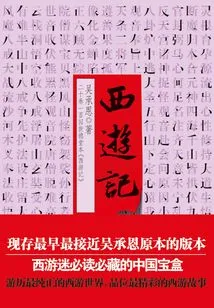
Journey to the West
General Fiction西游记
Wu Chengen
"Journey to the West" is an excellent classical novel of gods and demons. It has been widely circulated since its publication, has been translated into many languages, and is familiar to people in Southeast Asia and around the world. Among them, characters such as Sun Wukong, Tang Monk, Zhu Bajie, Sha Seng and stories such as "Havoc in Heaven", "Three Strikes of Bone Demons" and "Three Tunes of the Banana Fan" are even known to women and children. The emergence of "Journey to the West" opened up a new category of long chapter novels, ended the short mode of supernatural novels since the Wei and Jin Dynasties, and pushed novels about gods, demons and monsters to the peak of full-length novels. "Journey to the West" is a representative work of Chinese classical romantic novels and occupies an important position in the history of world literature. The "American Encyclopedia" calls it "a mythical novel with rich content and brilliant ideas."
"Journey to the West" is an excellent classical novel of gods and demons. It has been widely circulated since its publication, has been translated into many languages, and is familiar to people in Southeast Asia and around the world. Among them, characters such as Sun Wukong, Tang Monk, Zhu Bajie, Sha Seng and stories such as "Havoc in Heaven", "Three Strikes of Bone Demons" and "Three Tunes of the Banana Fan" are even known to women and children. The emergence of "Journey to the West" opened up a new category of long chapter novels, ended the short mode of supernatural novels since the Wei and Jin Dynasties, and pushed novels about gods, demons and monsters to the peak of full-length novels. "Journey to the West" is a representative work of Chinese classical romantic novels and occupies an important position in the history of world literature. The "American Encyclopedia" calls it "a mythical novel with rich content and brilliant ideas."
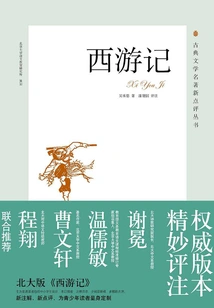
Journey to the West (set Volume 1 and 2)
General Fiction西游记(套装上下卷)
Wu Chengen
"Journey to the West (Volume 1 and 2)" includes 2 volumes: "Journey to the West (Volume 1)" and "Journey to the West (Volume 2)". Brief introduction to "Journey to the West (Volume 1 and 2)": The Peking University Chinese Language Education Institute and Peking University Press specially invited Professor Wen Rumin to plan and host this "New Commentary Series on Classical Literature Masterpieces" specially designed for primary and secondary school students and readers with intermediate education levels. The commentary is arranged along with the text, grasping the essence of the content and art of the work, exploring the subtleties, and gaining unique insights. It is not only in line with the reading experience, but also often has a rational explanation, which perfectly combines the traditional comment method with modern criticism. As one of the four masterpieces of classical novels, "Journey to the West (Set Volume 1 and 2)" contains extremely rich and diverse thoughts and culture. Monks read about the boundless Dharma, Taoists read about the Golden elixir, philosophers read about Yangming's philosophy of mind, and historians read about social reality. For ordinary readers, they read more wonderful stories about conquering demons and fully appreciate the spiritual charm of freedom, wisdom, courage, perseverance, self-entertainment, and childlike innocence. Pan Jianguo, a professor at the Department of Chinese at Peking University, used the Shidetang engraving of the Ming Dynasty as a base, collated all the copies, and compiled a text of "Journey to the West (Set of Volumes 1 and 2)" that is closest to the original. He also made comments based on the specific plot from the aspects of contemporary thought, religious culture, literature, art, and academic research. It is wise, original, humorous, and vivid, and guides readers on a wonderful journey of "literary learning."
"Journey to the West (Volume 1 and 2)" includes 2 volumes: "Journey to the West (Volume 1)" and "Journey to the West (Volume 2)". Brief introduction to "Journey to the West (Volume 1 and 2)": The Peking University Chinese Language Education Institute and Peking University Press specially invited Professor Wen Rumin to plan and host this "New Commentary Series on Classical Literature Masterpieces" specially designed for primary and secondary school students and readers with intermediate education levels. The commentary is arranged along with the text, grasping the essence of the content and art of the work, exploring the subtleties, and gaining unique insights. It is not only in line with the reading experience, but also often has a rational explanation, which perfectly combines the traditional comment method with modern criticism. As one of the four masterpieces of classical novels, "Journey to the West (Set Volume 1 and 2)" contains extremely rich and diverse thoughts and culture. Monks read about the boundless Dharma, Taoists read about the Golden elixir, philosophers read about Yangming's philosophy of mind, and historians read about social reality. For ordinary readers, they read more wonderful stories about conquering demons and fully appreciate the spiritual charm of freedom, wisdom, courage, perseverance, self-entertainment, and childlike innocence. Pan Jianguo, a professor at the Department of Chinese at Peking University, used the Shidetang engraving of the Ming Dynasty as a base, collated all the copies, and compiled a text of "Journey to the West (Set of Volumes 1 and 2)" that is closest to the original. He also made comments based on the specific plot from the aspects of contemporary thought, religious culture, literature, art, and academic research. It is wise, original, humorous, and vivid, and guides readers on a wonderful journey of "literary learning."
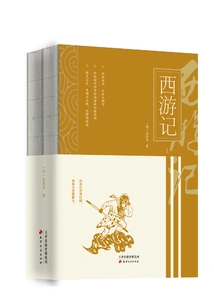
Journey to the West (two Volumes)
General Fiction西游记(全二册)
Wu Chengen
This book is one of China's four famous novels. Its content is based on "The Western Regions of the Tang Dynasty", folklore, and Yuan dramas. It is a classic of Chinese novels about gods and demons and has reached the pinnacle of ancient romantic novels. Since the publication of this book, various editions have emerged one after another. There are six editions published in the Ming Dynasty, seven editions and manuscripts published in the Qing Dynasty, and thirteen editions recorded in classics have been lost. This book combines the characteristics of many excellent versions on the market and uses a full version of one hundred chapters. In order to facilitate students and the general public to read, phonetic notations and uncommon word annotations have been included along with the text, and an introduction to the creative background and annotations on Chinese studies knowledge have been added. The book draws a map of the route that Tang Seng and his disciples took to learn scriptures, so that readers can more intuitively understand the route that Tang Seng and his disciples took, and help readers understand the changing rhythm of the story. The rest of the selected illustrations are all exquisite and detailed, with extremely high aesthetic value and collection value.
This book is one of China's four famous novels. Its content is based on "The Western Regions of the Tang Dynasty", folklore, and Yuan dramas. It is a classic of Chinese novels about gods and demons and has reached the pinnacle of ancient romantic novels. Since the publication of this book, various editions have emerged one after another. There are six editions published in the Ming Dynasty, seven editions and manuscripts published in the Qing Dynasty, and thirteen editions recorded in classics have been lost. This book combines the characteristics of many excellent versions on the market and uses a full version of one hundred chapters. In order to facilitate students and the general public to read, phonetic notations and uncommon word annotations have been included along with the text, and an introduction to the creative background and annotations on Chinese studies knowledge have been added. The book draws a map of the route that Tang Seng and his disciples took to learn scriptures, so that readers can more intuitively understand the route that Tang Seng and his disciples took, and help readers understand the changing rhythm of the story. The rest of the selected illustrations are all exquisite and detailed, with extremely high aesthetic value and collection value.
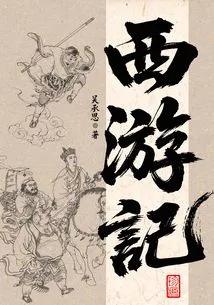
Journey to the West (vernacular Version)
General Fiction西游记(白话版)
Wu Chengen
"Journey to the West" is the best novel about gods and demons in ancient China. It is a masterpiece with a grand scale, a complete structure, and reflects social contradictions in a fantasy form. The book is written in vernacular and the language is easy to understand. The novel is based on the story of Xuanzang of the Tang Dynasty who went to the West to obtain Buddhist scriptures. It tells the story of Tang Monk, his master and his apprentice, who went through untold hardships and eighty-one difficulties, defeated countless demons and ghosts, and finally retrieved the scriptures. This is an ancient Chinese mythological fantasy novel full of romanticism, and it is also an ancient novel closest to children's literature. It is magical and bizarre, romantic and humorous, suitable for both refined and popular tastes. The main characters have distinctive personalities. It is widely circulated and has many readers. It occupies an important position in the history of Chinese novels.
"Journey to the West" is the best novel about gods and demons in ancient China. It is a masterpiece with a grand scale, a complete structure, and reflects social contradictions in a fantasy form. The book is written in vernacular and the language is easy to understand. The novel is based on the story of Xuanzang of the Tang Dynasty who went to the West to obtain Buddhist scriptures. It tells the story of Tang Monk, his master and his apprentice, who went through untold hardships and eighty-one difficulties, defeated countless demons and ghosts, and finally retrieved the scriptures. This is an ancient Chinese mythological fantasy novel full of romanticism, and it is also an ancient novel closest to children's literature. It is magical and bizarre, romantic and humorous, suitable for both refined and popular tastes. The main characters have distinctive personalities. It is widely circulated and has many readers. It occupies an important position in the history of Chinese novels.