Library
Browse and search books
1 novel found
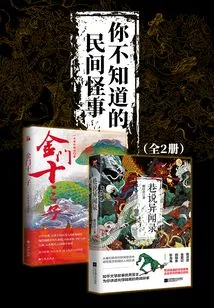
Weird Folk Stories You Don't Know (2 Volumes in Total)
General Fiction你不知道的民间怪事(全2册)
Tan Qishen Xie Huawei
"The Thirteen Sons of Kinmen" Lao Yu is a legendary and true writer. His father was one of the first batch of private entrepreneurs after the reform and opening up. Later, Lao Yu's family went bankrupt and he was forced to drop out of college. Then he hung out with an older brother named Lao Man in Beijing and lived in an old warehouse in Sanlitun. He worked as a screenwriter, a wild tour guide, and a fake antique dealer... He was later specially recruited by Mr. Dang Yong, a legend in the gaming industry, to join Tencent. At the age of 30, he was misdiagnosed with cancer and began to wander around. He discovered another "world", a mysterious "jianghu" hidden among the people: the big snake king who understands snake language on the Mekong River, the mysterious treasure-holding man on the edge of the Ussuri River, the horse Taoist who practices in Zhongnan Mountain, and Jiang who uses cattails to tell fortunes at the foot of Mount Emei. Brother Hu, Weishan Lakeside uses half of the "Thirteen Needles in the Gate of Ghosts" Jiang, Miaojiang Blood Phoenix, Jingzhou Jiaojiao, Baoding Haunted House, Shennongjia Iron Man... Some of these stories are the writer's real experiences, and some are the stories the writer has heard from others. They are true and false, mysterious and interesting, and have constructed a unique "folk world". At present, 8 stories in this book have been contracted for film and television adaptation... The stories in this book come from the story column of Tan Shinsuke, a well-known answerer of literary stories on Zhihu. It has real characters and historical backgrounds. It combines a variety of popular reading elements such as fantasy, suspense, and reasoning, and is also connected with some folklore and customs. For example, "Beheading the Dragon's Horns" is a metaphor for Yuan Shikai, and "Breaking Hell" is connected with the historical background of the Republic of China and Taoist culture. It reflects and satirizes reality through absurdity and magic, showing the cruelty of war, discrimination against women, charlatans and other phenomena, making people feel the causal cycle of good and evil being rewarded, and giving people a positive perception.
"The Thirteen Sons of Kinmen" Lao Yu is a legendary and true writer. His father was one of the first batch of private entrepreneurs after the reform and opening up. Later, Lao Yu's family went bankrupt and he was forced to drop out of college. Then he hung out with an older brother named Lao Man in Beijing and lived in an old warehouse in Sanlitun. He worked as a screenwriter, a wild tour guide, and a fake antique dealer... He was later specially recruited by Mr. Dang Yong, a legend in the gaming industry, to join Tencent. At the age of 30, he was misdiagnosed with cancer and began to wander around. He discovered another "world", a mysterious "jianghu" hidden among the people: the big snake king who understands snake language on the Mekong River, the mysterious treasure-holding man on the edge of the Ussuri River, the horse Taoist who practices in Zhongnan Mountain, and Jiang who uses cattails to tell fortunes at the foot of Mount Emei. Brother Hu, Weishan Lakeside uses half of the "Thirteen Needles in the Gate of Ghosts" Jiang, Miaojiang Blood Phoenix, Jingzhou Jiaojiao, Baoding Haunted House, Shennongjia Iron Man... Some of these stories are the writer's real experiences, and some are the stories the writer has heard from others. They are true and false, mysterious and interesting, and have constructed a unique "folk world". At present, 8 stories in this book have been contracted for film and television adaptation... The stories in this book come from the story column of Tan Shinsuke, a well-known answerer of literary stories on Zhihu. It has real characters and historical backgrounds. It combines a variety of popular reading elements such as fantasy, suspense, and reasoning, and is also connected with some folklore and customs. For example, "Beheading the Dragon's Horns" is a metaphor for Yuan Shikai, and "Breaking Hell" is connected with the historical background of the Republic of China and Taoist culture. It reflects and satirizes reality through absurdity and magic, showing the cruelty of war, discrimination against women, charlatans and other phenomena, making people feel the causal cycle of good and evil being rewarded, and giving people a positive perception.