Library
Browse and search books
4 novels found
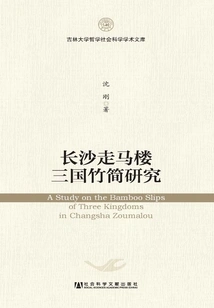
长沙走马楼三国竹简研究
Shen Gang
From the perspective of economic and social history, this book makes a relatively systematic investigation of some of the published bamboo slips in the Wu bamboo slips of the Three Kingdoms in Changsha's Zoumalou. Specifically, it includes three aspects: first, by sorting out household registration, master and assistant registration, official and civilian defection registration and other issues as well as rural officials, it reveals the grassroots administrative system such as population control, handicraft industry management, and the activities of grassroots subordinates in Linxiang during this period; second, it analyzes the government's control of money, cloth, and leather. Wait for the collection time of property, restore the form of accounts, and further discuss issues such as the fiscal and tax collection system, process, and nature of taxation; third, through the positioning of several social identities such as public servants, scholars, private servants, postmen, and guests that appear in Wu bamboo slips, point out their changes relative to the Qin and Han Dynasties. Through the above work, the changes in the grassroots management model and social class in Changsha area during Sun Wu's early period are relatively comprehensively demonstrated, which provides help for a deep understanding of early medieval Chinese society.
From the perspective of economic and social history, this book makes a relatively systematic investigation of some of the published bamboo slips in the Wu bamboo slips of the Three Kingdoms in Changsha's Zoumalou. Specifically, it includes three aspects: first, by sorting out household registration, master and assistant registration, official and civilian defection registration and other issues as well as rural officials, it reveals the grassroots administrative system such as population control, handicraft industry management, and the activities of grassroots subordinates in Linxiang during this period; second, it analyzes the government's control of money, cloth, and leather. Wait for the collection time of property, restore the form of accounts, and further discuss issues such as the fiscal and tax collection system, process, and nature of taxation; third, through the positioning of several social identities such as public servants, scholars, private servants, postmen, and guests that appear in Wu bamboo slips, point out their changes relative to the Qin and Han Dynasties. Through the above work, the changes in the grassroots management model and social class in Changsha area during Sun Wu's early period are relatively comprehensively demonstrated, which provides help for a deep understanding of early medieval Chinese society.
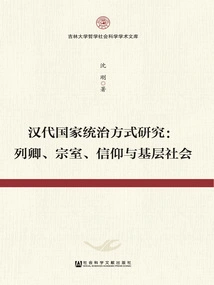
汉代国家统治方式研究:列卿、宗室、信仰与基层社会
Shen Gang
This book discusses the state governance methods of the Han Dynasty from four aspects: ministers, clans, folk beliefs and local social management. First, we analyze the characteristics of the establishment of central officials from the connotation, origin, selection and appointment of ministers in the Han Dynasty, as well as a case study of ministerial positions such as court lieutenants; secondly, we observe the clan management issues in the Han Dynasty through the measures of preferential care and control of princes, kings and ordinary clan groups in the Han Dynasty and the functions of clan officials; thirdly, through the folklore The characteristics of faith, interaction with local administrative agencies, and the connection between the imperial power of the Eastern Han Dynasty and prophecies are used to explore the relationship between faith and politics in the Han Dynasty. Finally, the intervention of the state in the form of residential areas, civil order, and social affairs in the Han Dynasty also shows the efforts made by state power to control society during this period.
This book discusses the state governance methods of the Han Dynasty from four aspects: ministers, clans, folk beliefs and local social management. First, we analyze the characteristics of the establishment of central officials from the connotation, origin, selection and appointment of ministers in the Han Dynasty, as well as a case study of ministerial positions such as court lieutenants; secondly, we observe the clan management issues in the Han Dynasty through the measures of preferential care and control of princes, kings and ordinary clan groups in the Han Dynasty and the functions of clan officials; thirdly, through the folklore The characteristics of faith, interaction with local administrative agencies, and the connection between the imperial power of the Eastern Han Dynasty and prophecies are used to explore the relationship between faith and politics in the Han Dynasty. Finally, the intervention of the state in the form of residential areas, civil order, and social affairs in the Han Dynasty also shows the efforts made by state power to control society during this period.
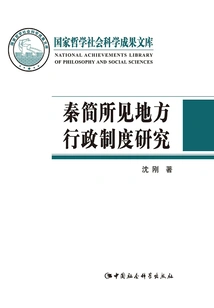
秦简所见地方行政制度研究
Shen Gang
This paper uses Qin bamboo slips as the main source of materials to explore the local administrative system of the Qin Dynasty, especially the administrative system at the county level. The discussion is carried out from three aspects. (1) Officials of county-level government. It mainly examines the levels of county-level officials, redundant officials, guards, and servants, as well as the selection of local officials. (2) Operation of local administrative system. This part of the content mainly discusses the roles played by central and local institutions at all levels in social management, information transmission channels, government affairs notification methods, and food reporting issues. (3) The specific application of Qin's local administrative system. In the Qin Dynasty, the state achieved the collection of social resources, including human resources and property, through the administrative system. This is mainly achieved through household registration, identity systems, local finance, statistics, and examination systems. At the same time, attention was also paid to issues such as market management and integration of folk customs. To a certain extent, this book restores the basic appearance of the local administrative system of the Qin Dynasty, shows the details of grassroots social governance in the early days of the ancient Chinese imperial system, and provides a new historical look at local administration when the feudal system was transformed into the county system.
This paper uses Qin bamboo slips as the main source of materials to explore the local administrative system of the Qin Dynasty, especially the administrative system at the county level. The discussion is carried out from three aspects. (1) Officials of county-level government. It mainly examines the levels of county-level officials, redundant officials, guards, and servants, as well as the selection of local officials. (2) Operation of local administrative system. This part of the content mainly discusses the roles played by central and local institutions at all levels in social management, information transmission channels, government affairs notification methods, and food reporting issues. (3) The specific application of Qin's local administrative system. In the Qin Dynasty, the state achieved the collection of social resources, including human resources and property, through the administrative system. This is mainly achieved through household registration, identity systems, local finance, statistics, and examination systems. At the same time, attention was also paid to issues such as market management and integration of folk customs. To a certain extent, this book restores the basic appearance of the local administrative system of the Qin Dynasty, shows the details of grassroots social governance in the early days of the ancient Chinese imperial system, and provides a new historical look at local administration when the feudal system was transformed into the county system.

Hunting
Fantasy狩望
Shen Gang
A hero doesn't care about his way out, and a rogue doesn't care about his age - this is the first truth that the elf boy Yalanvi learned in the human world. The Elf Republic was destroyed, and the Elf siblings Yalanvi and Shanni became human captives. After Yu Xueye escaped by chance, the brother and sister were attacked by the monster "Mirror Charm" and fell into a long sleep. A hundred years later, Yalanvi woke up in human form, and his sister was missing. In order to find his sister, Alan Wei had to wander into the human world. As soon as he entered the world, he was involuntarily involved in Duke Phoenix's conspiracy to plot the reincarnated angel. After several twists and turns, the magic power of the "Mirror Charm" begins to appear, and the mysterious girl Moira he encounters unexpectedly drags him into the dark world. Can this elf who only wants to live a comfortable life find his sister as he wishes? Can it adapt to the human world? Can the "unrestrained, free and open-minded will to survive" guide his path?
A hero doesn't care about his way out, and a rogue doesn't care about his age - this is the first truth that the elf boy Yalanvi learned in the human world. The Elf Republic was destroyed, and the Elf siblings Yalanvi and Shanni became human captives. After Yu Xueye escaped by chance, the brother and sister were attacked by the monster "Mirror Charm" and fell into a long sleep. A hundred years later, Yalanvi woke up in human form, and his sister was missing. In order to find his sister, Alan Wei had to wander into the human world. As soon as he entered the world, he was involuntarily involved in Duke Phoenix's conspiracy to plot the reincarnated angel. After several twists and turns, the magic power of the "Mirror Charm" begins to appear, and the mysterious girl Moira he encounters unexpectedly drags him into the dark world. Can this elf who only wants to live a comfortable life find his sister as he wishes? Can it adapt to the human world? Can the "unrestrained, free and open-minded will to survive" guide his path?