Library
Browse and search books
2 novels found
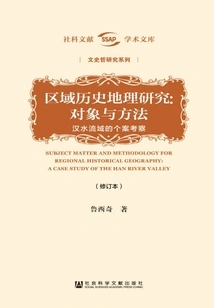
区域历史地理研究:对象与方法·汉水流域的个案考察(修订本)
Rusic
Through the investigation of the reconstruction of the natural and human geographical features of the Han River Basin in the historical period and its evolution process, we explore the formation, evolution and causes of historical geographical areas, analyze the regional development process, internal structure and the characteristics of the regional human-land relationship, and at the same time explore the ideas and methods of regional historical geography research. Combining historical document analysis, geographical fieldwork methods, and anthropological ideas, we start from the place and stand from a human perspective to observe and analyze the regional historical development process and the evolution of geographical features.
Through the investigation of the reconstruction of the natural and human geographical features of the Han River Basin in the historical period and its evolution process, we explore the formation, evolution and causes of historical geographical areas, analyze the regional development process, internal structure and the characteristics of the regional human-land relationship, and at the same time explore the ideas and methods of regional historical geography research. Combining historical document analysis, geographical fieldwork methods, and anthropological ideas, we start from the place and stand from a human perspective to observe and analyze the regional historical development process and the evolution of geographical features.
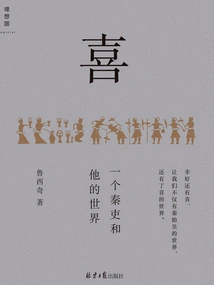
喜:一个秦吏和他的世界
Rusic
Happy, the owner of Qin Tomb No. 11 In Sleeping Tiger Land. He was born in the era of Qin Shi Huang, three years older than Qin Shi Huang Ying Zheng, died four years after Qin Shi Huang completed the great cause of unifying China, and died seven years earlier than Qin Shi Huang. He and Qin Shi Huang were contemporaries. He rose from the ranks of the people to the people, and then became a low-level official in the hometown of Chu State. He has parents, brothers, wife and children. His family continued smoothly into the Han Dynasty, and his social status and living conditions improved slightly. The author connects the scattered materials together, trying to piece together a joy of being a human being, and finding joy in a distant and unfamiliar world. Imagine that you are standing in the position of Xi, seeing the world he lives in through his eyes, and describing the imperial ruling machine that an ordinary person or the ruled directly faces: through the household registration system, the military merit system, the militarized arrangement of neighborhoods, and the integrated military and political administration. The system fixes each Guizhou capital at a specific position in the national control system, allowing them to serve in the army, receive titles for meritorious service, pay rent, and monitor each other. When necessary or advantageous, they report on fellow soldiers and neighbors. They also share life and death on the battlefield, forming a living community. At the same time, this book strives to present several aspects of a humble individual's life in the great historical process of Qin Shihuang's unification of China, several individual-centered silhouettes in the great era, and several individual particles that can only be discovered with great difficulty in the historical structure where the overall pattern is relatively stable but the micro-environment is constantly changing.
Happy, the owner of Qin Tomb No. 11 In Sleeping Tiger Land. He was born in the era of Qin Shi Huang, three years older than Qin Shi Huang Ying Zheng, died four years after Qin Shi Huang completed the great cause of unifying China, and died seven years earlier than Qin Shi Huang. He and Qin Shi Huang were contemporaries. He rose from the ranks of the people to the people, and then became a low-level official in the hometown of Chu State. He has parents, brothers, wife and children. His family continued smoothly into the Han Dynasty, and his social status and living conditions improved slightly. The author connects the scattered materials together, trying to piece together a joy of being a human being, and finding joy in a distant and unfamiliar world. Imagine that you are standing in the position of Xi, seeing the world he lives in through his eyes, and describing the imperial ruling machine that an ordinary person or the ruled directly faces: through the household registration system, the military merit system, the militarized arrangement of neighborhoods, and the integrated military and political administration. The system fixes each Guizhou capital at a specific position in the national control system, allowing them to serve in the army, receive titles for meritorious service, pay rent, and monitor each other. When necessary or advantageous, they report on fellow soldiers and neighbors. They also share life and death on the battlefield, forming a living community. At the same time, this book strives to present several aspects of a humble individual's life in the great historical process of Qin Shihuang's unification of China, several individual-centered silhouettes in the great era, and several individual particles that can only be discovered with great difficulty in the historical structure where the overall pattern is relatively stable but the micro-environment is constantly changing.