Library
Browse and search books
5 novels found

拉伯雷与赫尔墨斯秘学(“经典与解释”第41期)
Lou Lin
This book "Rabbelais and Hermetic Mysteries" edited by Lou Lin is the 41st issue of "Classics and Interpretation". The main topic is "Rabbelais and the Hermetic Mysteries". Rabelais was one of the most outstanding humanist writers in France during the Renaissance. Rabelais's main work is the novel "Giant". The six articles in this collection discuss Rabelais and his "Giant" respectively from the following aspects: Rabelais's Platonic view of literature, Rabelais and Plato's esoteric tradition, Rabelais and the Colonial style of writing, Cicero's "On the Orator" and Rabelais, and the unification of the theme of the five volumes of "Giant". The "Ancient Texts and Modern Issues" section of this volume includes "Plato's Philosophy" by Al-Farabi, and the "Micrographs of the History of Thought" section includes "Hobbes and Thucydides" by Schlatter. Other articles such as "Fang Yizhi and Western Learning" also have their own fine points.
This book "Rabbelais and Hermetic Mysteries" edited by Lou Lin is the 41st issue of "Classics and Interpretation". The main topic is "Rabbelais and the Hermetic Mysteries". Rabelais was one of the most outstanding humanist writers in France during the Renaissance. Rabelais's main work is the novel "Giant". The six articles in this collection discuss Rabelais and his "Giant" respectively from the following aspects: Rabelais's Platonic view of literature, Rabelais and Plato's esoteric tradition, Rabelais and the Colonial style of writing, Cicero's "On the Orator" and Rabelais, and the unification of the theme of the five volumes of "Giant". The "Ancient Texts and Modern Issues" section of this volume includes "Plato's Philosophy" by Al-Farabi, and the "Micrographs of the History of Thought" section includes "Hobbes and Thucydides" by Schlatter. Other articles such as "Fang Yizhi and Western Learning" also have their own fine points.

伊索寓言中的伦理(“经典与解释”第46期)
Lou Lin
This book is the 46th issue of Classics and Interpretation, and its topic is "Ethics in Aesop's Fables." In ancient Greek tradition, Aesop is said to have been a Greek stranger (a Thracian or a Phrygian) who was extremely ugly and lived in the sixth century BC. He was first a slave on the island of Samos, but eventually won his freedom through his wisdom and explanatory skills. Regardless of whether this character actually existed, by the fifth century BC, we have begun to see that various legends about an extraordinary life and death experience have begun to crystallize around the character of Aesop. At the same time, the "lower" genre of "fables" began to be attributed to Aesop, and he began to be regarded as the maker and founder of fables. Within this tradition, Aesop's connection to pre-philosophical systems of wisdom is curiously dual: for he appears to both participate in the realm of higher intelligence and to criticize or parody higher intelligence from "below." Since the invention of philosophy itself is complexly related to these earlier "wisdom" traditions-philosophy simultaneously strives to "borrow" from these traditions and to distinguish itself from them; therefore, in terms of its dual connection with this wisdom tradition, the figure of Aesop is very useful to philosophy. Tracing the connection between "Socratic" philosophy and Aesop and Aesop's fables will enable us to directly confront many problems of form, style and content. That is, I argue that there is a hidden, Aesopian thread in the genealogy of Greek prose writing.
This book is the 46th issue of Classics and Interpretation, and its topic is "Ethics in Aesop's Fables." In ancient Greek tradition, Aesop is said to have been a Greek stranger (a Thracian or a Phrygian) who was extremely ugly and lived in the sixth century BC. He was first a slave on the island of Samos, but eventually won his freedom through his wisdom and explanatory skills. Regardless of whether this character actually existed, by the fifth century BC, we have begun to see that various legends about an extraordinary life and death experience have begun to crystallize around the character of Aesop. At the same time, the "lower" genre of "fables" began to be attributed to Aesop, and he began to be regarded as the maker and founder of fables. Within this tradition, Aesop's connection to pre-philosophical systems of wisdom is curiously dual: for he appears to both participate in the realm of higher intelligence and to criticize or parody higher intelligence from "below." Since the invention of philosophy itself is complexly related to these earlier "wisdom" traditions-philosophy simultaneously strives to "borrow" from these traditions and to distinguish itself from them; therefore, in terms of its dual connection with this wisdom tradition, the figure of Aesop is very useful to philosophy. Tracing the connection between "Socratic" philosophy and Aesop and Aesop's fables will enable us to directly confront many problems of form, style and content. That is, I argue that there is a hidden, Aesopian thread in the genealogy of Greek prose writing.

地缘政治学的历史片段(“经典与解释”第51期)
Lou Lin
This book is the 51st issue of Classics and Interpretation. This issue is titled "Historical Fragments of Geopolitics" and is personally planned by Professor Liu Xiaofeng. Geopolitics is not only a topic of concern in real politics, but also a very important theme in the history of political thought. The Greco-Persian relations in ancient Greece and the war between the Spartans and the Athenians have already highlighted the embryonic geopolitics of later generations. However, it was only in the era of globalization after the great geographical discovery that geopolitics became global in perspective and took on a stronger political urgency. The papers included in the "Topics" column of this volume are mainly papers on geopolitics by German geopolitical scientists Haushofer, Schmitt and others before World War II, focusing on understanding the geopolitical thinking of that period. At the same time, American scholar Tambus's paper was published before the United States proposed the "Return to Asia-Pacific" strategy (2002). This shows the impact of geopolitical research in American academic circles on national strategy. This article starts from the perspective of Haushofer's book "Pacific Geopolitics" (1925) and proposes that attention should be paid to changes in Pacific geopolitics. In addition, the famous American political geographer of Central Asia David Lattimore (1900-1989) has included an old article from the 1940s called "The United States and Asia" to understand the continuity of the U. S.'S Asian strategy and at the same time understand our own geostrategic significance. The articles in other columns of this issue are also very insightful and worthy of your reading.
This book is the 51st issue of Classics and Interpretation. This issue is titled "Historical Fragments of Geopolitics" and is personally planned by Professor Liu Xiaofeng. Geopolitics is not only a topic of concern in real politics, but also a very important theme in the history of political thought. The Greco-Persian relations in ancient Greece and the war between the Spartans and the Athenians have already highlighted the embryonic geopolitics of later generations. However, it was only in the era of globalization after the great geographical discovery that geopolitics became global in perspective and took on a stronger political urgency. The papers included in the "Topics" column of this volume are mainly papers on geopolitics by German geopolitical scientists Haushofer, Schmitt and others before World War II, focusing on understanding the geopolitical thinking of that period. At the same time, American scholar Tambus's paper was published before the United States proposed the "Return to Asia-Pacific" strategy (2002). This shows the impact of geopolitical research in American academic circles on national strategy. This article starts from the perspective of Haushofer's book "Pacific Geopolitics" (1925) and proposes that attention should be paid to changes in Pacific geopolitics. In addition, the famous American political geographer of Central Asia David Lattimore (1900-1989) has included an old article from the 1940s called "The United States and Asia" to understand the continuity of the U. S.'S Asian strategy and at the same time understand our own geostrategic significance. The articles in other columns of this issue are also very insightful and worthy of your reading.
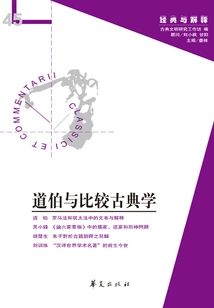
道伯与比较古典学(“经典与解释”第45期)
Lou Lin
This book is the 45th issue of "Classics and Interpretation", with the topic of "Daubert and Comparative Classics". David Daube (1909-1999), jurist, linguist and historian, was also a Roman jurist, religion and cultural expert. A portion of the published bibliography is carefully divided into "Roman Law," "Oriental Law and Historical Theology," and "Varia." The editors of the reprint also carefully classified Dauber's works into: Roman Law, Talmudic Law, New Testament-Jewish Studies, Biblical Law, and Wari Law. Dauber's research range is wide, in the New Testament and the Old Testament, in Greek philosophy, in Roman literature, in Roman law from the Twelve Tables to Justinian's Summa Civil Code, in the Talmud from the beginning to the 7th century AD, that is, in all the texts produced in the ancient Mediterranean region. His research results were divided into different volumes according to the research fields, but this division was not his own behavior. In his extensive research, there is its own unity. In addition, the "Study of Classical Works" column "On the Essentials of Six Schools", the "Old Texts and New Issues" column "\u003C Spring and Autumn Period \u003E Mencius" and "Zhu Xi's Views on the Exegesis of Ancient Books" are all related to the issue of the cardinal nature of Chinese classical scholarship. The two columns of the "Military History of Thought" column are respectively related to issues of theology, politics and historicism. The "Review" section "The Past and Present Life of "Chinese Translation of World Academic Masterpieces"" introduces my country's most important academic publishing project in detail, which is of high data value.
This book is the 45th issue of "Classics and Interpretation", with the topic of "Daubert and Comparative Classics". David Daube (1909-1999), jurist, linguist and historian, was also a Roman jurist, religion and cultural expert. A portion of the published bibliography is carefully divided into "Roman Law," "Oriental Law and Historical Theology," and "Varia." The editors of the reprint also carefully classified Dauber's works into: Roman Law, Talmudic Law, New Testament-Jewish Studies, Biblical Law, and Wari Law. Dauber's research range is wide, in the New Testament and the Old Testament, in Greek philosophy, in Roman literature, in Roman law from the Twelve Tables to Justinian's Summa Civil Code, in the Talmud from the beginning to the 7th century AD, that is, in all the texts produced in the ancient Mediterranean region. His research results were divided into different volumes according to the research fields, but this division was not his own behavior. In his extensive research, there is its own unity. In addition, the "Study of Classical Works" column "On the Essentials of Six Schools", the "Old Texts and New Issues" column "\u003C Spring and Autumn Period \u003E Mencius" and "Zhu Xi's Views on the Exegesis of Ancient Books" are all related to the issue of the cardinal nature of Chinese classical scholarship. The two columns of the "Military History of Thought" column are respectively related to issues of theology, politics and historicism. The "Review" section "The Past and Present Life of "Chinese Translation of World Academic Masterpieces"" introduces my country's most important academic publishing project in detail, which is of high data value.

诗艺与政治(“经典与解释”第38期)
Lou Lin
"Poetry and Politics" is the 38th volume of "Classics and Interpretation". There are three articles in the topic section. Nussbaum's "Aristophanes and Socrates on the Learning of Practical Wisdom" analyzes two works with moral cultivation as the core, one is Plato's "Protagoras" and the other is Aristophanes' "Clouds". The other two articles - "The Criminal Artist" by Bredekamp and "A Person's Love Letter" by Qin Yanchun - also analyze the relationship between poetry and politics from different angles.
"Poetry and Politics" is the 38th volume of "Classics and Interpretation". There are three articles in the topic section. Nussbaum's "Aristophanes and Socrates on the Learning of Practical Wisdom" analyzes two works with moral cultivation as the core, one is Plato's "Protagoras" and the other is Aristophanes' "Clouds". The other two articles - "The Criminal Artist" by Bredekamp and "A Person's Love Letter" by Qin Yanchun - also analyze the relationship between poetry and politics from different angles.