Library
Browse and search books
1 novel found
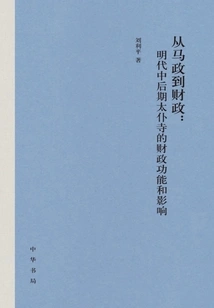
从马政到财政:明代中后期太仆寺的财政功能和影响
Liu Liping
This book mainly studies the emergence of the financial function of Taipu Temple in the middle and late Ming Dynasty and its impact on national finance. Taipu Temple has always been the central administrative agency that manages the country's horse administration. However, starting from the middle and late Ming Dynasty, under the background of the change of taxes and levies into silver, the horse administration's taxes and levies also started the process of converting them into silver. The horse households, horse pastures and horses in the northern and southern Zhili and some horse-raising prefectures and counties in Henan and Shandong under the jurisdiction of Taipus Temple in the two capitals were increasingly converted into silver income of Taipus Temple. As a result, Taipus Temple gradually became a money and grain yamen, and a Changying Treasury was built to specifically manage the storage and receipts of silver. Since the middle of the Ming Dynasty, with the deterioration of the royal family's finances and the national finances, the large amount of silver surplus in the Changying Treasury was regarded by the court as a life-saving straw to alleviate various financial crises. As a result, Taipu Temple was increasingly involved in the national finances and became a part of the central financial management system. It exerted a huge financial function and had an important impact on the financial management and alleviation of financial crises in the late Ming Dynasty. This book uses a large number of first-hand historical materials, collects thousands of data, and uses mathematical statistics and other methods to conduct rigorous analysis and demonstration of the views in the book. The conclusions are clear and reliable. It is the first monograph to date to systematically study the Ming Dynasty's horse politics from a financial perspective.
This book mainly studies the emergence of the financial function of Taipu Temple in the middle and late Ming Dynasty and its impact on national finance. Taipu Temple has always been the central administrative agency that manages the country's horse administration. However, starting from the middle and late Ming Dynasty, under the background of the change of taxes and levies into silver, the horse administration's taxes and levies also started the process of converting them into silver. The horse households, horse pastures and horses in the northern and southern Zhili and some horse-raising prefectures and counties in Henan and Shandong under the jurisdiction of Taipus Temple in the two capitals were increasingly converted into silver income of Taipus Temple. As a result, Taipus Temple gradually became a money and grain yamen, and a Changying Treasury was built to specifically manage the storage and receipts of silver. Since the middle of the Ming Dynasty, with the deterioration of the royal family's finances and the national finances, the large amount of silver surplus in the Changying Treasury was regarded by the court as a life-saving straw to alleviate various financial crises. As a result, Taipu Temple was increasingly involved in the national finances and became a part of the central financial management system. It exerted a huge financial function and had an important impact on the financial management and alleviation of financial crises in the late Ming Dynasty. This book uses a large number of first-hand historical materials, collects thousands of data, and uses mathematical statistics and other methods to conduct rigorous analysis and demonstration of the views in the book. The conclusions are clear and reliable. It is the first monograph to date to systematically study the Ming Dynasty's horse politics from a financial perspective.