Library
Browse and search books
2 novels found

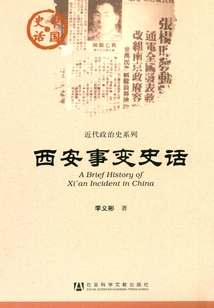
A Brief History of the Xi'an Incident (chinese Academy of Social Sciences Elderly Scholars Library)
History西安事变史略(中国社会科学院老年学者文库)
Li Yibin
This book closely focuses on the important historical event of the Xi'an Incident, using time as a clue to introduce in detail the background, process, and handling of the Xi'an Incident, as well as the conflicts and attitudes of the parties involved, and the impact of the incident. This book relies on detailed historical data to conduct a detailed analysis of all aspects of the Xi'an Incident, and strives to present a true and comprehensive Xi'an Incident to readers.
This book closely focuses on the important historical event of the Xi'an Incident, using time as a clue to introduce in detail the background, process, and handling of the Xi'an Incident, as well as the conflicts and attitudes of the parties involved, and the impact of the incident. This book relies on detailed historical data to conduct a detailed analysis of all aspects of the Xi'an Incident, and strives to present a true and comprehensive Xi'an Incident to readers.
西安事变史话
Li Yibin
In the 1930s, Japanese imperialism made further progress in its aggression against China. After the "September 18" invasion of the three eastern provinces, Shanhaiguan and Rehe were occupied in early 1933. After that, its aggressive claws further extended to North China, and the whole of China gradually fell into the danger of national subjugation and annihilation. At this time, the Kuomintang authorities headed by Chiang Kai-shek ignored the safety of the whole of China and still adhered to the policy of "pacifying the country before fighting foreign forces" and launched an encirclement and suppression campaign against the Red Army led by the Communist Party of China. This non-resistance policy against Japan aroused the dissatisfaction of all patriots. Against this background, the world-famous Xi'an Incident broke out on December 12, 1936. Patriotic generals represented by Zhang Xueliang and Yang Hucheng took control of Chiang Kai-shek at his residence in Huaqingchi, Lintong, and conducted "military remonstrances" against him, hoping to force Chiang Kai-shek to cooperate with the CCP in the fight against Japan. After the active efforts of many parties, the Xi'an Incident was finally peacefully resolved, which promoted the realization of the second cooperation between the Kuomintang and the Communist Party, and also ushered in a great situation in which the people of the whole country united to resist Japan.
In the 1930s, Japanese imperialism made further progress in its aggression against China. After the "September 18" invasion of the three eastern provinces, Shanhaiguan and Rehe were occupied in early 1933. After that, its aggressive claws further extended to North China, and the whole of China gradually fell into the danger of national subjugation and annihilation. At this time, the Kuomintang authorities headed by Chiang Kai-shek ignored the safety of the whole of China and still adhered to the policy of "pacifying the country before fighting foreign forces" and launched an encirclement and suppression campaign against the Red Army led by the Communist Party of China. This non-resistance policy against Japan aroused the dissatisfaction of all patriots. Against this background, the world-famous Xi'an Incident broke out on December 12, 1936. Patriotic generals represented by Zhang Xueliang and Yang Hucheng took control of Chiang Kai-shek at his residence in Huaqingchi, Lintong, and conducted "military remonstrances" against him, hoping to force Chiang Kai-shek to cooperate with the CCP in the fight against Japan. After the active efforts of many parties, the Xi'an Incident was finally peacefully resolved, which promoted the realization of the second cooperation between the Kuomintang and the Communist Party, and also ushered in a great situation in which the people of the whole country united to resist Japan.