Library
Browse and search books
2 novels found
一本书读懂人类简史
Kirshen
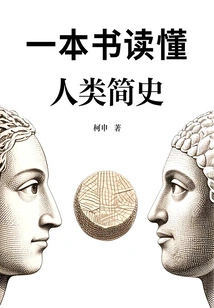
This book is based on the classic work of Israeli historian Yuval Harari. Through the folding of time and space of 70,000 years, this book reveals the ultimate code for Homo sapiens to leap from an ordinary species in the corner of Africa to the master of the earth. With the cognitive revolution, agricultural revolution, and scientific revolution as the three pillars, the book penetrates the weaving logic of fictional stories such as religion, currency, and empire, and analyzes how human beings use collective imagination to build the pyramid of civilization. From the awakening of the universe under the Galileo telescope, to CRISPR genetic scissors reshaping the laws of life; from the TikTok algorithm cocoon splitting social consensus, to the blockchain's impact on US dollar hegemony - this book not only presents the historical paradox of wheat domesticating humans and technology backlashing civilization, but also focuses on contemporary issues such as brain-computer interface and climate crisis, and provides 12 thinking keys to help readers break through in the era of uncertainty. The book runs through multidisciplinary perspectives and casts the Big Bang of physics, biological evolution, and the dilemma of digital civilization into a cognitive lens. It is not only an in-depth deconstruction of the ideological essence of "A Brief History of Humanity", but also a forward-looking response to the 21st century dilemmas such as the metaverse and AI anxiety, and ultimately points to the ultimate question of a community with a shared future for mankind: When the ability of fictional stories not only allows us to conquer the earth, but also brings the risk of self-destruction, can Homo sapiens keep the glimmer of humanity on the way to becoming "gods"?
This book is based on the classic work of Israeli historian Yuval Harari. Through the folding of time and space of 70,000 years, this book reveals the ultimate code for Homo sapiens to leap from an ordinary species in the corner of Africa to the master of the earth. With the cognitive revolution, agricultural revolution, and scientific revolution as the three pillars, the book penetrates the weaving logic of fictional stories such as religion, currency, and empire, and analyzes how human beings use collective imagination to build the pyramid of civilization. From the awakening of the universe under the Galileo telescope, to CRISPR genetic scissors reshaping the laws of life; from the TikTok algorithm cocoon splitting social consensus, to the blockchain's impact on US dollar hegemony - this book not only presents the historical paradox of wheat domesticating humans and technology backlashing civilization, but also focuses on contemporary issues such as brain-computer interface and climate crisis, and provides 12 thinking keys to help readers break through in the era of uncertainty. The book runs through multidisciplinary perspectives and casts the Big Bang of physics, biological evolution, and the dilemma of digital civilization into a cognitive lens. It is not only an in-depth deconstruction of the ideological essence of "A Brief History of Humanity", but also a forward-looking response to the 21st century dilemmas such as the metaverse and AI anxiety, and ultimately points to the ultimate question of a community with a shared future for mankind: When the ability of fictional stories not only allows us to conquer the earth, but also brings the risk of self-destruction, can Homo sapiens keep the glimmer of humanity on the way to becoming "gods"?

一本书读懂三体
Kirshen
This book is based on Liu Cixin's Hugo Award-winning masterpiece "The Three-Body Problem" trilogy, and panoramically deconstructs this cosmic epic spanning the rise and fall of civilization through seven dimensions. The book starts from the survival game of "Dark Forest Law", analyzes the life-and-death contest between Trisolaran civilization and human civilization in the chain of suspicion, technological explosion, and dimensionality reduction attack, and reveals the cold truth behind the sociology of the universe that "survival is the first need of civilization." The book deeply explores the hard core of science: three-body chaotic motion, strong interaction materials, two-way foil dimensionality reduction principle and other science fiction settings, all anchored by cutting-edge theories such as quantum physics and celestial mechanics, showing the amazing resonance between science fiction and reality. At the same time, the "spectrum of human nature" is used as a mirror to decode Luo Ji's art of intimidation, Cheng Xin's moral dilemma, and Zhang Beihai's rational choices, sublimating the fate of the characters into a philosophical torture for the survival of human civilization. It also creates an original chapter "Breaking the Circle Code" to analyze the miracle of cross-cultural communication of the novel from the Eastern Mohist cosmology to the global streaming media adaptation. Combining the visual reconstruction of Netflix series and the Hugo Award breaking circle effect, it reveals the underlying logic of Eastern elements such as "Human Computer" and "Ideological Stamp" detonating the world. The book is interspersed with real-life scientific and technological advances such as controllable nuclear fusion, quantum communications, and brain-computer interfaces, giving sci-fi concepts such as "water droplets" and "sophons" a sense of future predictability. Finally, in the ultimate thinking of "the possibility of interstellar cooperation" and "restarting the universe at zero," it completes the sublimation from science fiction narratives to a community with a shared future for mankind.
This book is based on Liu Cixin's Hugo Award-winning masterpiece "The Three-Body Problem" trilogy, and panoramically deconstructs this cosmic epic spanning the rise and fall of civilization through seven dimensions. The book starts from the survival game of "Dark Forest Law", analyzes the life-and-death contest between Trisolaran civilization and human civilization in the chain of suspicion, technological explosion, and dimensionality reduction attack, and reveals the cold truth behind the sociology of the universe that "survival is the first need of civilization." The book deeply explores the hard core of science: three-body chaotic motion, strong interaction materials, two-way foil dimensionality reduction principle and other science fiction settings, all anchored by cutting-edge theories such as quantum physics and celestial mechanics, showing the amazing resonance between science fiction and reality. At the same time, the "spectrum of human nature" is used as a mirror to decode Luo Ji's art of intimidation, Cheng Xin's moral dilemma, and Zhang Beihai's rational choices, sublimating the fate of the characters into a philosophical torture for the survival of human civilization. It also creates an original chapter "Breaking the Circle Code" to analyze the miracle of cross-cultural communication of the novel from the Eastern Mohist cosmology to the global streaming media adaptation. Combining the visual reconstruction of Netflix series and the Hugo Award breaking circle effect, it reveals the underlying logic of Eastern elements such as "Human Computer" and "Ideological Stamp" detonating the world. The book is interspersed with real-life scientific and technological advances such as controllable nuclear fusion, quantum communications, and brain-computer interfaces, giving sci-fi concepts such as "water droplets" and "sophons" a sense of future predictability. Finally, in the ultimate thinking of "the possibility of interstellar cooperation" and "restarting the universe at zero," it completes the sublimation from science fiction narratives to a community with a shared future for mankind.