Library
Browse and search novels
2 novels found

抗日战争:即使胜利也不能忘记
Jin Yinan
If there is any country with which China's relationship is most difficult to define, it is probably Japan. No country in history has had such a huge influence on the Japanese as China. From Chinese characters to Go, from the Analects of Confucius to the Lotus Sutra, the Japanese have almost invariably learned these cultural essences from China. No country in history has caused such huge harm to the Chinese people like Japan. Since the beginning of the Sino-Japanese War of 1894-1894, Japan has been indispensable in every war against China; no imperialist has killed people like the Japanese who massacred the city in Nanjing. The unclear relationship and unclear grievances between China and Japan are all represented by these four words: a thin strip of water. Because it is easy to communicate with others, it is also convenient to influence; because it is easy to plunder and invade, because it is easy to plunder and invade. In this book, Jin Yinan based on the height of strategic thinking, reviewed and discussed the national spirit of China and Japan, combined with the depth of history, profoundly analyzed the Anti-Japanese War. Through the analysis of the entire Anti-Japanese War, Jin Yinan believes that after the suffering of the Anti-Japanese War, the fire in the bones of the Chinese people was ignited. We should cherish this awakening and not forget it even if we win.

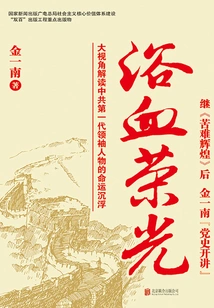
Bloody Glory
Literature浴血荣光
Jin Yinan
Jin Yinan wrote in the book "Blood and Glory": It is difficult to find any political party in the history of world political parties that is like the Communist Party of China. Its leaders are like cutting leeks, and they are slaughtered by the other party one after another. This is the unprecedented cruelty that cannot be compared to the Chinese revolution and other revolutions... It was an era of passion and rapid advancement. A group of young people from the Communist Party of China fought bloody battles, a group of young people from the Kuomintang were also struggling, and a group of young people from the Communist International were also struggling. This is an era where you can do great things at a young age, and it is also an era where you can lose your life at a young age. Lenin was less than 54 years old when he died. Stalin became general secretary at the age of 42. Chiang Kai-shek became the commander-in-chief of the National Revolutionary Army at the age of 39. Li Dazhao was less than 38 years old when he died. Mao Zedong went to Jinggangshan at the age of 34. Zhou Enlai presided over the Nanchang riots at the age of 29. Zhu De participated in the Dharma Protector War at the age of 31. At the age of 24, Bogu became the interim head of the Central Committee of the Communist Party of China.