Library
Browse and search books
1 novel found
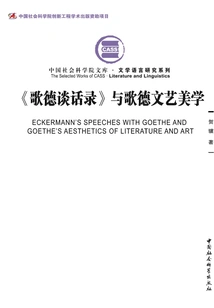
《歌德谈话录》与歌德文艺美学
He Ji
Starting from the basic concepts of aesthetics in "Goethe's Conversations \u003E and Goethe's Literary Aesthetics", the topic of "Goethe's Literary Aesthetics" is developed from six aspects. First, "\u003C Goethe's Conversations \u003E and Goethe's Literary Aesthetics" reviews Goethe's spontaneous materialism and spontaneous dialectics, and clarifies that his spontaneous materialist worldview is the ideological basis of his realist aesthetics. Second, "\u003C Goethe's Conversations \u003E and Goethe's Literary Aesthetics" is based on Goethe's harmonious nature. Characterizing him as an eclectic, he believes that artistic beauty is the organic unity of formal beauty and content beauty, perceptual images and rational concepts; "\u003C Goethe's Conversations \u003E and Goethe's Literary Aesthetics" also analyzes Goethe's independent and confident habits. It was this habit that drove him to initiate a symbolic revolution to cultivate pure art in the German literary field at the end of the 18th and early 19th centuries, and defended classical independent aesthetics. Third. "\U003C Goethe's Conversations \u003E and Goethe's Literary Aesthetics" discusses Goethe's theory of creation. Goethe believed that artistic creation mainly relies on imagination, and imagination is an important means to upgrade natural reality into artistic reality; he regarded genius as outstanding creativity and used magic to explain genius. Fourth, "\u003C Goethe's Conversations \u003E and Goethe's Literary Aesthetics" analyzes Goethe's view of nature, and Goethe starts from naturalism. Taking the universal and ideal ancient Greek and Roman literature and art as a model, he created classical realist aesthetics; using an empirical rationalist way of thinking, he established a typical creative method of "expressing the general in the particular". Fifth, "\u003C Goethe's Conversations \u003E and Goethe's Literary Aesthetics" introduces Goethe's internal research on artworks. He divided artworks into three organic structural elements (material, connotation and form), and proposed the theory of characteristics. He defined characteristics as expression objects that have both individual and universal connotations, and the result of formal artistic processing of connotations is artistic beauty. Sixth, "\u003C Goethe's Conversations \u003E and Goethe's Literary Aesthetics" reviews Goethe's concept of world literature, which refers to international literary exchanges. The conclusion of "\u003C Goethe's Conversations \u003E and Goethe's Literary Aesthetics" is that Goethe's literary aesthetics is a kind of classical realist aesthetics with romanticism.
Starting from the basic concepts of aesthetics in "Goethe's Conversations \u003E and Goethe's Literary Aesthetics", the topic of "Goethe's Literary Aesthetics" is developed from six aspects. First, "\u003C Goethe's Conversations \u003E and Goethe's Literary Aesthetics" reviews Goethe's spontaneous materialism and spontaneous dialectics, and clarifies that his spontaneous materialist worldview is the ideological basis of his realist aesthetics. Second, "\u003C Goethe's Conversations \u003E and Goethe's Literary Aesthetics" is based on Goethe's harmonious nature. Characterizing him as an eclectic, he believes that artistic beauty is the organic unity of formal beauty and content beauty, perceptual images and rational concepts; "\u003C Goethe's Conversations \u003E and Goethe's Literary Aesthetics" also analyzes Goethe's independent and confident habits. It was this habit that drove him to initiate a symbolic revolution to cultivate pure art in the German literary field at the end of the 18th and early 19th centuries, and defended classical independent aesthetics. Third. "\U003C Goethe's Conversations \u003E and Goethe's Literary Aesthetics" discusses Goethe's theory of creation. Goethe believed that artistic creation mainly relies on imagination, and imagination is an important means to upgrade natural reality into artistic reality; he regarded genius as outstanding creativity and used magic to explain genius. Fourth, "\u003C Goethe's Conversations \u003E and Goethe's Literary Aesthetics" analyzes Goethe's view of nature, and Goethe starts from naturalism. Taking the universal and ideal ancient Greek and Roman literature and art as a model, he created classical realist aesthetics; using an empirical rationalist way of thinking, he established a typical creative method of "expressing the general in the particular". Fifth, "\u003C Goethe's Conversations \u003E and Goethe's Literary Aesthetics" introduces Goethe's internal research on artworks. He divided artworks into three organic structural elements (material, connotation and form), and proposed the theory of characteristics. He defined characteristics as expression objects that have both individual and universal connotations, and the result of formal artistic processing of connotations is artistic beauty. Sixth, "\u003C Goethe's Conversations \u003E and Goethe's Literary Aesthetics" reviews Goethe's concept of world literature, which refers to international literary exchanges. The conclusion of "\u003C Goethe's Conversations \u003E and Goethe's Literary Aesthetics" is that Goethe's literary aesthetics is a kind of classical realist aesthetics with romanticism.