Library
Browse and search books
3 novels found

Typhoon No. 17
General Fiction十七号台风
Guo Haihong
The two candles on the Buddhist niche were blown askew by the wind, and the one on the left went out. Lao Xiao stood on tiptoe, stretched out his hand to straighten them, pulled out the extinguished branch, pointed it at the other branch, lit it again, and then inserted it back into its original place. This old man is not good at this job. When the boss and his wife came from Taiwan, this was their homework every morning and evening. Usually, the company's important officials were responsible for paying respect to the Ksitigarbha Bodhisattva statue. Many factories enshrine Guan Gong or Guanyin, but Lao Xiao and his boss like Ksitigarbha Bodhisattva. It is said that the year they opened the factory, the couple specially brought this white jade ceramic Bodhisattva statue from Taiwan to the mainland. Lao Xiao didn't know what to call this bald Bodhisattva until he got here, holding a gold and tin staff and holding a pearl on his palm. He had never heard of "Ksitigarbha Bodhisattva" before. Lao Xiao does not believe in Buddhism, but his boss has not been here for more than two months, and the employees and important ministers have almost dispersed. During these days, he has been thinking about burning incense and lighting candles.
The two candles on the Buddhist niche were blown askew by the wind, and the one on the left went out. Lao Xiao stood on tiptoe, stretched out his hand to straighten them, pulled out the extinguished branch, pointed it at the other branch, lit it again, and then inserted it back into its original place. This old man is not good at this job. When the boss and his wife came from Taiwan, this was their homework every morning and evening. Usually, the company's important officials were responsible for paying respect to the Ksitigarbha Bodhisattva statue. Many factories enshrine Guan Gong or Guanyin, but Lao Xiao and his boss like Ksitigarbha Bodhisattva. It is said that the year they opened the factory, the couple specially brought this white jade ceramic Bodhisattva statue from Taiwan to the mainland. Lao Xiao didn't know what to call this bald Bodhisattva until he got here, holding a gold and tin staff and holding a pearl on his palm. He had never heard of "Ksitigarbha Bodhisattva" before. Lao Xiao does not believe in Buddhism, but his boss has not been here for more than two months, and the employees and important ministers have almost dispersed. During these days, he has been thinking about burning incense and lighting candles.
Pass
General Fiction过关
Guo Haihong
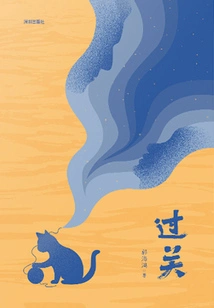
The novel "Passing the Passage" takes the interaction between two families and two generations in Shenzhen and Hong Kong as the main line, and writes about the beautiful feelings, pure love and the entrepreneurial journey of young people in the integrated development of Shenzhen and Hong Kong under the background of the new era. The life encounters between Zhu Charlie and his son and Li Gaimei's family are both dramatic and accidental, and also reflect the universality of the social development of the times. The novel not only shows the emotional and spiritual world of the characters, but also reflects the complexity and treachery of business activities. It not only observes the happiness of marriage and love of the elderly, but also presents the hardships of young people in their careers. It has many elements of dramatic conflicts and expressions of the times. The author's writing style is delicate, and he has a precise grasp and expression of human nature. He has created three-dimensional and rich portraits of characters such as Li Gaimei, Zhu Charlie, and Professor Zhang, showing their different spiritual worlds. At the same time, it also has a comprehensive and profound understanding of the grand era, and writes about the complex texture of the urban commercial field. It is an excellent work with a warm sense of the times and a vivid presentness. "Passing the Passage" is about the interactions of a limited number of people, but what it reveals is a big theme, namely the coordinated development of Shenzhen and Hong Kong.
The novel "Passing the Passage" takes the interaction between two families and two generations in Shenzhen and Hong Kong as the main line, and writes about the beautiful feelings, pure love and the entrepreneurial journey of young people in the integrated development of Shenzhen and Hong Kong under the background of the new era. The life encounters between Zhu Charlie and his son and Li Gaimei's family are both dramatic and accidental, and also reflect the universality of the social development of the times. The novel not only shows the emotional and spiritual world of the characters, but also reflects the complexity and treachery of business activities. It not only observes the happiness of marriage and love of the elderly, but also presents the hardships of young people in their careers. It has many elements of dramatic conflicts and expressions of the times. The author's writing style is delicate, and he has a precise grasp and expression of human nature. He has created three-dimensional and rich portraits of characters such as Li Gaimei, Zhu Charlie, and Professor Zhang, showing their different spiritual worlds. At the same time, it also has a comprehensive and profound understanding of the grand era, and writes about the complex texture of the urban commercial field. It is an excellent work with a warm sense of the times and a vivid presentness. "Passing the Passage" is about the interactions of a limited number of people, but what it reveals is a big theme, namely the coordinated development of Shenzhen and Hong Kong.
Chronicles of the Ancestral Hall: the Coming and Going of the Governor-general's Appointment
General Fiction祠堂记:巡抚王来任的来与去
Guo Haihong
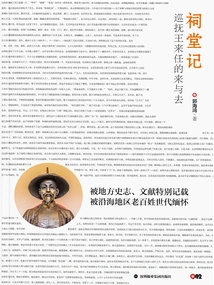
This book was created by Guo Haihong, a member of the Chinese Writers Association and vice chairman of the Baoan District Writers Association. In the form of "non-fiction writing", this book creates a historical figure respected and commemorated by the people along the Guangdong coast, especially in Shenzhen and Hong Kong - Wang Lairen, the governor of Guangdong in the early years of Kangxi, who was a typical image of integrity, love for the people and diligence.
This book was created by Guo Haihong, a member of the Chinese Writers Association and vice chairman of the Baoan District Writers Association. In the form of "non-fiction writing", this book creates a historical figure respected and commemorated by the people along the Guangdong coast, especially in Shenzhen and Hong Kong - Wang Lairen, the governor of Guangdong in the early years of Kangxi, who was a typical image of integrity, love for the people and diligence.