Library
Browse and search books
2 novels found
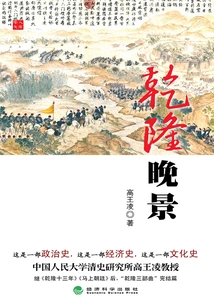
乾隆晚景
Gao Wangling
Compared with the previous fifty years, Qianlong's later years became the most failed and criticized period of Qianlong's rule. The writing style of this book is quite different from the first two. This book puts forward different opinions on several theories, and seems to be a little defense for Emperor Qianlong: was the reason for his failure, or was it because of the dereliction of political affairs? Or is it because of official corruption? Or is it because He Shen is the one responsible? Or lack of vision, resulting in the loss of a possible opportunity (such as in international trade)? ... The biggest controversy may still lie in the so-called "political dereliction". The "autocratic centralization" that people imagine is actually not easy in this country with a vast territory and a high degree of mobility among the people? Another character mentioned in the Qianlong Trilogy is Liu Songling, who is discussed in detail in this book. In addition, the author's methodology for researching Qing history for more than thirty years is also listed for readers to meet. In the end, Qianlong still had to bid farewell to this world and leave with great regret. And our Qianlong Trilogy can come to an end here.
Compared with the previous fifty years, Qianlong's later years became the most failed and criticized period of Qianlong's rule. The writing style of this book is quite different from the first two. This book puts forward different opinions on several theories, and seems to be a little defense for Emperor Qianlong: was the reason for his failure, or was it because of the dereliction of political affairs? Or is it because of official corruption? Or is it because He Shen is the one responsible? Or lack of vision, resulting in the loss of a possible opportunity (such as in international trade)? ... The biggest controversy may still lie in the so-called "political dereliction". The "autocratic centralization" that people imagine is actually not easy in this country with a vast territory and a high degree of mobility among the people? Another character mentioned in the Qianlong Trilogy is Liu Songling, who is discussed in detail in this book. In addition, the author's methodology for researching Qing history for more than thirty years is also listed for readers to meet. In the end, Qianlong still had to bid farewell to this world and leave with great regret. And our Qianlong Trilogy can come to an end here.
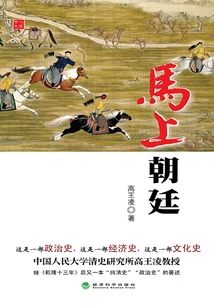
Immediately to the Court
History马上朝廷
Gao Wangling
The Qianlong Dynasty needs to be studied in stages, and it is not appropriate to write straightforwardly. It is sixty-three years at a time. Therefore, the author divides the Qianlong Dynasty into three stages: 1. "Initial Qianlong Administration" (i. E., "Thirteen Years of Qianlong"), about the first fifteen years; 2. "Middle Qianlong" (i. E., "Mashing the Court"), from the 16th to 49th year of Qianlong; 3. "Late Scene of Qianlong", which lasts for more than ten years. In the first stage of the Qianlong Dynasty, the country was mainly governed based on traditional Confucian concepts - such as "restoring the three generations" - but in the second stage, it showed more of the "Manchu characteristics" of Qing rule. This was not a simple "discrimination between leniency and strictness" or "changing from leniency to strictness", but rather reproduced their characteristic of "ruling the country immediately". This book is about the Qianlong Dynasty, about thirty-three years of history. Taking the Southern Tour as the center, I connected many things together, especially those related to "teaching the people" as opposed to "nurturing the people", including "literary prison" and other not-so-small topics. Like writing a story, I wrote them down one by one, paragraph by paragraph, year by year...
The Qianlong Dynasty needs to be studied in stages, and it is not appropriate to write straightforwardly. It is sixty-three years at a time. Therefore, the author divides the Qianlong Dynasty into three stages: 1. "Initial Qianlong Administration" (i. E., "Thirteen Years of Qianlong"), about the first fifteen years; 2. "Middle Qianlong" (i. E., "Mashing the Court"), from the 16th to 49th year of Qianlong; 3. "Late Scene of Qianlong", which lasts for more than ten years. In the first stage of the Qianlong Dynasty, the country was mainly governed based on traditional Confucian concepts - such as "restoring the three generations" - but in the second stage, it showed more of the "Manchu characteristics" of Qing rule. This was not a simple "discrimination between leniency and strictness" or "changing from leniency to strictness", but rather reproduced their characteristic of "ruling the country immediately". This book is about the Qianlong Dynasty, about thirty-three years of history. Taking the Southern Tour as the center, I connected many things together, especially those related to "teaching the people" as opposed to "nurturing the people", including "literary prison" and other not-so-small topics. Like writing a story, I wrote them down one by one, paragraph by paragraph, year by year...