Library
Browse and search books
4 novels found
Outline of Chinese History
History中国人史纲
Bo Yang
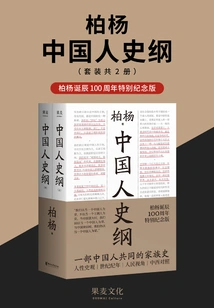
"Outline of Chinese History" starts from the mythical age of Pangu and ends with the war of aggression against China launched by the Eight-Power Allied Forces in the early 20th century. It uses 100 years (a century) as the chronological unit. It is a masterpiece that covers five thousand years of Chinese history. Bo Yang had no intention of hypocritically praising the emperors and generals. He abandoned all meaningless posthumous titles and honorary titles, pulled them down from the altar, called them by their first names, and judged them as ordinary Chinese. At the same time, Bo Yang also focused on the ordinary Chinese people who were drowned by history. He sympathized with the working people, despised the powerful warlords, and took humanity and human rights as his only foothold. Therefore, "Outline of Chinese History" is a general history of China with attitude and human touch. We can learn from the "Outline of Chinese History" that there are five major turning points that have affected China's national destiny: the three golden ages (the contention of a hundred schools of thought in the Spring and Autumn Period and the Warring States Period, the prosperous Tang Dynasty during the Li Shimin period, and the Qing Dynasty established by the Manchus who entered the country) and the Great Split Era ( It was these five major turning points that established China's territory, culture, values, economic structure, social stratification and international status. When reviewing Chinese history through Bo Yang's writings, we can also find that history keeps repeating itself, and China has always learned the same lesson for thousands of years: every dynasty in Chinese history reached a bottleneck period forty or fifty years after its establishment, or when it passed to the second or third generation. When entering the narrow channel of the bottleneck, unless the ruling class has a high degree of wisdom and ability, they cannot avoid encountering a bottleneck crisis that is enough to undo all their previous efforts, that is, to destroy their country and their family. History shows that if you can get through this bottleneck, you can achieve longer-term stability; if you can't get through this bottleneck or remain stuck in this bottleneck, it will inevitably collapse. In the cycle of history, China has gone through thousands of years. Although it has gone through vicissitudes of life, it remains unyielding. As Bo Yang said: China is like a huge cube. It will topple in the waves of water and sea. But after the wave recedes, it still stands there proudly, facing the world from the other side, never disappearing, never sinking. Read "Outline of Chinese History" to understand China's past, and then create our own golden age.
"Outline of Chinese History" starts from the mythical age of Pangu and ends with the war of aggression against China launched by the Eight-Power Allied Forces in the early 20th century. It uses 100 years (a century) as the chronological unit. It is a masterpiece that covers five thousand years of Chinese history. Bo Yang had no intention of hypocritically praising the emperors and generals. He abandoned all meaningless posthumous titles and honorary titles, pulled them down from the altar, called them by their first names, and judged them as ordinary Chinese. At the same time, Bo Yang also focused on the ordinary Chinese people who were drowned by history. He sympathized with the working people, despised the powerful warlords, and took humanity and human rights as his only foothold. Therefore, "Outline of Chinese History" is a general history of China with attitude and human touch. We can learn from the "Outline of Chinese History" that there are five major turning points that have affected China's national destiny: the three golden ages (the contention of a hundred schools of thought in the Spring and Autumn Period and the Warring States Period, the prosperous Tang Dynasty during the Li Shimin period, and the Qing Dynasty established by the Manchus who entered the country) and the Great Split Era ( It was these five major turning points that established China's territory, culture, values, economic structure, social stratification and international status. When reviewing Chinese history through Bo Yang's writings, we can also find that history keeps repeating itself, and China has always learned the same lesson for thousands of years: every dynasty in Chinese history reached a bottleneck period forty or fifty years after its establishment, or when it passed to the second or third generation. When entering the narrow channel of the bottleneck, unless the ruling class has a high degree of wisdom and ability, they cannot avoid encountering a bottleneck crisis that is enough to undo all their previous efforts, that is, to destroy their country and their family. History shows that if you can get through this bottleneck, you can achieve longer-term stability; if you can't get through this bottleneck or remain stuck in this bottleneck, it will inevitably collapse. In the cycle of history, China has gone through thousands of years. Although it has gone through vicissitudes of life, it remains unyielding. As Bo Yang said: China is like a huge cube. It will topple in the waves of water and sea. But after the wave recedes, it still stands there proudly, facing the world from the other side, never disappearing, never sinking. Read "Outline of Chinese History" to understand China's past, and then create our own golden age.
柏杨曰(套装共3册)
Bo Yang
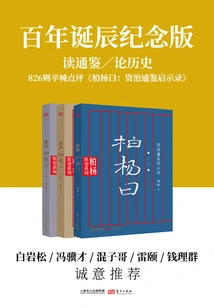
"Bo Yang Yue" is compiled by Bo Yang himself from 72 volumes of "Bo Yang Vernacular Edition of Zizhi Tongjian", which took five years to compile. It can be called the essence of "Bo Yang Vernacular Edition". "Bo Yang Yue" can be said to be the most exciting story, the most exciting characters in "Zi Zhi Tong Jian" and Bo Yang's most exciting interpretation and analysis. When discussing history, Bo Yang always puts human nature first, despises power, yearns for freedom, coexists passion and rationality, and is both beautiful in thought and writing. "Bo Yang Yue" uses unique historical materials, discusses each incident, has a novel perspective, beautiful language, and is fascinating. It presents more historical truths than textbooks and contains more humanistic care than legendary novels. It is a "revelation of Chinese history from a modern perspective."
"Bo Yang Yue" is compiled by Bo Yang himself from 72 volumes of "Bo Yang Vernacular Edition of Zizhi Tongjian", which took five years to compile. It can be called the essence of "Bo Yang Vernacular Edition". "Bo Yang Yue" can be said to be the most exciting story, the most exciting characters in "Zi Zhi Tong Jian" and Bo Yang's most exciting interpretation and analysis. When discussing history, Bo Yang always puts human nature first, despises power, yearns for freedom, coexists passion and rationality, and is both beautiful in thought and writing. "Bo Yang Yue" uses unique historical materials, discusses each incident, has a novel perspective, beautiful language, and is fascinating. It presents more historical truths than textbooks and contains more humanistic care than legendary novels. It is a "revelation of Chinese history from a modern perspective."
通鉴纪事本末(套装共19册)
Bo Yang
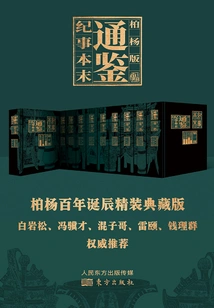
Editor's recommendation: 177 events were written in more than 1,300 years of history. Read the tome "Zi Zhi Tong Jian". Taking the "Tongjian" incident as the theme, Bo Yang wrote "Bo Yang's Edition of Tongjian Chronicles", with creative interpretation, refinement, development and extension, and new perspectives and perspectives. The historical materials are comprehensive and the academic style is rigorous. The whole book adopts the AD chronology, and notes the modern names and official names of ancient places and modern translations. It also adds maps by hand, making it suitable for contemporary readers. Compared with "Bo Yang's Vernacular Edition of Zizhi Tongjian", this book breaks the constraints of time and makes it easier for readers to accurately grasp the beginning and end of events. Throughout the book, you can have a panoramic view of the historical events of more than 1,300 years. Authoritative recommendations by Bai Yansong, Feng Jicai, Hun Zige, Lei Yi, Qian Liqun, and Chen Xiaoming. Content introduction: "Bo Yang's Edition of Tongjian Chronicles" (19 volumes in total) is a chronicle-style history book based on "Bo Yang's Vernacular Edition of Zizhi Tongjian" by the writer Mr. Bo Yang, who re-cut and adapted 1362 historical materials from 403 BC to AD 959 into 177 major events. Beginning in 1983, Bo Yang spent 10 years translating "Zi Zhi Tong Jian" into modern vernacular and compiled the chronicle "Bo Yang's Vernacular Edition of Zi Zhi Tong Jian". Due to the limitations of chronicles, which are confusing and complex, it is difficult to grasp the causes and consequences of historical events. Therefore, Mr. Boyang used Yuan Shu's method of compiling "Tongjian Chronicles", based on "Bo Yang's Vernacular Edition of Zizhi Tongjian", and took the "Tongjian" incident as the theme, re-cut and adapted it according to its causes and consequences, and completely recorded 177 major historical events, and compiled "Bo Yang's Vernacular Edition of Tongjian Chronicles" (19 volumes in total). "Boyang Edition of Tongjian Chronicles" retains features such as the AD chronology, modern annotations of place names, modern translations of official names, and additional maps drawn by the author himself. It continues the author's sharp and sophisticated writing style and independent and unruly academic style. Compared with "Bo Yang's Vernacular Edition of Zizhi Tongjian", it is more convenient for contemporary readers to accurately grasp the whole story of the incident. About the author: Bai Yang (1920-2008), a native of Huixian County, Henan Province. A contemporary Chinese writer who was once listed as one of the "Taiwan's Top Ten Best-Selling Writers". Since the 1950s, he has been engaged in novel creation under the name Guo Yidong, which is the beginning of his writing career. In the 1960s, he wrote essays for Taiwan's Zili Evening News and Gonglunbao under the pen name Bo Yang. He was considered the greatest essayist after Lu Xun. On March 7, 1968, he was arrested for the "Popeye" incident and was not released until April 1, 1977. Starting in 1983, he spent ten years translating Sima Guang's "Zizhi Tongjian", breaking the previous patent that only senior intellectuals could read "Tongjian", and using modern terminology for annotation, giving the obscure ancient humanities masterpiece a new modern look. His creative career can be roughly divided into ten years of novels, ten years of essays, ten years of history, and ten years of "Tongjian". He wrote a lot in his life. His works include a wide range of genres, including novels, essays, poems, reportage, historical works, etc. Representative works: "Bo Yang's Vernacular Version of Zizhi Tongjian", "Bo Yang's Version of Zizhi Tongjian's Chronicles", "The Ugly Chinese" and "Outline of Chinese History".
Editor's recommendation: 177 events were written in more than 1,300 years of history. Read the tome "Zi Zhi Tong Jian". Taking the "Tongjian" incident as the theme, Bo Yang wrote "Bo Yang's Edition of Tongjian Chronicles", with creative interpretation, refinement, development and extension, and new perspectives and perspectives. The historical materials are comprehensive and the academic style is rigorous. The whole book adopts the AD chronology, and notes the modern names and official names of ancient places and modern translations. It also adds maps by hand, making it suitable for contemporary readers. Compared with "Bo Yang's Vernacular Edition of Zizhi Tongjian", this book breaks the constraints of time and makes it easier for readers to accurately grasp the beginning and end of events. Throughout the book, you can have a panoramic view of the historical events of more than 1,300 years. Authoritative recommendations by Bai Yansong, Feng Jicai, Hun Zige, Lei Yi, Qian Liqun, and Chen Xiaoming. Content introduction: "Bo Yang's Edition of Tongjian Chronicles" (19 volumes in total) is a chronicle-style history book based on "Bo Yang's Vernacular Edition of Zizhi Tongjian" by the writer Mr. Bo Yang, who re-cut and adapted 1362 historical materials from 403 BC to AD 959 into 177 major events. Beginning in 1983, Bo Yang spent 10 years translating "Zi Zhi Tong Jian" into modern vernacular and compiled the chronicle "Bo Yang's Vernacular Edition of Zi Zhi Tong Jian". Due to the limitations of chronicles, which are confusing and complex, it is difficult to grasp the causes and consequences of historical events. Therefore, Mr. Boyang used Yuan Shu's method of compiling "Tongjian Chronicles", based on "Bo Yang's Vernacular Edition of Zizhi Tongjian", and took the "Tongjian" incident as the theme, re-cut and adapted it according to its causes and consequences, and completely recorded 177 major historical events, and compiled "Bo Yang's Vernacular Edition of Tongjian Chronicles" (19 volumes in total). "Boyang Edition of Tongjian Chronicles" retains features such as the AD chronology, modern annotations of place names, modern translations of official names, and additional maps drawn by the author himself. It continues the author's sharp and sophisticated writing style and independent and unruly academic style. Compared with "Bo Yang's Vernacular Edition of Zizhi Tongjian", it is more convenient for contemporary readers to accurately grasp the whole story of the incident. About the author: Bai Yang (1920-2008), a native of Huixian County, Henan Province. A contemporary Chinese writer who was once listed as one of the "Taiwan's Top Ten Best-Selling Writers". Since the 1950s, he has been engaged in novel creation under the name Guo Yidong, which is the beginning of his writing career. In the 1960s, he wrote essays for Taiwan's Zili Evening News and Gonglunbao under the pen name Bo Yang. He was considered the greatest essayist after Lu Xun. On March 7, 1968, he was arrested for the "Popeye" incident and was not released until April 1, 1977. Starting in 1983, he spent ten years translating Sima Guang's "Zizhi Tongjian", breaking the previous patent that only senior intellectuals could read "Tongjian", and using modern terminology for annotation, giving the obscure ancient humanities masterpiece a new modern look. His creative career can be roughly divided into ten years of novels, ten years of essays, ten years of history, and ten years of "Tongjian". He wrote a lot in his life. His works include a wide range of genres, including novels, essays, poems, reportage, historical works, etc. Representative works: "Bo Yang's Vernacular Version of Zizhi Tongjian", "Bo Yang's Version of Zizhi Tongjian's Chronicles", "The Ugly Chinese" and "Outline of Chinese History".
柏杨白话版资治通鉴(全72册)
Bo Yang
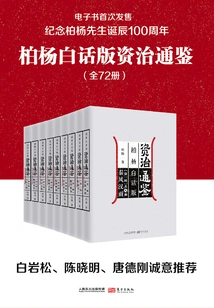
Take history as a mirror to know the ups and downs and understand the gains and losses. Bo Yang spent ten years translating "Zi Zhi Tong Jian" into modern languages, allowing a history book that was originally only read by emperors and generals to fly into the homes of ordinary people. The book contains more than 1,500 maps and palace maps, allowing readers to understand history from the pictures. Bo Yang consulted historical books, supplemented the comments on relevant events by famous historical figures in the past dynasties, and independently wrote "Bo Yang said" from a modern point of view, allowing ancient and modern dialogues, collisions of speculation, and multi-faceted and multi-angle interpretations of historical events. Historical allusions, cultural common sense, and current place names are included with the text to help readers understand the vast masterpiece from scratch. Chen Xiaoming, vice president of the Chinese Contemporary Literature Research Association and director of the Chinese Department of Peking University, Bai Yansong, the famous host of CCTV, and Tang Degang, the famous historian, sincerely recommend it.
Take history as a mirror to know the ups and downs and understand the gains and losses. Bo Yang spent ten years translating "Zi Zhi Tong Jian" into modern languages, allowing a history book that was originally only read by emperors and generals to fly into the homes of ordinary people. The book contains more than 1,500 maps and palace maps, allowing readers to understand history from the pictures. Bo Yang consulted historical books, supplemented the comments on relevant events by famous historical figures in the past dynasties, and independently wrote "Bo Yang said" from a modern point of view, allowing ancient and modern dialogues, collisions of speculation, and multi-faceted and multi-angle interpretations of historical events. Historical allusions, cultural common sense, and current place names are included with the text to help readers understand the vast masterpiece from scratch. Chen Xiaoming, vice president of the Chinese Contemporary Literature Research Association and director of the Chinese Department of Peking University, Bai Yansong, the famous host of CCTV, and Tang Degang, the famous historian, sincerely recommend it.