Library
Browse and search novels
2 novels found

Everyone is Different
Literature人各有异
(u. S.) E. B. White
Simplicity and joy in a complex world, peace and clarity in a feather. The most famous collection of essays by E. B. White, the greatest American essayist of the 20th century, returns to nature and sees sincerity in the trivial, which is the farm life essay that hatched "Charlotte's Web". E. B. White's "People Are Different" is a summary of what he saw, heard, thought, and did during five years on his farm in Maine. In the winter of 1938, just as his career at The New Yorker was going smoothly, White suddenly turned around and ran to Maine to work as a farmer. From spring to summer, and from autumn to winter, he personally managed a farm. The reason here may have a lot to do with Thoreau. From White's writings, we can always see the connection between the two. However, the more important point is that White, like Thoreau, is always wary of the deprivation and infringement of personal freedom in the name of the country, government, collective, etc. Even The New Yorker's requirement that editors always speak as "we" made him uncomfortable. It was in the countryside of Maine that "he found his subject (himself) and a gentle but sincere tone." He replaced "we" with "I" and achieved the independent existence of intellectuals as individuals. From this we can see that this book is a slow book, so we might as well read it slowly. There is no subtle statement in the book, but when it comes to society, it is still common sense. What he wrote is an attitude and a state of mind. What he wants to build is a simple, aesthetic life, although this simple life sometimes requires miserable management and a lot of work.
Simplicity and joy in a complex world, peace and clarity in a feather. The most famous collection of essays by E. B. White, the greatest American essayist of the 20th century, returns to nature and sees sincerity in the trivial, which is the farm life essay that hatched "Charlotte's Web". E. B. White's "People Are Different" is a summary of what he saw, heard, thought, and did during five years on his farm in Maine. In the winter of 1938, just as his career at The New Yorker was going smoothly, White suddenly turned around and ran to Maine to work as a farmer. From spring to summer, and from autumn to winter, he personally managed a farm. The reason here may have a lot to do with Thoreau. From White's writings, we can always see the connection between the two. However, the more important point is that White, like Thoreau, is always wary of the deprivation and infringement of personal freedom in the name of the country, government, collective, etc. Even The New Yorker's requirement that editors always speak as "we" made him uncomfortable. It was in the countryside of Maine that "he found his subject (himself) and a gentle but sincere tone." He replaced "we" with "I" and achieved the independent existence of intellectuals as individuals. From this we can see that this book is a slow book, so we might as well read it slowly. There is no subtle statement in the book, but when it comes to society, it is still common sense. What he wrote is an attitude and a state of mind. What he wants to build is a simple, aesthetic life, although this simple life sometimes requires miserable management and a lot of work.
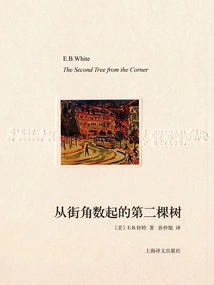
从街角数起的第二棵树(译文随笔)
(u. S.) E. B. White
A rather unique collection of essays by E. B. White, the author of "Charlotte's Web" and the master of American essays. "The Second Tree Counting from the Street Corner" is a unique collection of essays by the American essayist E. B. White. It not only selects White's most representative essays, but also includes his early poems, short stories and journal notes. The content includes politics, culture, urban life style, environmental protection, etc. The writing style is humorous, vivid, full of interest, and multi-faceted, reflecting the writing style of this stylistic master. It is a rare must-have book for readers who cherish White's works.
A rather unique collection of essays by E. B. White, the author of "Charlotte's Web" and the master of American essays. "The Second Tree Counting from the Street Corner" is a unique collection of essays by the American essayist E. B. White. It not only selects White's most representative essays, but also includes his early poems, short stories and journal notes. The content includes politics, culture, urban life style, environmental protection, etc. The writing style is humorous, vivid, full of interest, and multi-faceted, reflecting the writing style of this stylistic master. It is a rare must-have book for readers who cherish White's works.