Library
Browse and search books
3 novels found

Lyme "ion Teach" Series (set of 2 Volumes in Total)
General Fiction莱姆“伊翁·蒂奇”系列(套装共2册)
(poland) Stanislaw Lem
"Interstellar Travel Diaries": Taking the adventures of space traveler Ion Teach, a frequent guest in Lem's novels, as its theme, it brings readers many highly original and prophetic whimsical ideas through the twelve diaries in which the protagonist records his own adventures. In these chapters, in addition to Lem's consistent reflections on human civilization and artificial intelligence ("The Eighth Voyage" and "The Eleventh Voyage"), there are also clever historical parodies ("The Twentieth Voyage"), poignant political allegories ("The Thirteenth Voyage"), and deep philosophical speculations ("The Twenty-first Voyage"). "Memoirs of a Space Traveler": includes a series of short stories by Stanislaw Lem, the master of Polish science fiction, taking the adventures of space traveler Ion Teach, a frequent visitor of Lem's works, as the theme. Through the first-person perspective of the protagonist, it tells the story of Teach's strange and interesting adventures, supplementing the voyage stories in "Star Trek Diary" and adding some new adventures.
"Interstellar Travel Diaries": Taking the adventures of space traveler Ion Teach, a frequent guest in Lem's novels, as its theme, it brings readers many highly original and prophetic whimsical ideas through the twelve diaries in which the protagonist records his own adventures. In these chapters, in addition to Lem's consistent reflections on human civilization and artificial intelligence ("The Eighth Voyage" and "The Eleventh Voyage"), there are also clever historical parodies ("The Twentieth Voyage"), poignant political allegories ("The Thirteenth Voyage"), and deep philosophical speculations ("The Twenty-first Voyage"). "Memoirs of a Space Traveler": includes a series of short stories by Stanislaw Lem, the master of Polish science fiction, taking the adventures of space traveler Ion Teach, a frequent visitor of Lem's works, as the theme. Through the first-person perspective of the protagonist, it tells the story of Teach's strange and interesting adventures, supplementing the voyage stories in "Star Trek Diary" and adding some new adventures.
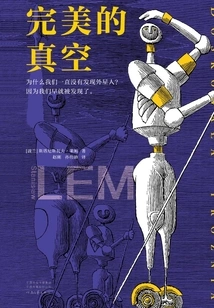
Perfect Vacuum
General Fiction完美的真空
(poland) Stanislaw Lem
Why haven't we discovered aliens yet? Because we were discovered long ago. Revealing a more profound cosmic game 40 years earlier than "The Three-Body Problem"! Humanity has been looking up at the stars alone. Among the 250 billion stars, we have never found an alien. Because they have been watching us from the dark. The universe is a huge chessboard, and the earth is just a chess piece. As players, advanced civilizations took their seats early to monitor the silent universe. Why must the universe be silent? Why are we weak still alive? Lem is known as the "Borges of science fiction". He wrote 16 book reviews of non-existent books, using absurd and ironic jokes to solve the real problem of human beings - existence at the boundary of science fiction and philosophy. Open "Perfect Vacuum", become an idiot, a philosopher, a madman, and a God, and play a brain-burning thinking game!
Why haven't we discovered aliens yet? Because we were discovered long ago. Revealing a more profound cosmic game 40 years earlier than "The Three-Body Problem"! Humanity has been looking up at the stars alone. Among the 250 billion stars, we have never found an alien. Because they have been watching us from the dark. The universe is a huge chessboard, and the earth is just a chess piece. As players, advanced civilizations took their seats early to monitor the silent universe. Why must the universe be silent? Why are we weak still alive? Lem is known as the "Borges of science fiction". He wrote 16 book reviews of non-existent books, using absurd and ironic jokes to solve the real problem of human beings - existence at the boundary of science fiction and philosophy. Open "Perfect Vacuum", become an idiot, a philosopher, a madman, and a God, and play a brain-burning thinking game!

Eden (translation of Lin Fantasy Series)
General Fiction伊甸(译林幻系列)
(poland) Stanislaw Lem
Because of a flight accident, six astronauts made an emergency landing on Eden, a beautiful but strange planet. In the confusing architectural maze, there are images of death everywhere: mass graves, corpses in ditches and wells, clusters of egg-shaped structures filled with bones... "Eden" is one of the masterpieces of Polish science fiction master Stanislaw Lem, which describes a creepy but familiar alien civilization.
Because of a flight accident, six astronauts made an emergency landing on Eden, a beautiful but strange planet. In the confusing architectural maze, there are images of death everywhere: mass graves, corpses in ditches and wells, clusters of egg-shaped structures filled with bones... "Eden" is one of the masterpieces of Polish science fiction master Stanislaw Lem, which describes a creepy but familiar alien civilization.