Library
Browse and search books
1 novel found
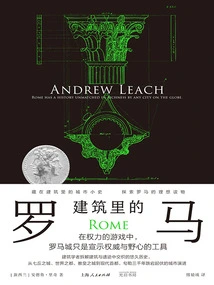
Rome in Architecture
History建筑里的罗马
(new Zealand)andrew Rich
The city of Rome is like a piece of parchment that has been covered and rebuilt over the centuries. From the Pantheon to the MAXXI curve designed by Zaha Hadid, architecture professor Andrew Leach interprets buildings, historical sites, city streets and the construction intentions behind them, and outlines a series of historical sketches for readers. In each chapter, he leads readers to explore history in real neighborhoods, matching architectural remains with movies, legends, stories, and murals to help readers understand how the city of Rome was formed and how it was shaped by history. As the former center of the empire, the capital of the world, the center of the Renaissance and the modern capital, Rome has countless cultural overlays intertwined together, which is particularly evident in its architecture. The brick buildings of the royal period were almost replaced by marble, and the temples of the Roman Empire were either abandoned or used for church construction. St. Peter's Basilica witnessed the development of the Christian church from a humble beginning to a spiritual empire with tentacles in all directions. The reconstruction of Tenimi Station was the architectural expression of humanitarianism replacing fascist values. The author has planned a route map in sequence based on the different eras in which Rome lived, explored history in real Roman neighborhoods, interpreted different historical levels of architecture, and imagined Rome from its origins to the royal period, the imperial period, the Middle Ages, the Renaissance, the Kingdom of Italy, and the short-lived Third Reich period. By digging into the historical details behind the buildings, the charm of Rome is presented in depth.
The city of Rome is like a piece of parchment that has been covered and rebuilt over the centuries. From the Pantheon to the MAXXI curve designed by Zaha Hadid, architecture professor Andrew Leach interprets buildings, historical sites, city streets and the construction intentions behind them, and outlines a series of historical sketches for readers. In each chapter, he leads readers to explore history in real neighborhoods, matching architectural remains with movies, legends, stories, and murals to help readers understand how the city of Rome was formed and how it was shaped by history. As the former center of the empire, the capital of the world, the center of the Renaissance and the modern capital, Rome has countless cultural overlays intertwined together, which is particularly evident in its architecture. The brick buildings of the royal period were almost replaced by marble, and the temples of the Roman Empire were either abandoned or used for church construction. St. Peter's Basilica witnessed the development of the Christian church from a humble beginning to a spiritual empire with tentacles in all directions. The reconstruction of Tenimi Station was the architectural expression of humanitarianism replacing fascist values. The author has planned a route map in sequence based on the different eras in which Rome lived, explored history in real Roman neighborhoods, interpreted different historical levels of architecture, and imagined Rome from its origins to the royal period, the imperial period, the Middle Ages, the Renaissance, the Kingdom of Italy, and the short-lived Third Reich period. By digging into the historical details behind the buildings, the charm of Rome is presented in depth.