Library
Browse and search novels
3 novels found

For the Day When Life Shines
Literature为了生命闪耀之日
(japan) Saito Shigeo
There is a child who was diagnosed with Down syndrome with damaged internal organs when she was just born. There is little hope of sustaining life. If you were her parents, a doctor, a nurse, or an outsider who has nothing to do with her, would you choose to save her or let her die? Focusing on the life and death of this child with Down syndrome, Japanese society has launched a heated discussion, questioning the meaning of life, and reflecting on mankind's continuous pursuit of evolution... This is a life rescue race against death. But was the child finally saved?

The Unburnt Evening Scene
Literature燃烧未尽的晚景
(japan) Saito Shigeo
Generations of Japanese women in the past gave birth to many children, took care of their elderly and demented parents, worked hard to overcome poverty, and quickly ended their short lives... But who said that women are born to be attached to their husbands and contribute to their families? As time goes by, housewives are becoming more and more determined to develop themselves. They are burdened with heavy caregiving pressure, they are bursting with vitality, they have no place to express their depression and have to end their lives... Together, they depict the portrait of modern Japanese women in their old age. How to age with more dignity? Has the "revolution" of wives, mothers, and daughters-in-law succeeded?

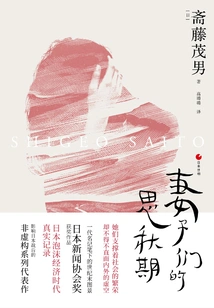
日本世相系列:妻子们的思秋期
(japan) Saito Shigeo
"My husband and I were like riding on two different elevators. He kept going up, and I kept going down, so we were staggered..." Behind the seemingly bright and happy family, there is endless loneliness and emptiness. These ordinary housewives from urban middle-class families in Japan devote themselves wholeheartedly to their families, allowing their husbands, who are "corporate warriors," to run at full speed without worries, supporting the rapid development of Japan's economy. However, no one sees their pain, which includes endless waiting, helpless loneliness, and powerless endurance. Wives who don't want to worry about "What have I been doing all my life?" When they die and try to live out their own lives, will their "revolution" succeed? This book not only describes the family life of couples and corporate social issues, but also introduces the psychoanalysis of psychological counselors to analyze the causes of marital crises of several interviewees from the perspective of their original families, including the psychological roots of problems such as the relationship between mother-in-law and daughter-in-law, parent-child relationship, etc. It is sharp and interesting.